
Most people who start a business do their homework. They price out equipment and map out the runway they’ll need before the money starts coming in. Most research licensing costs in their state. The plan feels like the thing standing between them and a costly mistake.
But preparation and readiness, it turns out, are two different things. We surveyed 776 U.S. small business owners about what it actually cost them to get off the ground, and the difference between what founders planned for and what they paid was wider than most expected going in. More than half of owners encountered costs they’d never even heard of before launching.
This is the true cost of starting a business that doesn’t show up on most founders’ launch checklists.
Key takeaways
- More than half of founders (51%) had at least one expense they completely overlooked.
- 54% encountered costs they were unaware of in advance, and 32% said there were several.
- Bluevine data shows business openings are growing, but average starting balances are down over 15% since 2025—making SMB ownership more accessible than ever.
- Equipment, insurance, and licensing topped the list of costs that blindsided founders, each cited by more than 1 in 3 respondents.
- Nearly 2 in 3 founders cut or eliminated their own pay in their first year due to startup financial pressure.
- Of the founders who expected to profit within 6 months to 1 year, only 56% actually did.

Most founders planned — and still got blindsided
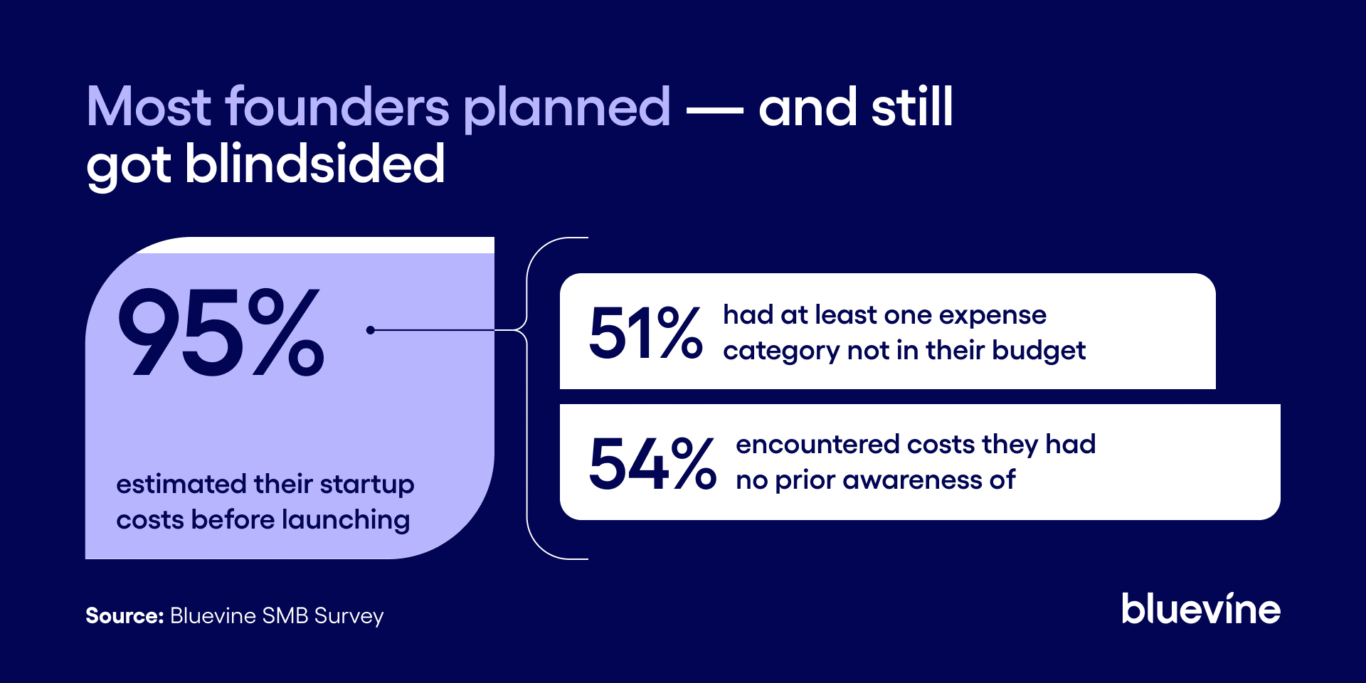
Nearly all founders (95%) estimated their startup costs before they launched.
But even after estimating their costs, 51% of owners had expenses they failed to budget for entirely. These weren’t just line items that came in a little high. They were categories that never made it onto the budget in the first place. Among those owners, 34% said there were several such expenses, and 17% pointed to one major one they’d missed.
The deeper issue is that more than half (54%) of founders ran into costs they were unaware of beforehand. Of that group, 32% experienced several of these expenses they’d never considered at all. Planning can’t always protect you from a cost you don’t know exists.
“Nine times out of ten, it is not bad planning. It is flying blind,” says Ramon Liriano Jr., Managing Partner of Elevated Tax Strategies, who’s also a Bluevine customer and accounting partner.
Liriano continues, “They never set up real books, so they could not see their true numbers until the year was already over. Money felt fine in the checking account, so they kept spending. But the checking account balance is not profit.”
These findings on planning and knowledge gaps could be uncomfortable for anyone about to launch a business. For a clearer picture of what early ownership looks like once the doors are open, our research on the realities of owning a small business and the challenges of starting a new one covers what most founders wish they’d seen ahead of time.

A closer look
In our Small Business Expectations vs. Reality Report, 77% of entrepreneurs said owning a business has met or exceeded their expectations.
At the same time, 56% of owners we surveyed faced significant cash flow problems within their first three years.
Most founders expected to profit within a year — more than 1 in 3 took longer
How long it takes to turn a profit is one of the first questions anyone asks before launching, and the survey shows that most expected the climb to be short. 59% of founders expected to be profitable within their first year, with 25% banking on under six months and 34% on six months to a year. Time is the one cost a founder can’t borrow or save their way out of. Months, you just have to live through.
Of the founders who expected to profit within six months to a year, only 56% actually did so within that window. Only 51% of the owners who gave themselves one to two years were successful. The longer founders set their expectations out, the more room there was for reality to fall short.
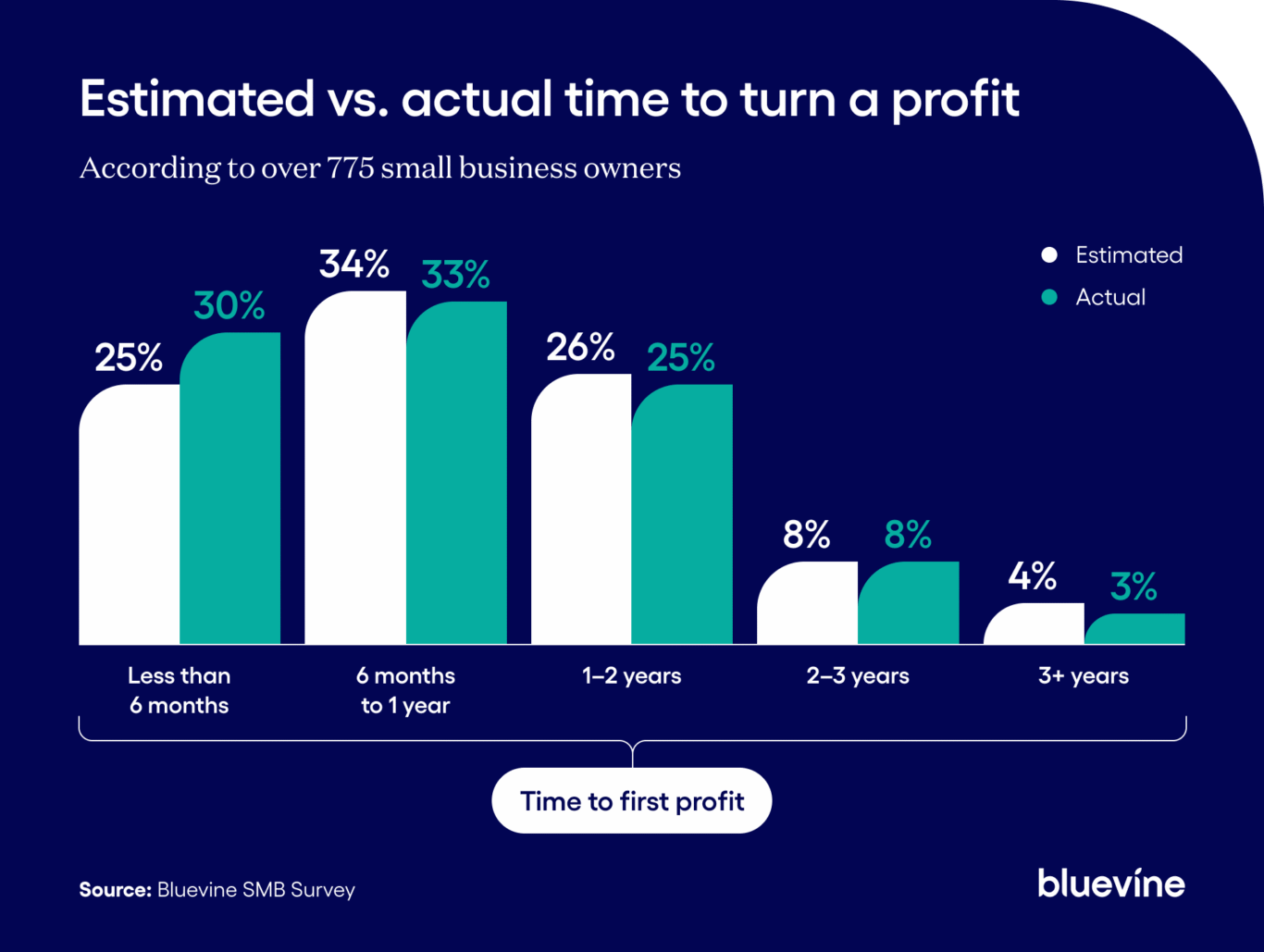
Timelines to profitability are underestimated across the board. Every extra month is another month of covering costs personally, and that’s usually where the personal funds start to run out.
In fact, our Small Business Burnout Report found that 62% of small business owners have reduced or skipped their own pay at least once in the past year to cover business expenses.
Founders’ biggest surprises are equipment, insurance, and licensing
The not-so-glamorous costs of simply being allowed to open and operate are the ones that catch founders off guard most.
Equipment and physical space topped the list of expenses that cost significantly more than expected, cited by 37% of founders. Business insurance came next (35%), followed closely by licensing, permits, and compliance costs (34%). The operational and regulatory costs of running a business outpaced everything else.
Digital and growth-oriented costs, like software (28%), marketing (27%), and payroll costs (22%), trailed the operational categories. The tools founders spend the most time reading about before launch turned out to be more predictable than the fixed costs that don’t come up as often.
Take construction as an example. Among categorized transactions, Bluevine data shows that the greatest percentage of spending categories beyond payments and money transfers are supplies (18.7% of all categorized transactions), grocery stores and food (6.8% of all categorized transactions), and fuel costs (3.5% of all categorized transactions). While these categories may seem obvious, they’re the same operational costs that founders said caught them off guard the most.
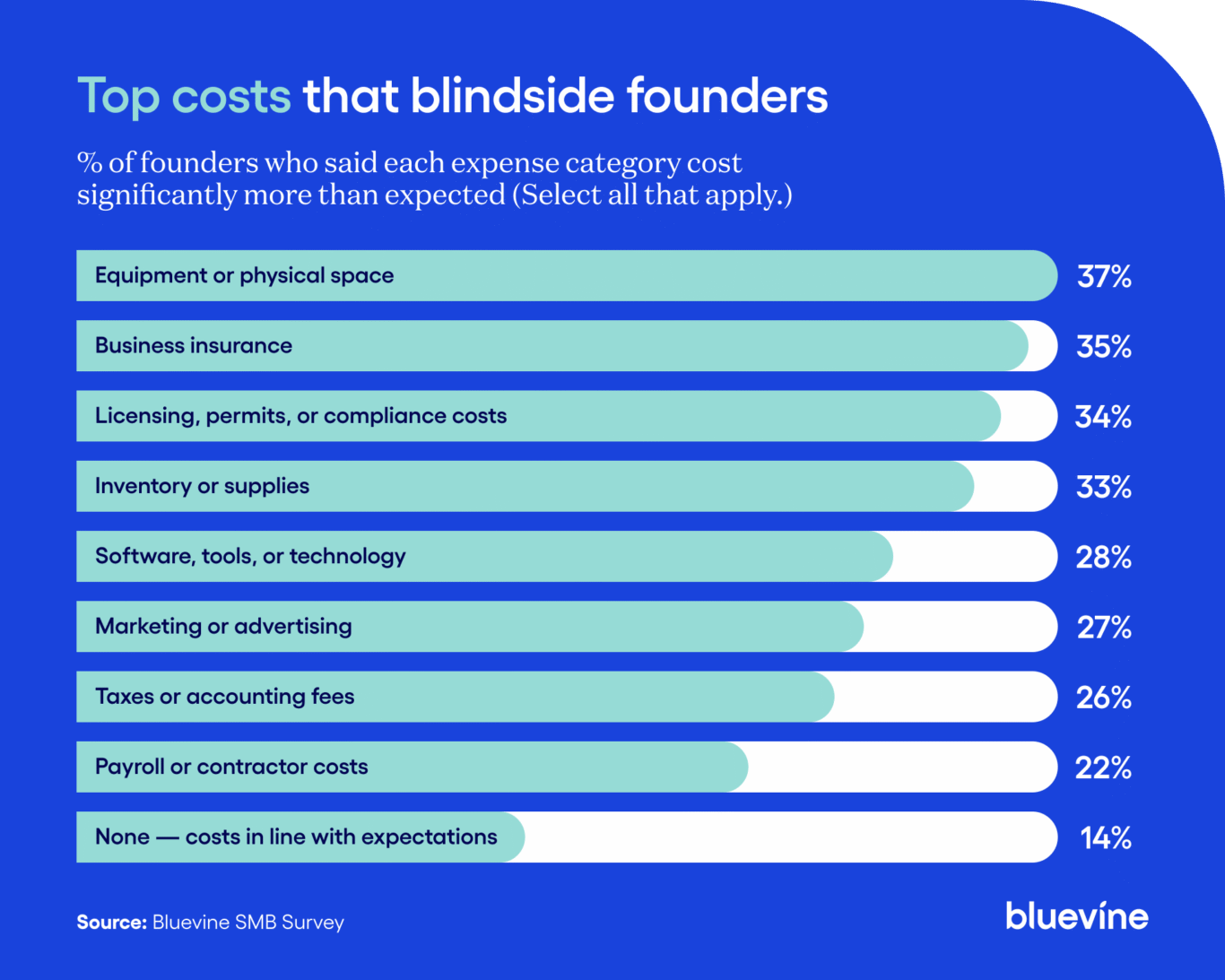
Just 14% of founders said that all of their costs came in as expected, meaning that the vast majority were surprised by at least one category.
Some industries felt it more than others, particularly regulated ones. For example, licensing and compliance costs were the most reported by construction and trades founders (46%), the highest of any sector.
Starting capital varies just as much by industry. Among Bluevine users, white-collar professions like real estate, business management, and finance carried the highest average account balances at opening. Education, accounting, administration, retail, and transportation carried the lowest, on average, 82% less than the top industries.
The blind spots are the mandatory costs that people don’t talk about when chasing a dream. It’s a lot harder to plan for a compliance requirement that you didn’t know applied to you.
Nearly two-thirds of founders cut their own pay in year one
The founders’ personal lives are a direct example of budget blind spots. The most obvious evidence is how owners pay themselves.
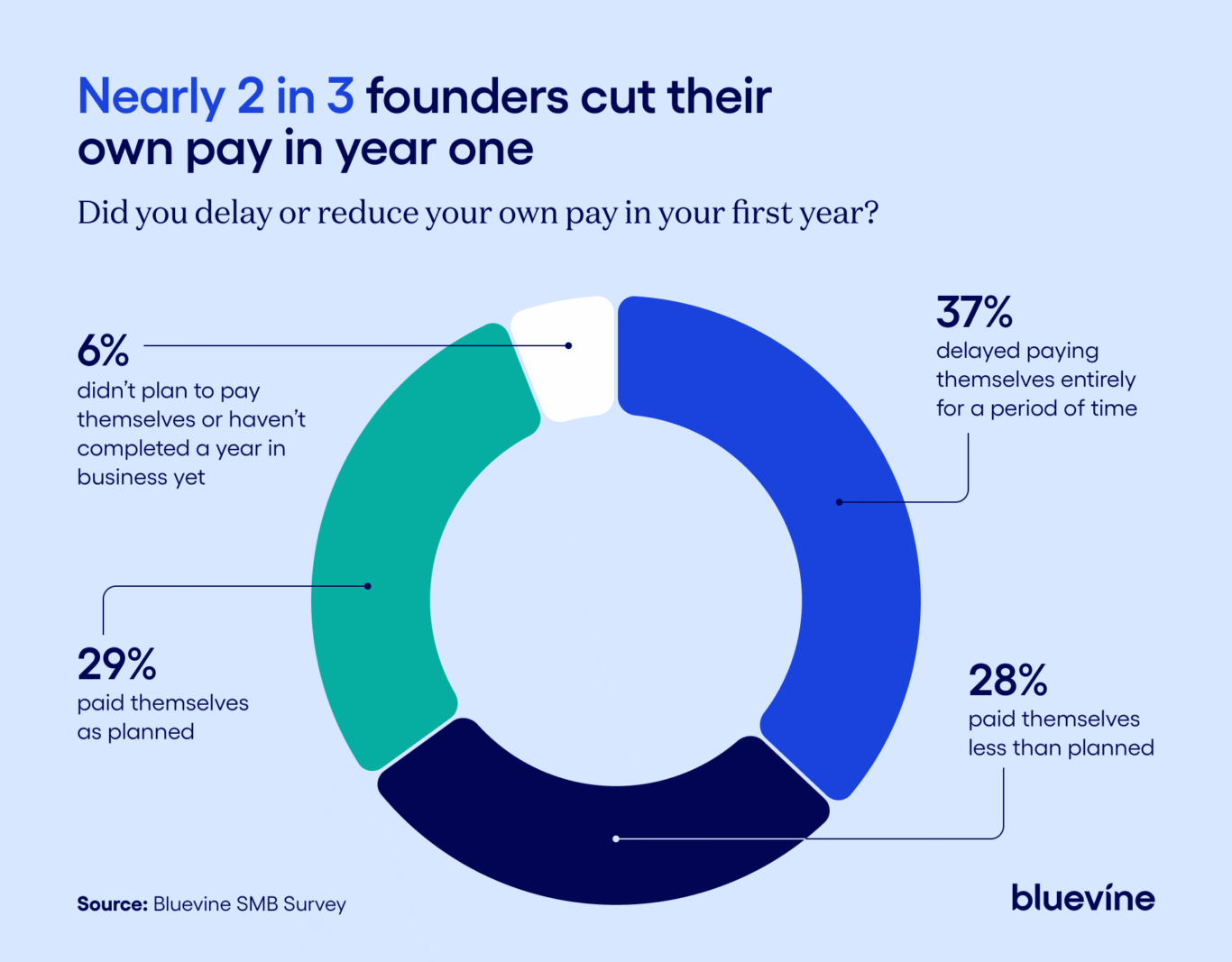
Nearly two-thirds of founders cut or eliminated their own pay in their first year. More than a third (37%) went without a paycheck for a period of time, and another 28% paid themselves less than they’d expected. Unexpected costs piled up and the first thing to go was the owner’s salary.
Most founders dipped into their own personal funds to get their business off the ground, taking on financial risk before the business had even opened its doors. Personal savings or cash was the most common source (63%), followed by personal credit cards (31%) and personal loans (19%). Only 8% said their business generated enough immediate revenue to cover costs from the start without touching personal savings or seeking outside capital.
“Relying on personal savings can be the fastest way to get started, and it does signal strong personal commitment,” says Aditya Narula, Bluevine SVP & GM of Lending and Credit.
Narula continues, “The risk is that it concentrates too much financial exposure on the founder before the business has proven consistent cash flow. That’s why new business owners should look at funding options based on stage and need.”
According to Narula, friends and family funding can work well early, as long as expectations and repayment terms are clear. Seed funding may fit high-growth businesses, though it can require giving up equity and control, which is a dealbreaker for some owners.
SBA loans can offer more structured capital and longer repayment terms. There are also business lines of credit and term loans that could be the right fit, depending on the business. Lines of credit work well for ongoing expenses and as a safety net, while term loans can help cover large one-time purchases.
“The positive news,” Narula adds, “is that founders have more financing paths than ever. So, the goal is not to avoid personal capital altogether, but to use it thoughtfully alongside the right external funding.”

Bluevine Tip
With one simple application, you can apply for multiple forms of business financing—including the Bluevine Line of Credit and lines of credit or term loans from our lending partnersBVSUP-00151—all without impacting your personal credit score.BVSUP-00128
In hindsight, 79% of founders said they would have saved up more money before launching if they had it to do over again, with 22% saying they would have saved up more than double what they actually did. Separately, a surprising 23% said they didn’t feel they had made any significant financial mistake, even with evidence in front of them. Many owners view the financial pain as the cost of admission.
Year one is not the end of the owners’ personal exposure either. Our Late Payment Gaps Report found that almost one-third of SMB owners still pay themselves late, often because customers pay them late. Founders who start by taking a cut in their own pay tend to keep doing that as cash-flow pressure follows them into ongoing operations. The same survey work on cash flow management and the broader challenges facing small business owners shows how early financial habits harden into long-term ones.

Did you know?
According to Bluevine’s cash flow management survey, 39% of small businesses report having less than a month’s worth of operating expenses on hand.
Whether you’re trying to establish good financial habits or focusing on profitability, Bluevine’s powerful cash flow management tools—including versatile sub-accounts and custom automatic transfer rules—can help you set aside money for expenses, taxes, owner’s pay, profit, and more.
How to get ahead of costs most founders forget
By the end of year one, most founders have a clear list of what they’d do differently.
Asked what they wish they’d known before launching, 35% said they wished they’d known how quickly unexpected expenses pile up, with concerns about personal finances (31%), compliance costs (30%), and income stability (29%) not far behind. It was the sum total that surprised them.
But not everyone got buried. 1 in 5 founders said they felt well-prepared and didn’t encounter any major surprises. The preparation gap is real, but the data shows it’s not inevitable.
“Separate the money before the first dollar moves,” recommends Ramon Liriano Jr., Managing Partner of Elevated Tax Strategies. “Open a business checking account the same week you decide to start.”
Bluevine helps founders who want to start off on the right foot keep personal and business finances separate from day one with a business checking account built for how small businesses actually operate and business loans for costs that show up uninvited.
See why 1 million+ small businesses chose Bluevine.
Methodology
The survey was conducted by Centiment for Bluevine. The survey was fielded between May 30 and June 2, 2026. The results are based on 776 completed surveys. In order to qualify, respondents were screened to be residents of the United States, over 18 years of age, and own a small business with between 1 and 99 employees and annual revenue between $50,000 and $5,000,000. Data is unweighted, and the margin of error is approximately +/-3% for the overall sample with a 95% confidence level.


