Exciting news: Bluevine has agreed to be acquired by Valley National Bancorp, the parent company of Valley Bank. Read the announcement or view Customer FAQs.
Bluevine’s best cities for small businesses in 2026
We studied 100 U.S. metro areas to find where small businesses are showing the most momentum—and what sets the top markets apart.
Key takeaways
Three Colorado metros made the top 15: Colorado Springs (#1), Denver (#2), and Greeley (#12), though each stood out for different reasons.
Growth and staying power diverged: Five top-15 metros ranked in the top 10 for business growth; none of those five reached the top half for business survival.
Strong markets came in different sizes and across the country: Kansas City, Minneapolis, Nashville, and Philadelphia ranked in the top half of all four of the categories in the rankings. Nine of the top 15 metros fell outside the 30 largest in the U.S.
Bluevine data adds what public rankings can miss: New Haven ranked 78th for business growth based on public data, while average account balances among its Bluevine customers nearly doubled.
How we determined the best cities for small business
With data from more than 200,000 active accounts, Bluevine has a unique view into small business momentum across America. We combined that proprietary perspective with government data to rank the 100 U.S. metros with the most Bluevine customers and identify our top 15 for 2026.
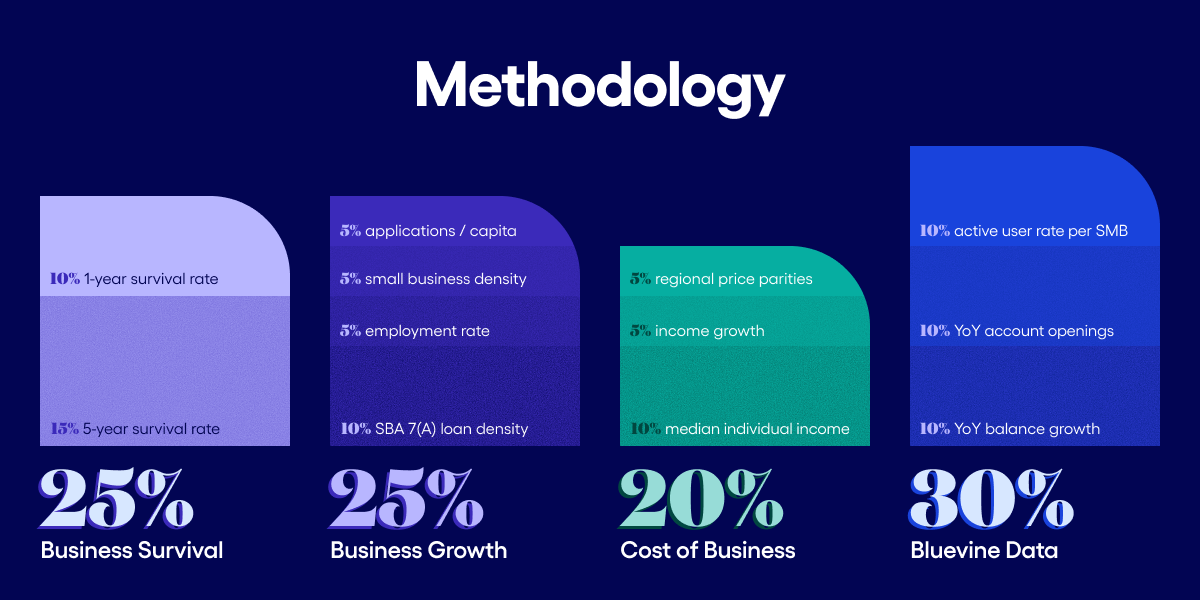
To create the Bluevine Best Cities for Small Business list, we built a weighted methodology with four categories: business survival statistics, business growth metrics, cost of business metrics, and Bluevine banking data (new accounts, growth in balances, and account density). Each of the categories included multiple data points, which can be viewed in our methodology footnote. From there, we standardized the results into a single score for each metro.
What the rankings reveal
Bluevine’s Best Cities for Small Business 2026 list includes 15 very different kinds of small business markets. The balance of our methodology allowed for markets that may have ranked poorly in a certain metric like regional price parity to still score well if they ranked well in other metrics like median individual income. The mix of public data and activity from more than 200,000 active Bluevine accounts helps show where each market’s strengths lie.
Colorado led the list, in three different ways
Colorado Springs ranked No. 1, Denver No. 2, and Greeley No. 12, making Colorado the only state with three metros in the top 15. Colorado Springs led on Bluevine customer measures, Denver ranked first in business growth, and Greeley ranked first on cost-related measures. Colorado Springs also saw a 133% year-over-year increase in Bluevine account openings. Colorado’s showing is striking because its three metros did not rely on the same strengths to get there.
Business growth and survival did not always move together
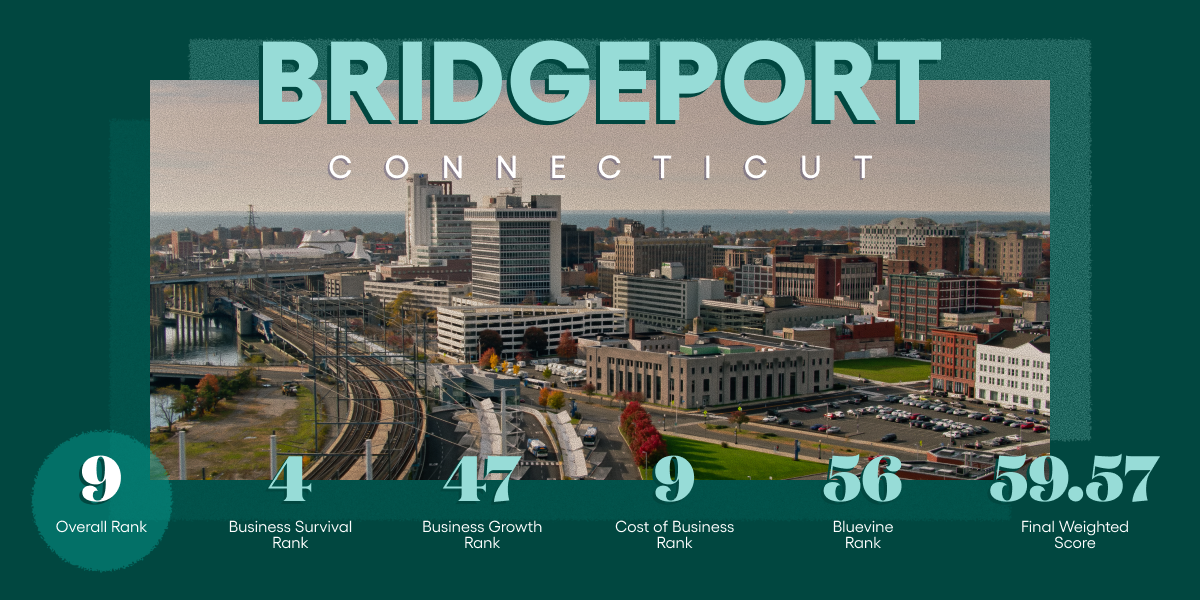
Five of the top-15 metros ranked in the top 10 for business growth: Colorado Springs, Denver, Salt Lake City, Dallas–Fort Worth, and Atlanta. None ranked in the top half for business survival. Bridgeport and New Haven showed a different pattern, ranking fourth and 13th in survival but 47th and 78th in growth. The distinction matters: A metro can show strong business activity without scoring equally well on how long businesses last. Both measures help explain its overall ranking.
Well-rounded markets appeared across the country
Kansas City, Minneapolis–St. Paul, Nashville, and Philadelphia each ranked in the top half of all four categories. Kansas City had the most even showing, placing between 10th and 37th in every category. These metros are spread across several regions, giving small business owners more than one part of the country to consider if they’re looking for a market with strengths across the board. Interestingly, midsize metros dominated the list: Nine of the 15 winning metros ranked 30th or lower in total population.
One weak ranking did not keep a metro out of the top 15
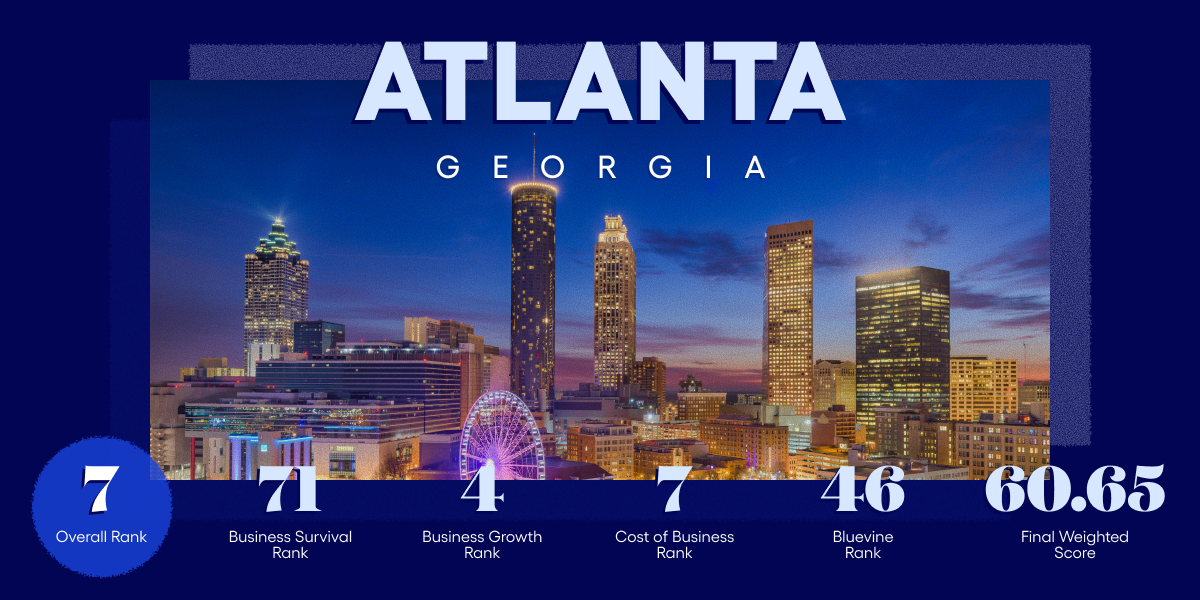
Greeley ranked 97th in business survival but 1st on cost-related measures, 17th in growth, and 6th on Bluevine customer measures. Atlanta ranked 71st in survival yet reached No. 7 overall, helped by top-10 rankings in growth and cost-related measures. Those weak spots matter, but so do the strengths around them. The overall rankings are a starting point, but there’s a lot more to each market.
Bluevine’s account data surfaced activity that public measures alone would miss
New Haven ranked 78th in the business growth category, yet average balances among Bluevine customers there nearly doubled year over year—the largest increase among the top 15. Kansas City saw 120% growth in its number of Bluevine accounts. These figures describe Bluevine customers rather than every business in a metro, and they offer another, more granular view of small business activity alongside public measures such as applications and survival.
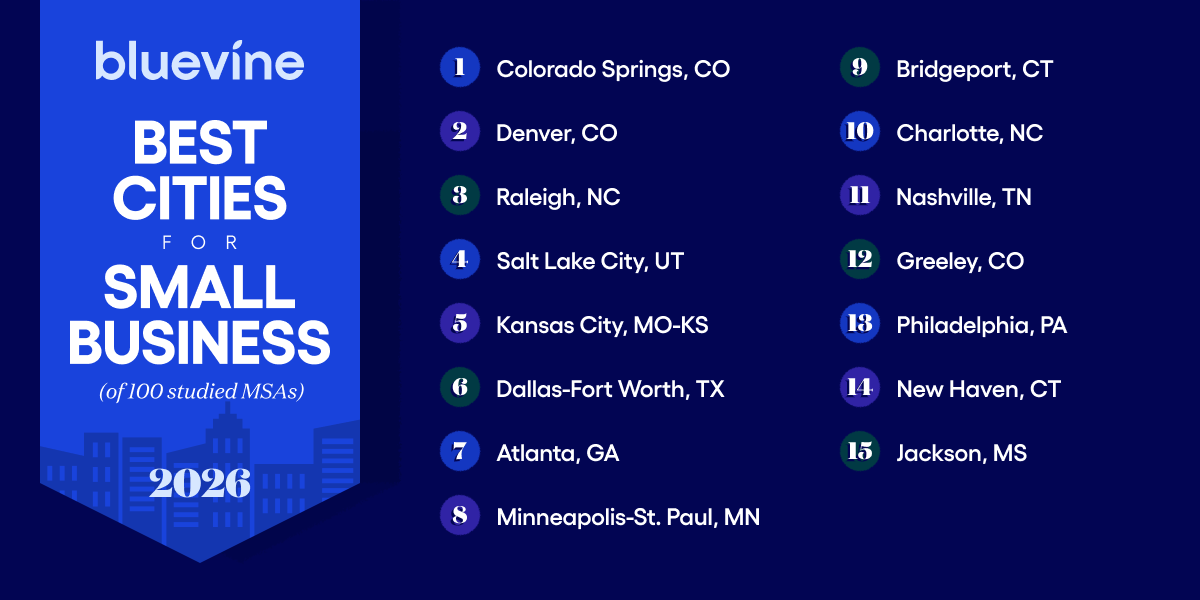
The top 15 best cities for small businesses
2026 Rank
Metro Area
1
Colorado Springs, CO
2
Denver, CO
3
Raleigh, NC
4
Salt Lake City, UT
5
Kansas City, MO-KS
6
Dallas-Fort Worth, TX
7
Atlanta, GA
8
Minneapolis-St. Paul, MN
9
Bridgeport, CT
10
Charlotte, NC
11
Nashville, TN
12
Greeley, CO
13
Philadelphia, PA
14
New Haven, CT
15
Jackson, MS
Of 100 studied MSAs
1. Colorado Springs, CO
Colorado’s second most populated metro, Colorado Springs, is Bluevine’s Best City for Small Business of 2026.
Looking at the data, the reason why Colorado Springs claimed the top spot is clear: It was one of the 10 metros with the highest business growth metrics and ranked first in Bluevine customer success metrics. It is one of only five measured metros to have two top-10 rankings in its data set, and the business growth data points to there currently being a rush of small business openings in Colorado Springs.
Colorado Springs ranked near the middle in business survival and in the bottom half for cost of doing business among the 100 metros we studied. But those scores didn’t prevent it from being named the Best City for Small Business. The metro scored particularly well on SBA 7(a) loan density and business applications per 100,000 residents. Bluevine’s data showed strong activity, too: new account openings rose 133% year over year—the highest among the top 15 metros—while average account balances grew 55%, the fourth-highest increase.
“My experience as a small business owner taught me that great cities do not simply attract businesses; they create the conditions for people with ideas and ambition to start, grow, and thrive,” said Colorado Springs Mayor Yemi Mobolade, about his city’s top spot in the rankings. “I’m incredibly proud of the small-business ecosystem we have built together in Colorado Springs and, most of all, of the entrepreneurs who make it work every day.”
What makes Colorado Springs special is the spirit of collaboration, from fellow entrepreneurs to Mayor Yemi and his team. This isn’t just where we do business. It’s our home, and we’re invested in making it even better.”
The Denver metro area is the second of three Colorado cities to make the top 15.
Colorado’s capital claimed the second place spot because it finished first in overall small business growth rank out of the 100 metros we studied and 12th in cost of business rank. That strong business growth, combined with high individual incomes, suggests Denver offers an attractive environment for entrepreneurs to launch and grow their businesses.
As a result, businesses have found a welcome home in Denver for them to try to build new business concepts, and the city has rewarded them with a supportive clientele: Bluevine accounts grew 88% year-over-year while balances grew 46% year-over-year on average.
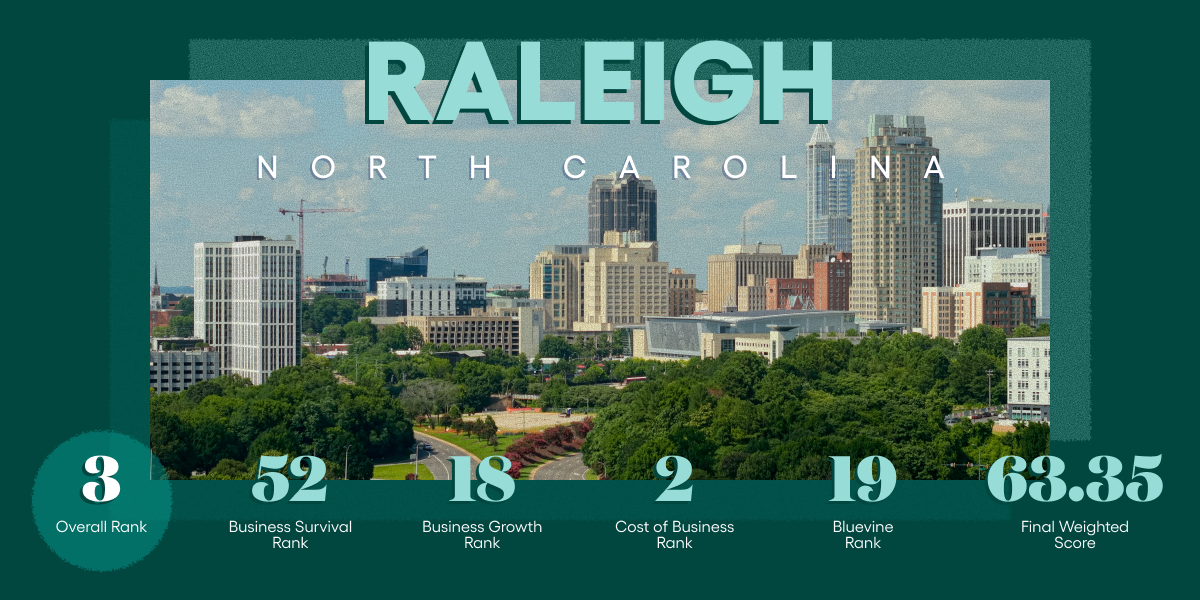
Raleigh is growing on multiple fronts. Not only was North Carolina’s capital the fastest-growing U.S. metro area with more than 1 million residents from 2024 to 2025, it also ranked 18th in our business growth category. The rapidly expanding population represents a growing pool of potential customers for local small businesses, while high median individual income and strong income growth suggest ample spending power to support newcomers and longtime residents pursuing their small business dreams.
Raleigh’s culture also makes it the perfect place for home-grown businesses to set up shop. Julie Hafer, owner of Beauty Ethics, says, “In Raleigh, there’s a welcoming energy that makes you feel supported.” She jokes, “Some of us call it ‘Small-leigh’ because of how quickly things can catch on from word of mouth.”
That level of word-of-mouth excitement helped the city see 82% in Bluevine accounts year-over-year, while Raleigh-based Bluevine customers saw 37% growth in their account balances, on average, year-over-year.
Of the 100 metros we studied, Salt Lake City’s metro area scored top 10 in the rate of small business growth and in the cost of doing business data set due to its high median individual income and median individual income growth. This helped it land as number four on the Bluevine Best Cities for Small Business 2026 list, despite ranking in the middle of the 100 metros we measured for Bluevine customer success and business survival rate.
Those favorable conditions helped Salt Lake City score the fifth-highest growth in average account balances year-over-year within the top 15 metros (51%), while Bluevine accounts grew 87% year-over-year within the metro.
I’ve lived in a lot of big cities, and goodwill is common, not universal—but it’s overflowing in SLC. There’s a lot of good faith here; people are always willing to help each other.”
The Kansas City metro area is unique among the Bluevine Best Cities for Small Business 2026 list: It’s one of only four metro cities in the 100 we studied that didn’t rank in the bottom half of any of our four statistical categories and the only one that scored in the upper 40th percentile of every category.
So, in a sense, the Kansas City metro area small business climate provides the most balanced blend of positive factors for hopeful entrepreneurs. Specifically, it ranked 10th across all metros in small business survival rates—meaning that when small businesses set down roots in KC, the city fosters an environment that allows them to last.
That’s been evident in the growth in Bluevine accounts within the city, with Kansas City having the second-highest yearly growth rate within the top 15 metros (120%), as well as a 28% yearly growth in average Bluevine account balances in the metro.
Kansas City is big enough where there are great opportunities, but small enough to get your name out there and build a reputation. Everybody here wants the community to succeed.”
DFW ranked in the top 10 of the 100 metros we studied in business growth and number 11 in cost of doing business, showcasing that the expansive metro not only has an influx of population but a climate that makes small business ownership accessible. Its high median individual income and median individual income growth, combined with a growing diversity of industries and verticals, has helped insulate Dallas from some of the economic downturns in recent years—and has helped Bluevine accounts grow 106% year-over-year in the metro, while average Bluevine account balances grew 28%.
The Dallas area has an abundance of resources for small business owners—including incubators, investor programs, and VCs—so you can do everything you need to do from a startup standpoint. Plus, it’s convenient to travel to either coast, or even internationally.”
Atlanta metro’s position as the financial and business capital of the Southeast has been solidified over the last decade, which makes it no surprise that it finds itself on Bluevine’s Best Cities for Small Business 2026 list.
Buoyed by top-10 metro rankings in business growth and cost of doing business across the 100 metros we studied, Atlanta has proven to be a fantastic place for many small business owners to chase their dreams—with 82% growth year-over-year in Bluevine accounts and 30% growth in average Bluevine user account balances.
The Twin Cities metro area comes in at number 8 on Bluevine’s Best Cities for Small Business 2026 list, thanks in large part to being one of the four metros of the 100 we studied that finished in the upper half of all four data sets we measured.
Eric Trettel of Sota Bookkeeping says, “Don’t assume you need a storefront or a downtown address to be part of this business community. A lot of the energy now happens through remote and fractional work, not just foot traffic.” He adds, “And talk to other small business owners early. In my experience, this is a market where people tend to make introductions and share what worked for them rather than treating every other small business like competition.”
The Minneapolis metro showed fantastic growth in Bluevine accounts over the time period measured—with 108% growth year-over-year in Bluevine accounts, and the second-highest average growth in Bluevine account balances of the top 15 cities, with 73% average growth.
I work with many small businesses across the metro as their bookkeeper and/or fractional controller, and almost none of them are standing still. They're hiring, adding services, figuring out how to scale without losing what made them good in the first place, etc., and this growth isn't happening by accident. The city backs it up with real infrastructure, grants, and resources. This isn't just a nice place to run a business on paper; there's actual support underpinning the growth.”
The Bridgeport–Stamford metropolitan area—like many former U.S. manufacturing hubs—has faced a prolonged period of decline in economics and population over much of the last 100 years. But over the last two decades, the metro has focused on increasing density in its expansion, recently being named the second-most compact and connected midsized metro in the U.S. in a study by Johns Hopkins.
Perhaps as a result of that effort, the Bridgeport metropolitan area has become ripe for entrepreneurs looking to tie their small business future to the metro’s revitalization. That revitalization, and the white space it allows for new SMBs, may help contribute to Bridgeport’s high rankings in cost of doing business (9th) and business survival (4th). The metro area also saw 95% annual growth in Bluevine accounts, while the average account balances of those Bluevine accounts grew 41% year-over-year.
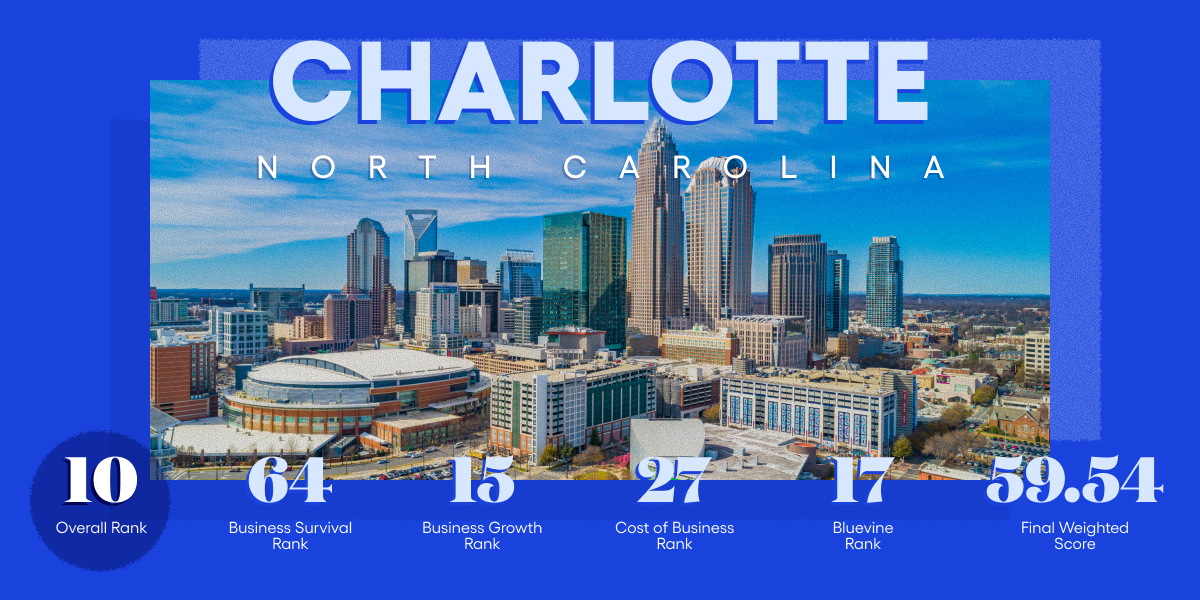
10. Charlotte-Concord-Gastonia, NC-SC
North Carolina’s growth in recent years has been well-documented: It currently ranks as the third-fastest growing state in the U.S. The Charlotte metropolitan area, the largest in the state, has become a haven for small businesses.
The Queen City metro finds itself at number 10 on Bluevine’s Best Cities for Small Business 2026 list because it ranked in the top 20 of 100 measured metros in small business growth rank and for Bluevine growth metrics. It experienced 97% annual growth in Bluevine accounts, while those Bluevine accounts saw a 40% average growth year-over-year in account balances.
You don’t have to go looking very hard in Charlotte to find people who are building something of their own.”
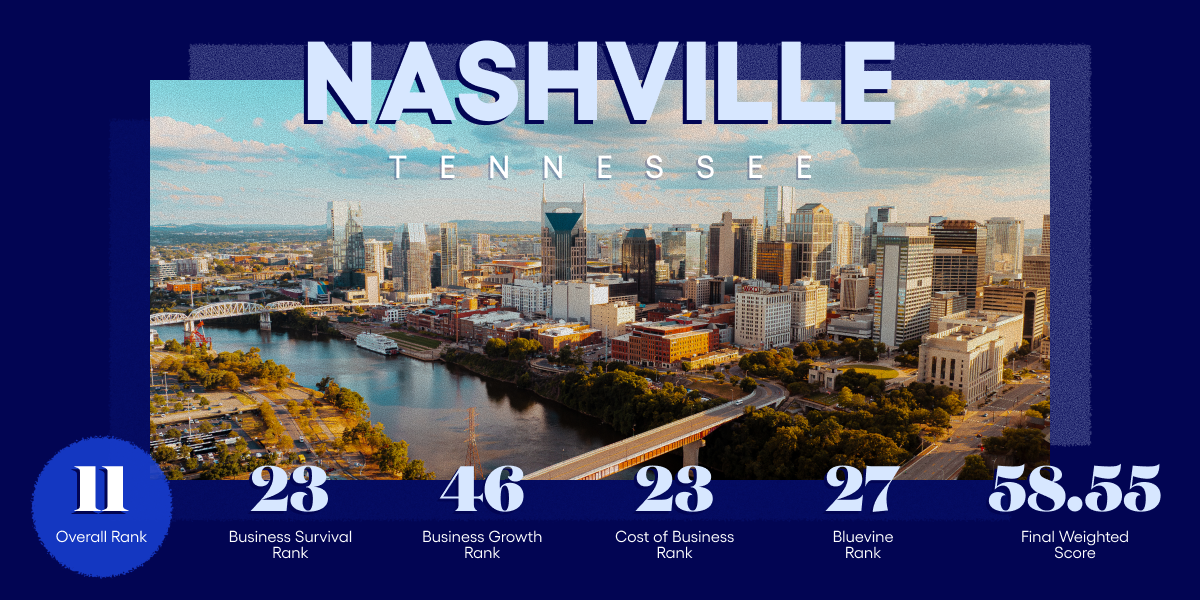
Coming in at number 11 on Bluevine’s Best Cities for Small Business 2026 list is the Nashville metropolitan area. The Music City—like Minneapolis and Kansas City before it—is one of four metros of the 100 we studied that scored in the upper half of all four data sets we measured. Notably, it finished in the upper 30th percentile of business survival rank, cost of doing business, and in Bluevine growth metrics, with 98% annual growth in new accounts and 65% annual growth in average account balances.
Greeley, Colorado was the smallest of the 100 metros we measured and the only one in the top 15 on Bluevine’s Best Cities for Small Business list to score in the bottom 10 of any individual metric: Greeley ranked third-worst of all the metros we pulled in business survival rank. The reason for that low small business survival ranking may be due to the fact that it is a small city that is rapidly expanding: Greeley has an aggressive development plan that currently ranks it as the fastest-growing city in the Centennial State with estimates it will double in size by 2050.
Despite the low business survival ranking, the city still secured a spot in the top 15 best cities for small business due to its strong rankings in the other three categories we measured: Greeley is one of only three metros on the list to rank in the top 20 in business growth rank (17th), Bluevine account metrics (6th), and cost of doing business (1st). Its cost of doing business rank is buoyed by extremely strong scores in median individual income and median individual income growth, which may suggest that the growing population is also growing in spending capability.
Greeley’s position as the metro with the most favorable cost of doing business in the U.S. shows the benefit small business owners get from putting down roots in a metro that is still within an hour of Denver but with lower costs. That climate may be why we saw 104% annual growth in Bluevine accounts, with a 50% growth in average Bluevine account balances.
13. Philadelphia-Camden-Wilmington, PA-NJ-DE-MD
The City of Brotherly Love ranks number 13 on Bluevine’s Best Cities for Small Business 2026 list, due in large part to being the fourth city out of 100 we studied for this list to score in the upper half of all four data sets we measured. Philadelphia scored its highest ranks in Bluevine account metrics and business growth ranks, where it placed 32nd in both. Specifically, it saw a 106% growth in overall Bluevine accounts within the metro and a 31% growth in average Bluevine balances.
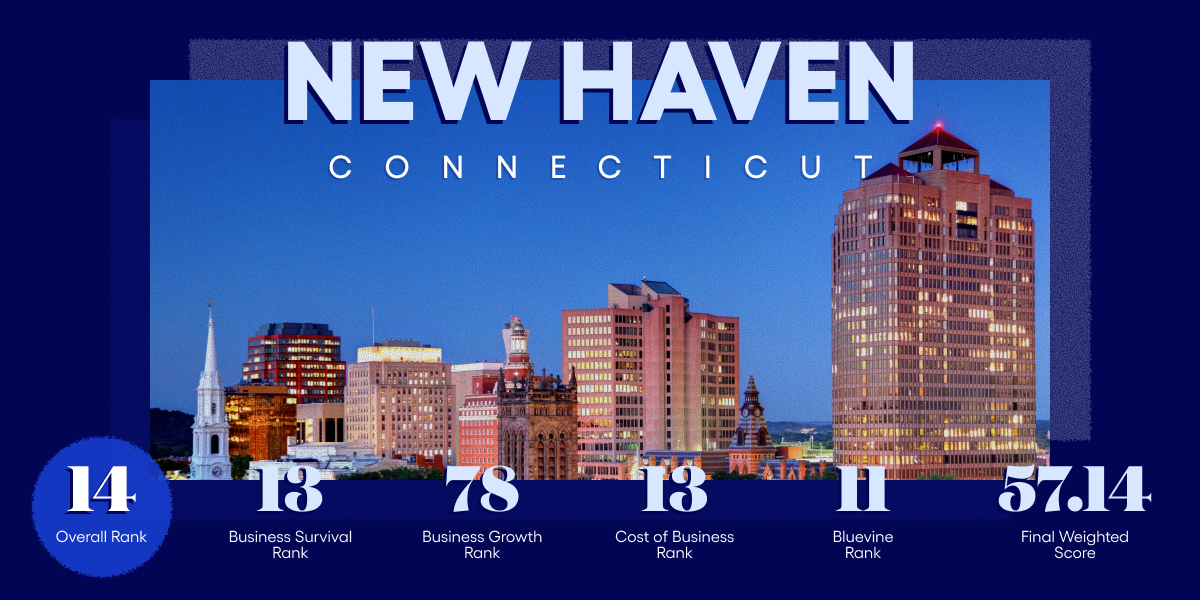
The New Haven, Connecticut metropolitan area has been riding a wave of good press in recent years that belies its stunning revitalization after decades of downturn.
In just the last half-decade, the New York Times has profiled the city’s rebirth as a destination for individuals seeking a small, accessible, and affordable coastal city a handful of times. The statistics we measured for Bluevine’s Best Cities for Small Business 2026 list largely agree with much of that positive press: New Haven ranked in the top 15 of the 100 studied metros for small business survival rank (13th), Bluevine customer success metrics (11th), and cost of doing business rank (13th).
In fact, New Haven scored the highest rank of any of the top 15 cities in average yearly Bluevine account balance growth (98%), while its Bluevine accounts also grew 98%.
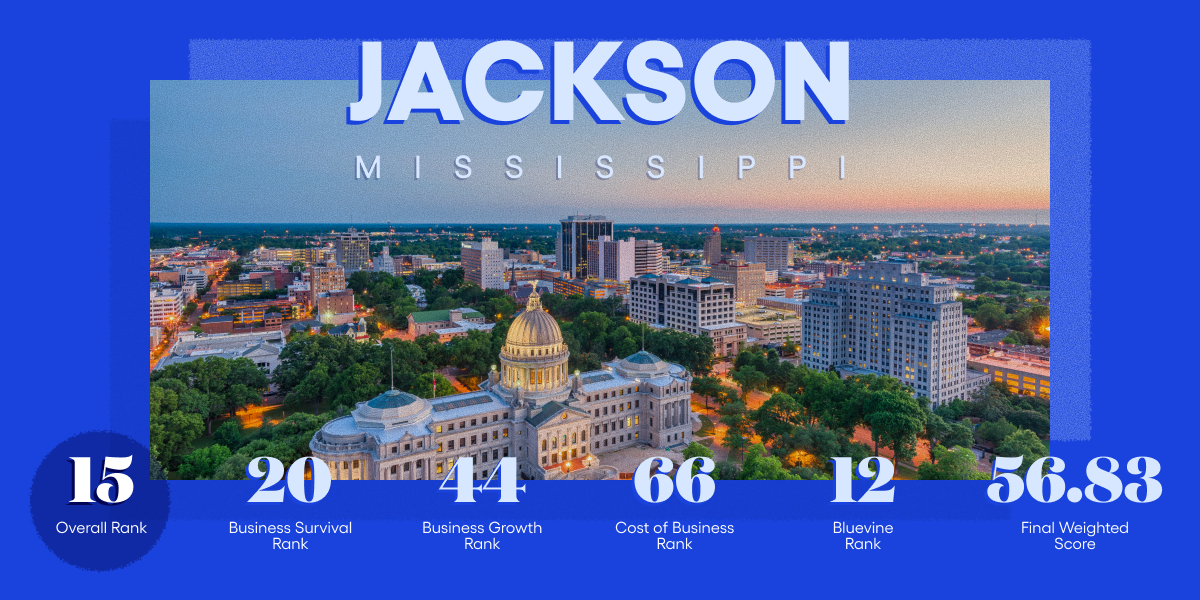
15. Jackson, MS
Jackson—Mississippi’s capital city and largest metro area—takes the final spot on Bluevine’s Best Cities for Small Business 2026 list.
Jackson scored in the top 20 out of 100 studied metros in two categories, ranking 12th in Bluevine success metrics and 20th in business survival rank. And, while Jackson ranked in the bottom half of measured metros for our cost of doing business data set due to a low median individual income score, it offers prospective entrepreneurs an accessible path to business ownership and high survival rates within the greater national context.
According to US News and World Report, Mississippi ranks as the most affordable state in the country. And that affordability could be a contributor to the growth in Jackson, with 111% year-on-year increase in Bluevine accounts and 53% increase in account balances.
Bluevine evaluated the 100 U.S. metro areas with the most Bluevine customers. The ranking combines public data with data from more than 200,000 active Bluevine accounts.
What went into the score
Each metro was scored across four categories. The percentages below show how much each measure contributed to the final score.
Business survival (25%): Bureau of Labor Statistics (BLS) one-year business survival rate (10%) and five-year survival rate (15%).
Business growth (25%): U.S. Census Bureau business applications per 100,000 residents (5%); Small Business Administration (SBA) small business density (5%) and 7(a) loan density (10%); and BLS employment rate (5%).
Cost of business (20%): Bureau of Economic Analysis regional price parities (5%); U.S. Census Bureau median individual income (10%); and BLS income growth (5%).
Bluevine customer activity (30%): Bluevine account density (10%), year-over-year growth in new account openings (10%), and year-over-year growth in average account balances (10%). Account density is the number of active Bluevine business accounts divided by the estimated number of small businesses in each metro.
How metros were ranked
Bluevine standardized the measures so they could be combined into a single weighted score for each metro. A metro received a proportional penalty if it ranked in the bottom half of the 100 metros in any of the four categories. The 15 metros with the highest final scores appear in the ranking.
The results compare the 100 metros studied. Bluevine account measures describe activity among Bluevine customers in those markets, rather than all small businesses there.
Disclaimer
This content is for educational purposes only and should not be construed as professional advice of any type, such as financial, legal, tax, or accounting advice. This content does not necessarily state or reflect the views of Bluevine or its partners. Please consult with an expert if you need specific advice for your business. For information about Bluevine products and services, please visit the Bluevine FAQ page.
Get answers in a snap, right from your dashboard during business hours.
Disclaimer
This content is for educational purposes only and should not be construed as professional advice of any type, such as financial, legal, tax, or accounting advice. This content does not necessarily state or reflect the views of Bluevine or its partners. Please consult with an expert if you need specific advice for your business. For information about Bluevine products and services, please visit the Bluevine FAQ page.
Subscribe to our monthly email newsletter.
Be the first to hear about Bluevine’s latest tips, insights, and product offerings.
Bluevine is a financial technology company, not a bank. Banking services provided by Coastal Community Bank, Member FDIC. Not all features available in all countries. Limitations apply. See international features for details.