

A late invoice or a slow month is survivable for most businesses. Too many of these aren’t. Small businesses fail when they run out of money before they can support themselves, and while the causes vary, nearly all of them first show up as a cash problem.
The scale of failure is easy to misread, though. Of the 677,876 private-sector establishments that opened between March 2014 and March 2015, roughly 443,000 had closed by March 2025, according to the Bureau of Labor Statistics. Two-thirds gone inside a decade. But BLS simply counts the number of establishments, so a business closing isn’t the same thing as failing. Some of those owners retired. Others sold.
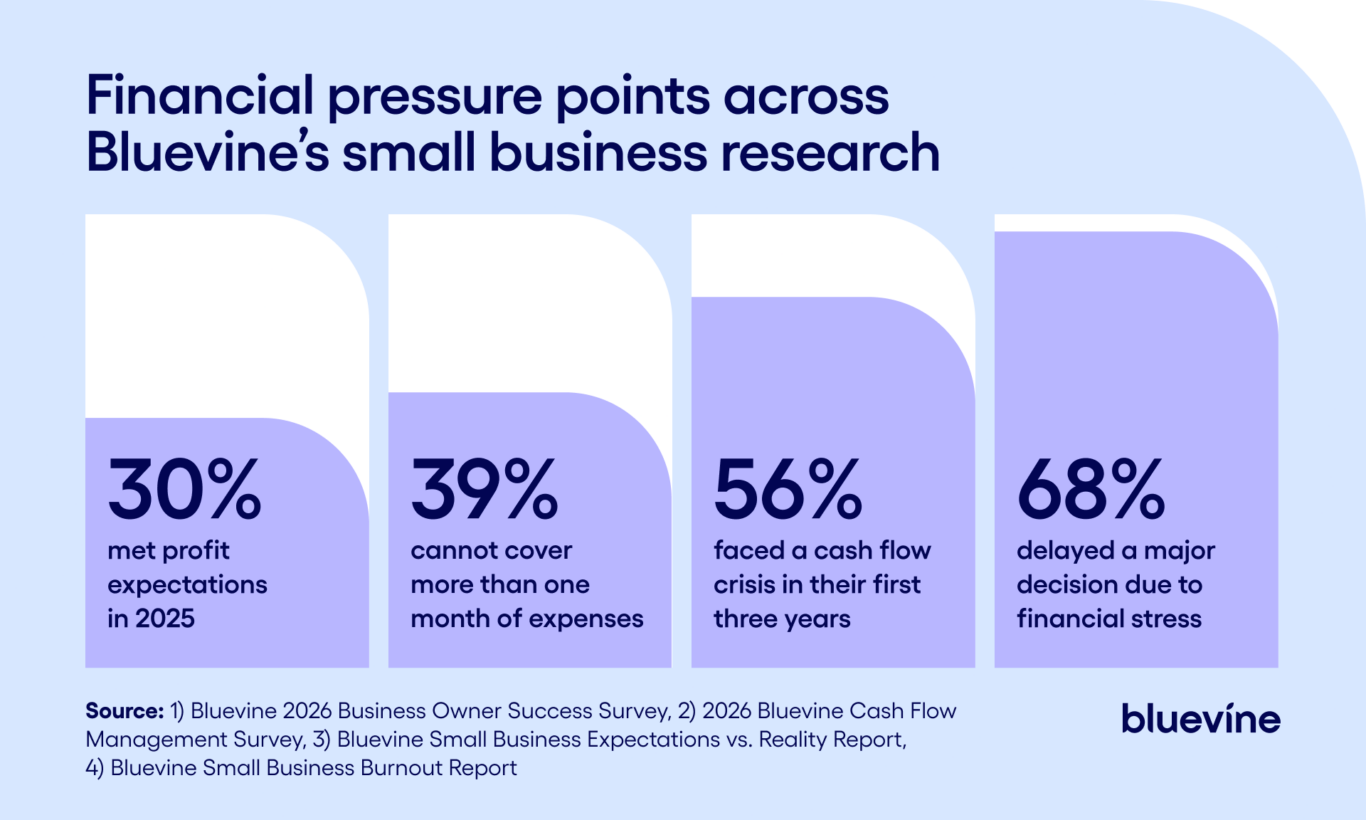
Besides, survival rates describe the past. Bluevine’s own data reflects what’s happening to businesses still standing right now: 43% of small businesses have less than a month of cash on hand, up from 39% the year before. And only 30% of owners finished 2025 with profitability above expectations, down nearly 50% from 2024.
The warning signs are usually visible months before the doors close. Here are six reasons why small businesses fail, and what to do about each one.
1. Running out of cash before the business finds its footing
A slow cash drain is one of the clearest failure patterns: It ends when payroll or another bill arrives, and the account can’t cover it. Among businesses still operating, 43% have less than a month of cash on hand for operating expenses.
Even within that one month, the picture is worse than it was a year ago. The share of owners holding 7 to 14 days of cash rose from 14% to 20%, while the share with one to two months fell from 18% to 14%. Owners who used to have a month of breathing room now report about two weeks.
Newer businesses carry the most exposure. Only 19.6% of firms five years old or younger hold three to twelve months of cash, against 39.2% of firms six years or older.
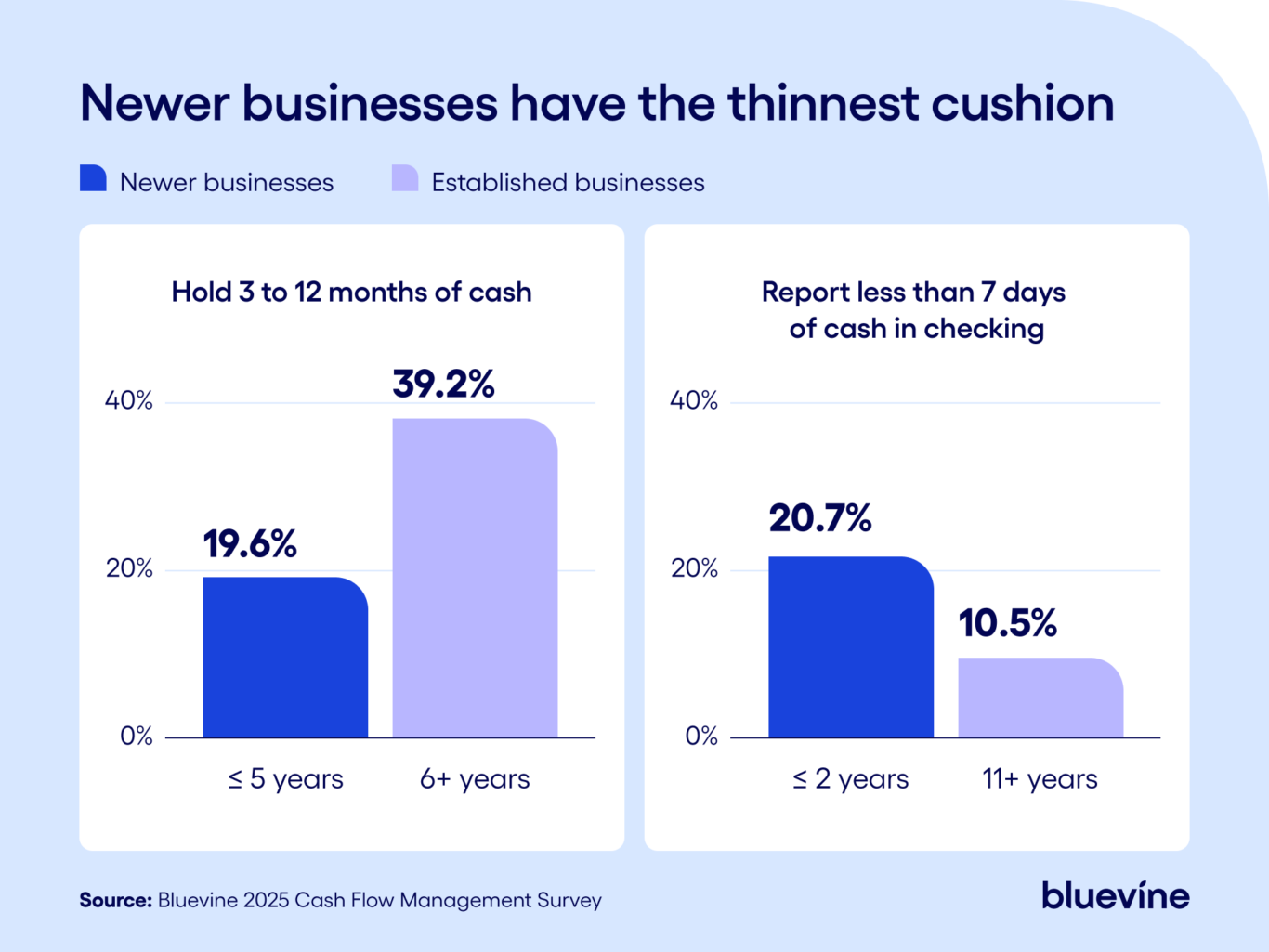
That same pattern shows up in day-to-day terms, too. Among businesses under two years old, 20.7% report less than seven days of cash on hand, compared with 10.5% of businesses 11 years or older.
None of this means the business itself is unprofitable, though. A business can look healthy on paper and still miss payroll when receivables land after payables come due. More than half of owners (56%) faced significant cash flow problems within their first three years, and 8 in 10 say managing cash flow creates stress at least a few times a year.
Late payment is where that timing risk usually starts, shifting liquidity risk from the customer onto the owner. Almost 6 in 10 small businesses (59%) experience some degree of late payments. Nearly 1 in 3 owners have delayed paying themselves because customers paid late, and 17% missed or nearly missed payroll.
Most businesses absorb that friction without guardrails. A mere 19% charge late fees on overdue invoices. Only 31% keep a dedicated reserve for late payments, and 32% keep none at all.
How to get ahead
Start by knowing your runway. Divide available cash by average monthly operating expenses, since owners who can state that number make different decisions than owners who can’t. Set payment terms before work begins and enable a payment option directly on the invoice. Enforce late fees and follow up on overdue invoices within a week rather than waiting a full billing cycle.
- Know your runway. Divide available cash by average monthly operating expenses, since owners who can state that number make different decisions than owners who can’t.
- Set payment terms before work begins, and enable a payment option directly on the invoice. Bluevine’s own data shows that Stripe-enabled Bluevine invoices are paid 174% faster than traditional invoice methods, averaging 7 days to get paid versus 18.
- Enforce late fees, and follow up on overdue invoices within a week rather than waiting a full billing cycle.
- Build toward 8 to 13 weeks of operating expenses in reserve, the range fractional CFO Eric Trettel of Sota Bookkeeping recommends, and automate a fixed percentage of monthly revenue into a separate reserve account rather than waiting for a surplus that never arrives.
Set aside reserves automatically, before a cash crunch hits.
2. No access to financing when it’s needed
Credit is increasingly doing work it wasn’t designed for. Among the 47% of owners who hold a line of credit or loan for operating expenses, half used it to cover routine day-to-day expenses or a shortfall, and only 26% used it for planned growth.
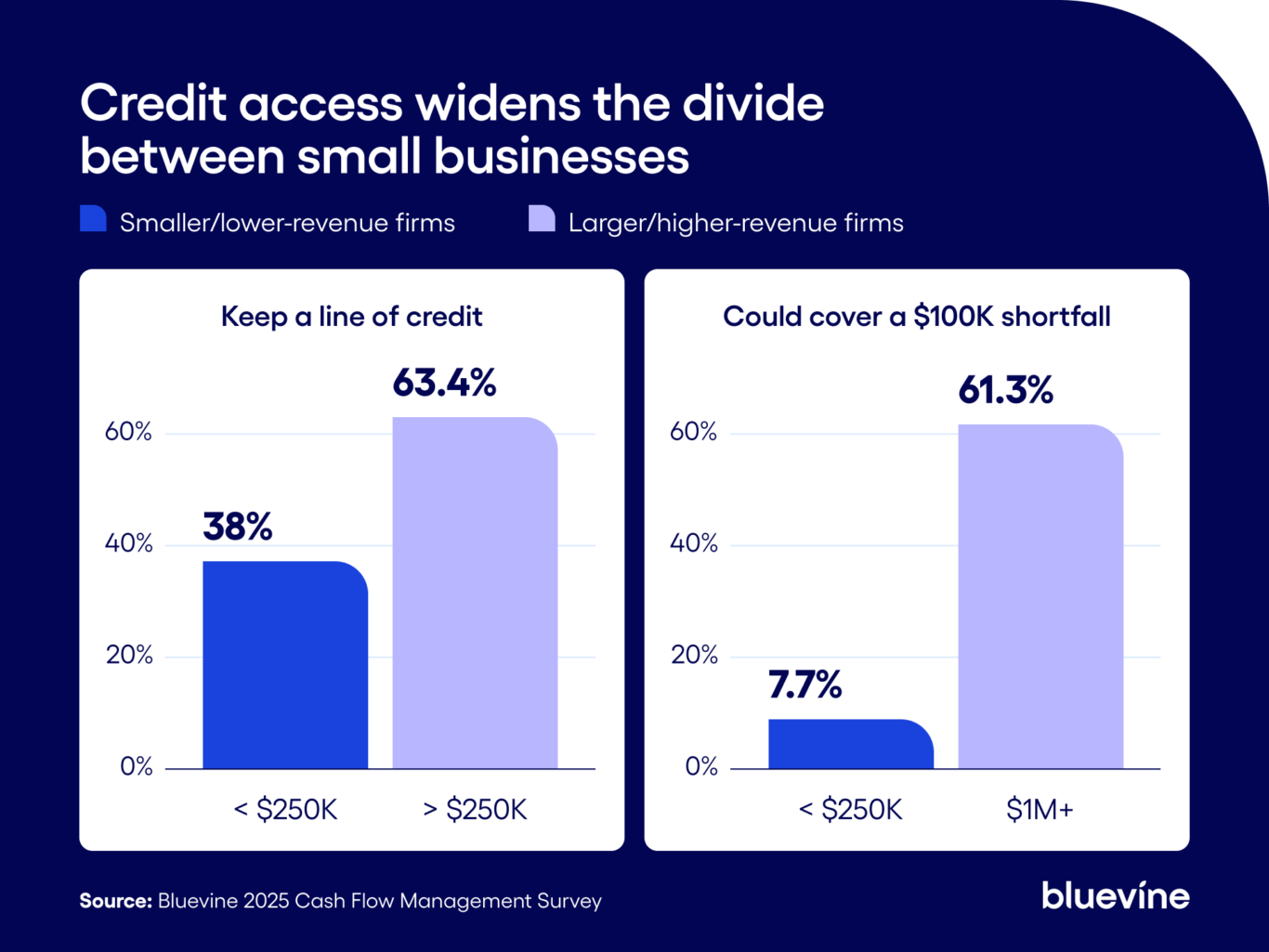
There’s also a gap in who gets access to credit at all, and it disproportionately favors larger businesses. Only 38% of firms earning under $250K maintain a line of credit for emergencies, compared with 63.4% of firms earning over $250K. Smaller firms also have less capacity to absorb a larger gap: Just 7.7% of businesses under $250K could cover a $100K shortfall, against 61.3% of firms at $1M or above.
Not having credit isn’t always a choice, either. Among owners without credit, 27% ran into an actual obstacle, whether they were turned down, unsure where to start, or never got around to applying.
So the money had to come from somewhere else: 63% of founders used personal savings to start their business, 31% used personal credit cards, and 19% took personal loans. Only 8% generated enough immediate revenue to cover costs without touching personal funds or seeking outside capital.
Owners don’t stop covering the gap themselves once the business is running, either. Three-quarters have used personal credit cards or personal loans for business expenses at some point in the last 12 months, turning a business problem into a household one.
Preparation also accounts for a meaningful share of the denials. About 25% of owners believe mistakes or issues in their most recent financing application caused it to be delayed or denied, and 37% of all owners surveyed ran into a problem with that application.
How to get ahead
- Apply during a strong quarter, when the financials show the business at its best.
- Before applying, research the lender’s approval requirements and check both personal and business credit scores.
- Update your financial statements, and have the last three months of bank records ready.
- As Eric Trettel, owner of Sota Bookkeeping, puts it, “The best time to secure financing is before you actually need it.”
Easily apply for multiple types of business financing with no impact to your credit score.BVSUP-00128
3. No demand for what you’re selling
The most cited external reason for business failure is building something the market doesn’t want badly enough to pay for. CB Insights analyzed 431 venture-backed companies that shut down since 2023 and found that running out of capital was the final event in 70% of cases. But poor product-market fit (43%) was the more telling cause, ahead of bad timing (29%) and unsustainable unit economics (19%).
Those venture-backed startups are a different population than most small businesses. For owners outside that world, the major problem is usually revenue arriving slower than planned. Nearly 6 in 10 (59%) of founders expected to be profitable within their first year. Of those who expected profit within six months to a year, only 56% actually achieved it. Among owners who gave themselves one to two years, only 51% were successful.
How to get ahead
- Test demand at the price you actually need to charge, not the price that gets an easy yes.
- Track monthly revenue against your original forecast every month.
- Treat a persistent gap as a signal that the market wants something different, not that the owner didn’t try hard enough.
4. Rising costs you didn’t reprice for
Costs climb faster than prices, and the margin gets swallowed up. Among owners, 80% say inflation is challenging for their business, and 34% say the rising cost of supplies has affected them in the last year.
Materials and fuel tie as the rising costs with the biggest cash flow impact, each named by 39% of owners. But which costs sting the most depends heavily on the industry. Construction and trades businesses named fuel at 60%, more than double the rate among professional and business services firms at 27%.
Startup costs run over in the same predictable places. Equipment and physical space topped the list of expenses that came in significantly higher than expected (37%), followed by business insurance (35%) and licensing, permits, and compliance (34%). Only 14% of founders said all of their costs came in as expected.
Rising costs call for repricing, but that’s not what most owners do. Around 1 in 3 (34%) reduced expenses in 2025 to adapt to the economy, while only 28% raised prices to offset higher costs.
How to get ahead
- Review pricing and gross margins regularly, and whenever material costs, labor costs, supplier terms, or market conditions change.
- Recalculate the cost to deliver each product or service.
- Assess whether current prices still cover costs and support the margin the business needs.
- Before raising prices, consider customer demand and competitor pricing.
5. Not knowing the numbers until it’s too late
Careful planning still has blind spots. A launch budget can’t account for every fee or bill that surfaces once the business is already running. More than half of founders (51%) had at least one expense they completely overlooked, and 54% encountered costs they were unaware of in advance. Visibility, not effort, usually decides which of those costs actually catch up with the business.
Without a system tracking real numbers as they change, even a carefully planned business can’t tell the difference between money sitting in the account and money actually earned.
Ramon Liriano Jr., Managing Partner of Elevated Tax Strategies and a Bluevine accounting partner, puts it directly: “Nine times out of ten, it is not bad planning. It is flying blind.” He adds that many owners “never set up real books, so they could not see their true numbers until the year was already over. Money felt fine in the checking account, so they kept spending. But the checking account balance is not profit.”
Bookkeeping is the largest weekly financial time drain for owners (42%), and it’s the function that slips first when owners get busy. Nearly 8 in 10 spend as much or more time on financial tasks than they anticipated, and 26% say financial administration takes longer than originally planned.
The tools most owners rely on don’t surface problems early enough to matter. Almost half (45%) track cash manually through spreadsheets or notebooks, and only 20% use forecasting software, so most businesses have nothing flagging a problem until it’s already had an impact. These numbers barely move among owners with less than a month of cash on hand (22%), which means the owners who would benefit most from an early warning are no more likely to have one.
How to get ahead
- Open a dedicated business checking account before your first business expense, and connect it to your accounting software so transactions sync automatically.
- Watch cash on hand and days sales outstanding every week.
- Track gross margin and upcoming fixed obligations alongside them.
- Checked together, weekly, those four numbers surface many problems before they become terminal.
6. Owner burnout stalls the decisions that matter
Owning a business takes a personal toll long before it ever shows up on a balance sheet. 65% of owners say operating at their current team size has negatively affected something over the past year, most often their own time off (33%) or their mental health (24%). The pressure also scales up with the size of the business. Among companies with 50–99 employees, the share reporting a negative impact jumps to 80%.
That strain doesn’t stay emotional. It shows up in real, measurable business decisions. Over 7 in 10 (71%) of small business owners report moderate, high, or extremely high financial stress, and 68% have delayed or avoided a major decision, such as hiring or expanding, because of it in the past 12 months.
Owners absorb the shortfall personally, and the thinner the cash cushion, the more it shows: 62% have reduced or skipped their own pay at least once in the past year to cover business expenses. Among owners with less than a month of cash on hand, 54% delayed paying themselves in the past 12 months, compared with 42% of owners overall.
Meanwhile, 41% say their biggest source of financial anxiety is the gap between money coming in and bills being due, ranking above payroll, taxes, and debt.
How to get ahead
- Treat financial visibility as part of managing owner stress, not separate from it.
- Set aside dedicated time each week for financial administration.
- Or bring in bookkeeping help early, rather than waiting until tax season to organize the books.
- Tools that automate repetitive financial tasks and improve cash flow visibility can also reduce the time burden.
Failure is mostly a cash problem, and those issues show up early
The reasons why small businesses fail are less mysterious than the stories suggest. Most of them show up in the numbers months before they show up at the door.
Visibility and liquidity are the two levers most within an owner’s control. A missed number on a spreadsheet is fixable in a way that bad luck never is, as long as someone sees it in time. Owners who know their runway in weeks and check the same four numbers every week catch problems earlier. Connecting a Bluevine account to accounting software like Xero makes that routine easier, keeping finances up to date in one place and giving owners a real-time picture of their financial health and position.
Most of the hazards above trace back to two shortfalls: not enough cash set aside, and not enough access to it when needed. A Bluevine business checking account with sub-accounts and automatic transfer rules makes the first gap easier to close, since reserves build without requiring a manual transfer each month. A Bluevine business line of credit secured during a strong quarter closes the second, so financing is already in place before a shortfall forces the issue.
Manage more of your finances in the same place.
Frequently asked questions
Are all business closures failures?
No, not all business closures are failures. When the Census Bureau last asked owners of employer firms why they closed, low sales ranked first (25%), retirement second (22%), and selling the business third (20%). Retirements and sales together account for more than 4 in 10 closures, meaning the number of businesses that actually failed is smaller than survival rates alone suggest.
What year of business is the riskiest?
The first year of business tends to be the riskiest, as it accounts for the largest share of closures in absolute terms, with about 1 in 5 businesses closing before their first anniversary. But attrition continues steadily rather than stopping: Roughly half of businesses close by year five and about two-thirds by year ten.
How much cash should a small business keep on hand?
Fractional CFO Eric Trettel of Sota Bookkeeping recommends that small business owners keep 8 to 13 weeks of operating expenses on hand. For context, 43% of owners currently hold less than one month’s worth of cash.
Can a profitable business still fail?
Yes, a profitable business can fail, and it happens regularly. Profit measures whether revenue exceeds costs over a period. Solvency measures whether there is sufficient money in the account when a bill comes due. A business with healthy margins and slow-paying customers can miss payroll while still being profitable on paper.
Is it harder to start a business now than it used to be?
No, Bluevine’s data points the other way on entry cost specifically, showing that starting a business may have a lower barrier of entry than in previous years. Business openings are growing while average starting balances are down more than 15% since 2025, meaning owners are launching with less capital than they used to.
External Sources
- Table 7. Survival of private sector establishments by opening year. U.S. Bureau of Labor Statistics (2025, March). https://www.bls.gov/bdm/us_age_naics_00_table7.txt
- 2015 Annual Survey of Entrepreneurs. U.S. Census Bureau (2018, May). https://advocacy.sba.gov/wp-content/uploads/2019/06/Small_Biz_Facts_Why_Do_Businesses_Close_May_2018_0.pdf
- The top 9 reasons startups fail. (2026, March). https://www.cbinsights.com/research/report/startup-failure-reasons-top/