Most small business owners don’t spend much time thinking about their bank until something goes wrong. Maybe they get hit with a late fee that could have been avoided if the system was just a little more efficient. Or they find themselves driving to a local branch for a task that really should have taken 30 seconds to handle online.
These kinds of headaches are a lot more common than people might think. A recent Bluevine survey of more than 700 small business owners in the U.S. found that 74% of those who added or switched to a fintech platform dealt with at least one real financial problem caused by slow or outdated traditional banking in the last year. The issues they faced ranged from constant cash flow stress to missed business opportunities.
Our survey also looks at what these owners are doing to fix the situation. We found that the vast majority of people who made the move to fintech feel like it was a move worth making.
Key takeaways
- The most common issues slow, outdated banking causes for SMB owners include visiting a physical branch or calling support for things that should be easy to do on a computer or phone (29%), cash flow stress (28%), and late fees or penalties (25%).
- 39% of SMBs started using a fintech platform for faster payments or transfers for their business.
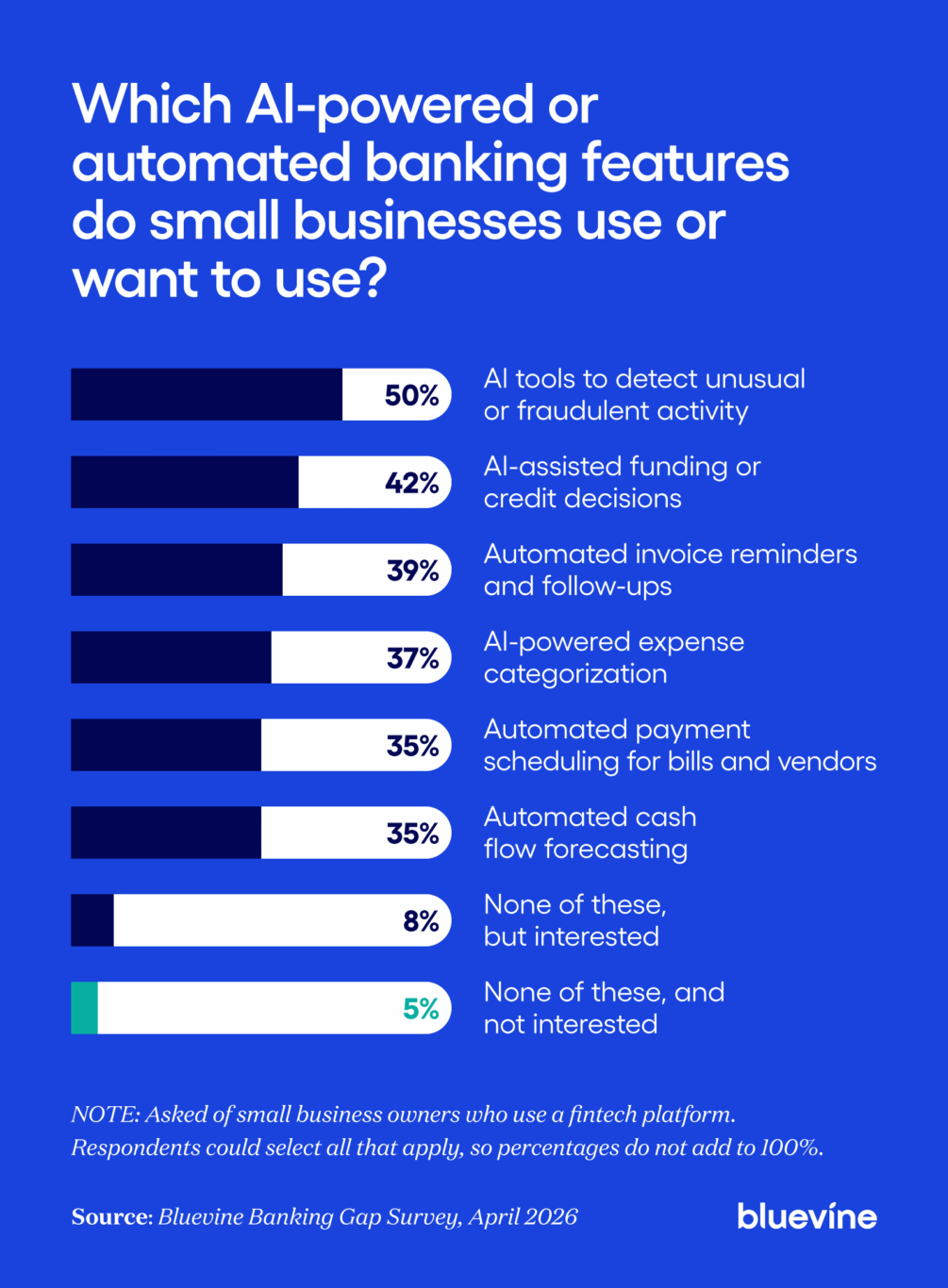
- Half of the small businesses using fintech either currently use or want to use AI tools to help them spot fraud.
- SMB owners who made the switch from a traditional bank to fintech say the online platform has been better in every major category, including transaction speed, personalization, and easy-to-use digital tools.

For the small business owners who have started using a fintech platform, dealing with slow or outdated traditional banking came with a price tag.
Nearly three out of every four owners said that old-school banking caused at least one specific financial problem for them in the last 12 months. Some of those problems did more damage over the long haul than others. About 21% of them said that banking delays caused them to miss out on a business opportunity, like being able to buy inventory at a discount or launching a big promotion while the timing was still right. When you lose an opportunity like that, it can hurt a small business’ bottom line for months.
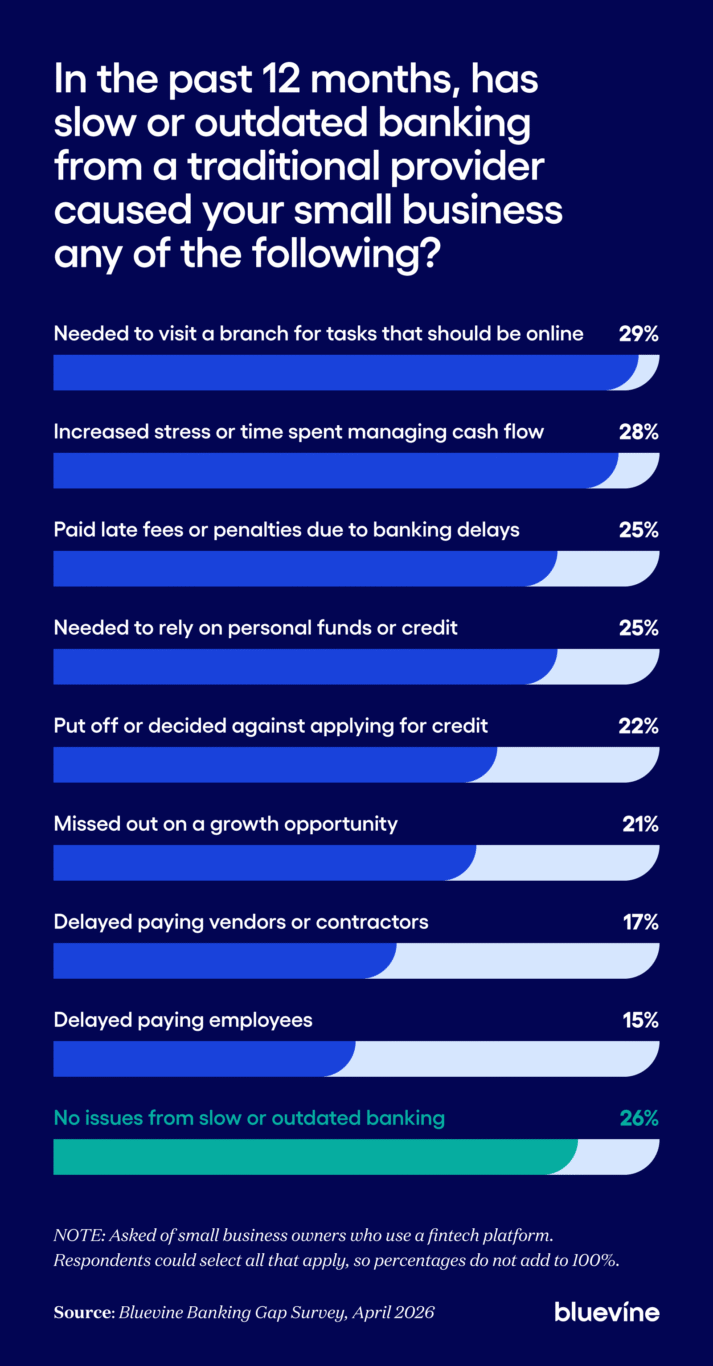
The most common day-to-day issues were things like cash flow stress (28%), late fees or penalties caused by banking delays (25%), and having to go to a branch or wait on the phone for tasks that should be doable online (29%). Another 22% put off or decided against applying for a business line of credit or term loan altogether, putting their small business growth on hold in the process.
The problems didn’t just stop with the owner, either. 15% of owners reported that they had to delay paying their employees, and 17% had to delay payments to their vendors or contractors. These numbers represent real, uncomfortable conversations that owners had to have with people who were relying on that money to pay their own bills.
Once small businesses try fintech, they rate it better across the board
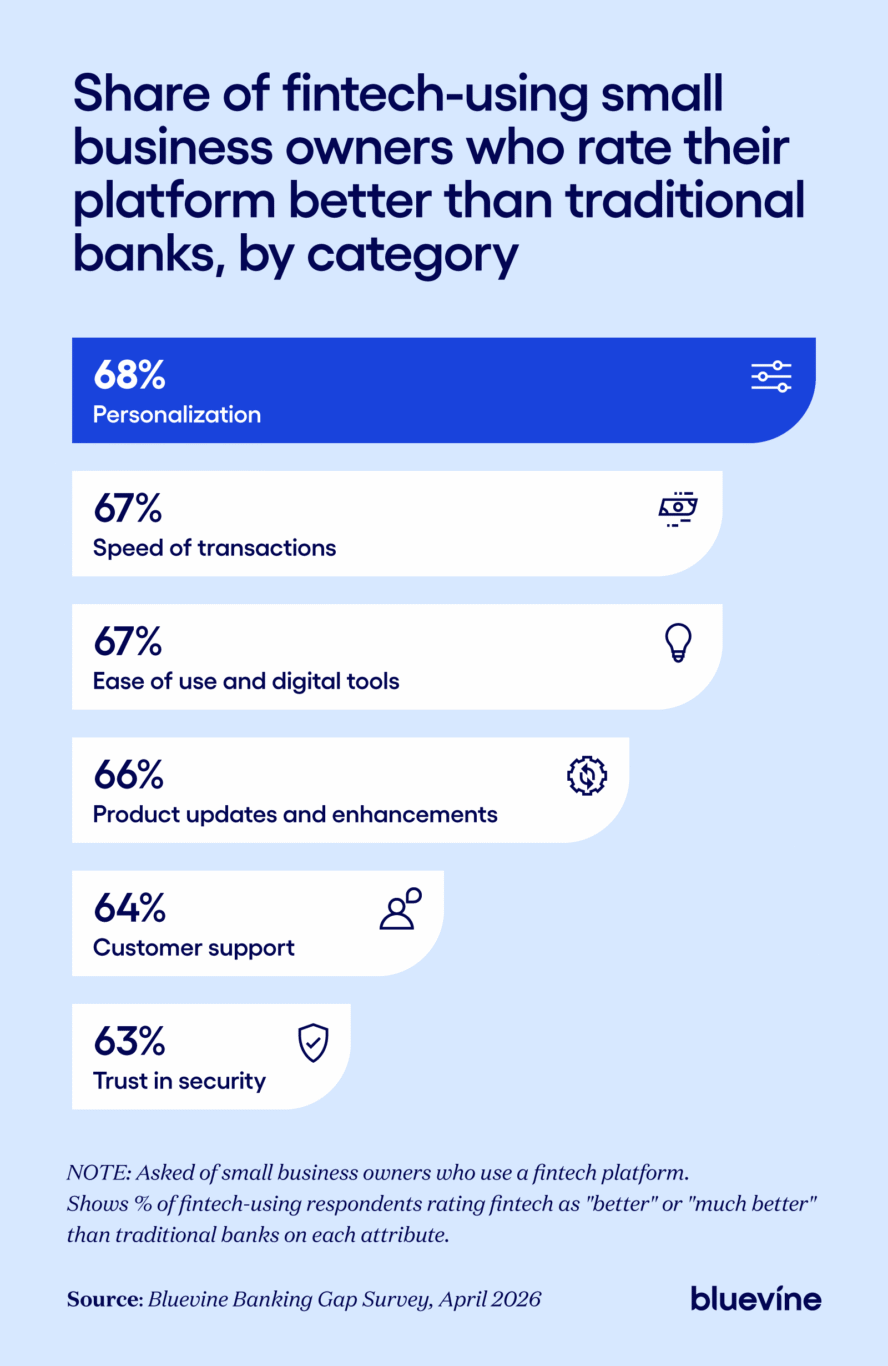
The feedback from owners who have used both types of banking is very consistent. When we asked them to compare their fintech platform to their traditional bank across six different areas, the number of people who rated fintech as the better option was high across the board.
- Personalization (68%)
- Speed (67%)
- Ease of use and digital tools (67%)
- Product updates (66%)
- Customer support (64%)
- Security (63%)
The finding about security is something people should pay attention to. Traditional banks have spent decades trying to build a reputation as the only safe place to keep your money. But the fact that 63% of these SMB owners now rate their fintech platform higher on trust and security suggests that the old-school reputation of big banks might not carry as much weight as it used to, at least for business owners who have tried both options.
Overall, 68% of fintech users said they are either satisfied or very satisfied with their current platform. That compares to a 62% satisfaction rate for traditional banks. For the most part, the owners who made the move are happy they did it.
That high satisfaction makes a lot of sense when you consider what fintech has already delivered for these SMB owners overall:
- 41% said they now have a much better view of their overall financial health.
- 41% said it has become easier to track their expenses.
- 37% said their budgeting and forecasting have become more accurate.
Only 9% of the people surveyed said that switching to fintech made no real difference in how they manage their company’s finances.
50% of fintech users want AI to handle banking tasks for them
Moving to fintech solved some of the immediate problems that traditional banking created, but many owners are looking for even more help. When we asked which AI or automated banking features they were interested in, they made it very clear that they want their platform to take over more of the heavy lifting that usually falls on their shoulders.
Half of the people we talked to said they either currently use or want AI tools that can detect unusual or fraudulent activity, which was the most popular feature in the survey. AI-assisted funding and credit decisions were the second most popular at 42%, followed by automated reminders for invoices (39%), AI-powered expense categorization (37%), automated payment scheduling (35%), and forecasting for cash flow (35%). Only 5% of people said they had no interest in any of these automated features at all.
The lure of faster payments brought 39% of SMB owners to fintech
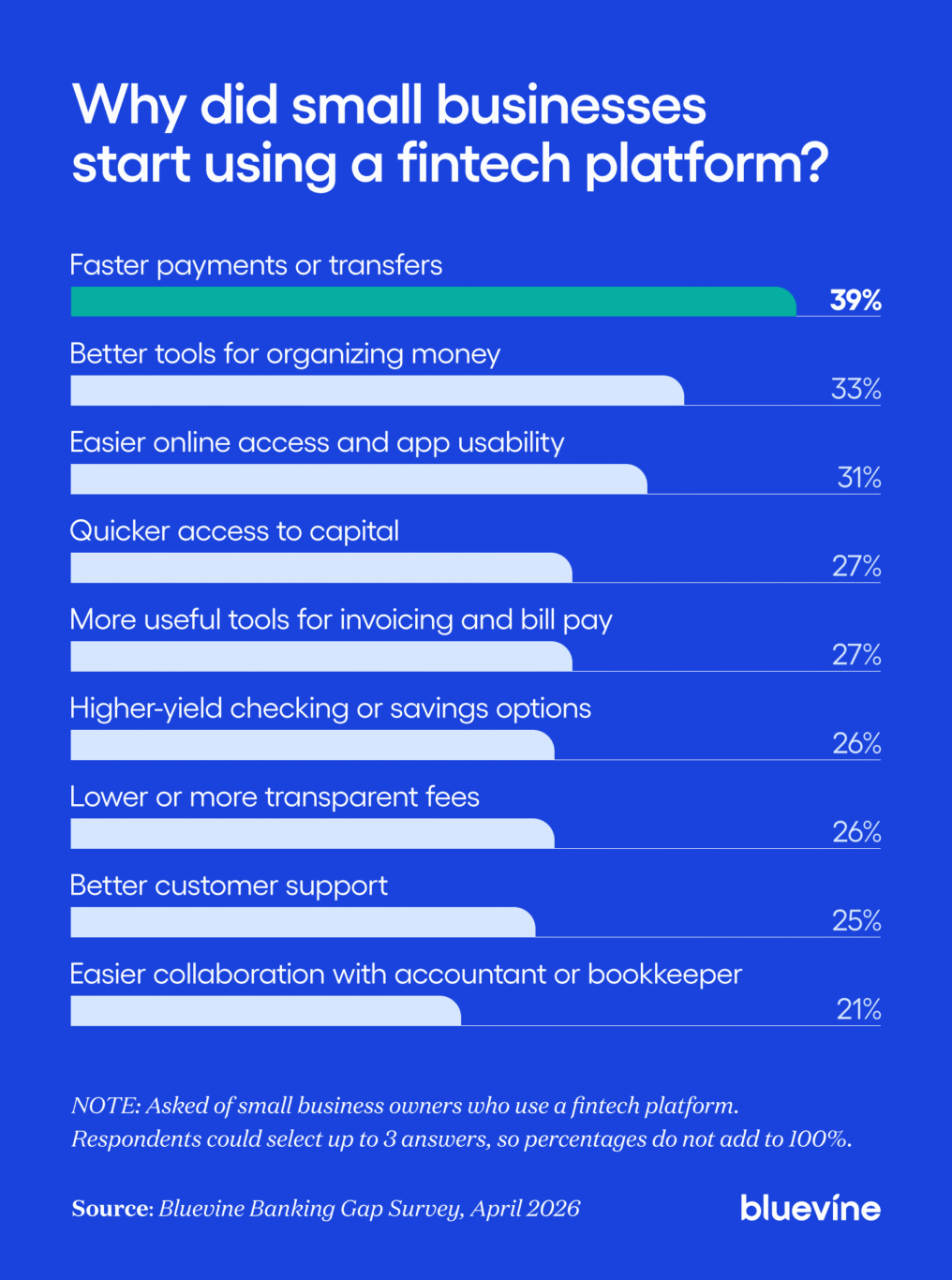
For most owners in our survey, the decision to try fintech came down to a familiar reality of small business ownership. Something specific wasn’t working, and they needed to fix it. 39% said that getting faster payments and transfers was a top reason they made the switch, which was way ahead of any other factor we looked at. Better tools for organizing money came second at 33%, followed by easier online access and a better mobile app at 31%.
Speed also changes how they use these fintech platforms every single day. The tool they use the most is the mobile app (53%), followed by fast payments and instant transfers (44%) and real time alerts (38%).
These small business owners have moved a huge portion of their daily banking tasks onto their phones. This lets them handle their money on their own time, rather than having to plan their day around when a bank branch is open or how long they might be stuck waiting on hold.
Most of these owners didn’t actually walk away from their traditional bank for good. Only 23% of them switched over completely. About 41% decided to keep their old bank account and just add a fintech platform on top of it. Others came to fintech even earlier, choosing it from the moment they were starting a new business. A lot of them are running both side by side, using each one for what it does best. The gaps that traditional banking left open, fintech stepped in to fill.
Your banking shouldn’t be working against you
Traditional banking is costing small business owners in ways that go way beyond just monthly fees. For the owners who took this survey, those costs showed up as late fees, missed chances to grow, delayed payments to staff, and too much time spent on chores that should have been automated years ago. Most people who made the switch found that there was a better way to work on the other side.
If you’re still relying solely on a traditional bank for your business, it may be worth asking what it’s actually costing your chances of running a successful business.
Bluevine is built for small business owners who need a banking partner that can actually keep up with how they work. Take a look at Bluevine Business Checking, a high-yield account with built-in invoicing and payment tools, to see what a smarter approach to business banking looks like. Plus, consider applying for multiple lending options through Bluevine—including lines of credit and term loans—all with one simple application.BVSUP-00151
See why Bluevine is the largest small business banking platform in the U.S.BVSUP-00186
Methodology
The survey was conducted by Centiment for Bluevine. The survey was fielded between April 14, 2026, and April 28, 2026. The results are based on 742 completed surveys.
In order to qualify, respondents were screened to be residents of the United States, over 18 years of age, and owner of a small business with an annual revenue between $50,000 and $5 million. Questions about the impact of traditional banking and fintech usage were shown only to respondents who currently use a fintech platform, either as their primary provider or alongside a traditional bank (n=384).
Data is unweighted, and the margin of error is approximately +/-4% for the overall sample with a 95% confidence level.


