

After a few years of volatility, 2025 proved to be a rebound year for small businesses.
To dig deeper into this year’s boom, we combined our data from more than 210,000 active business checking accounts with a proprietary survey of 1,067 U.S. small business owners. We explored the major challenges small businesses faced on their way to success, as well as which industries and cities thrived the most.
Here’s what stood out:

Key takeaways
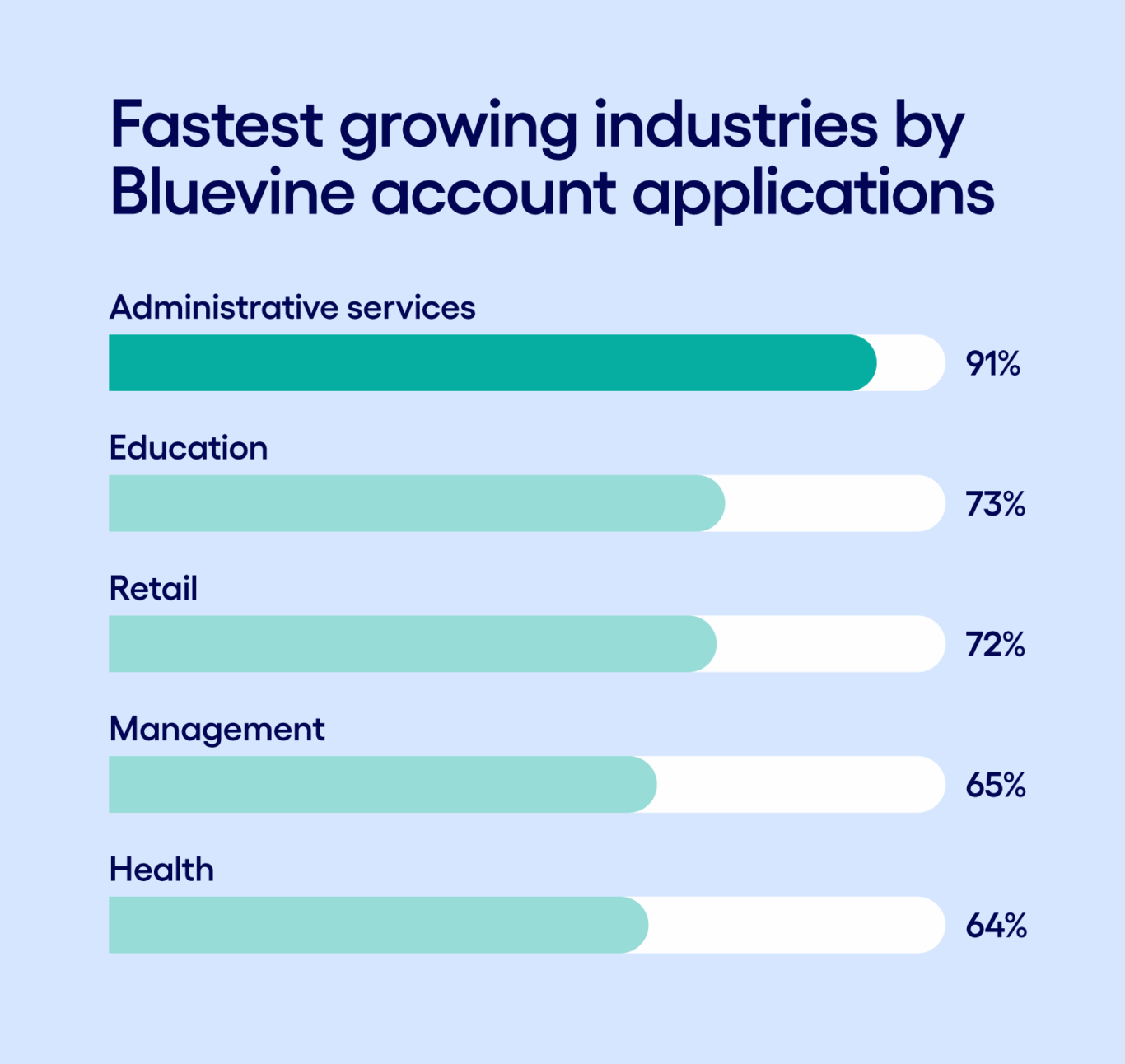
- The administrative services, education, retail, management, and health sectors grew the most, each posting projected YOY growth rates in Bluevine Business Checking account applications between 64% and 91%.
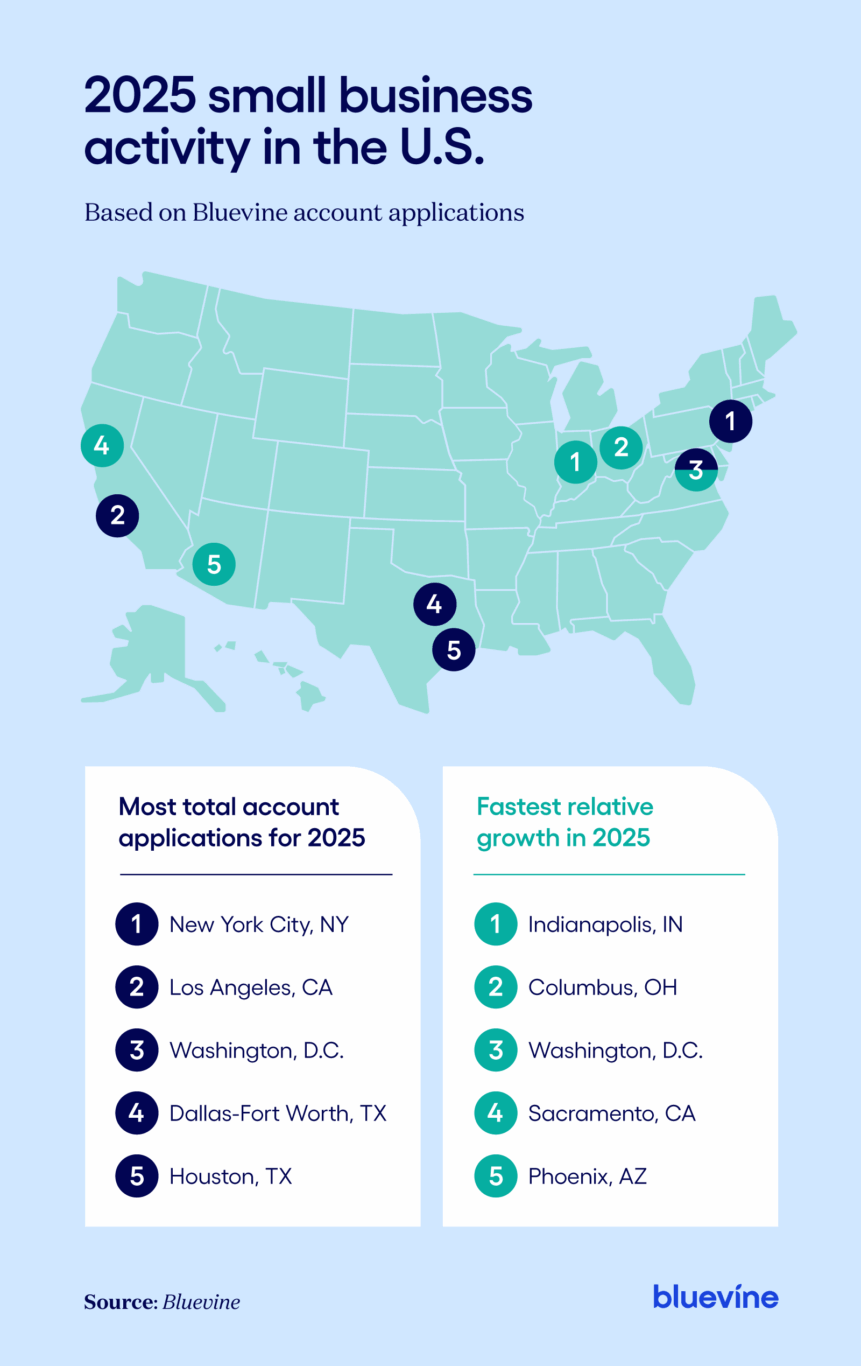
- Smaller metros experienced a surge in small business activity—for example, there was a 175% growth in total Bluevine account applications in Washington, D.C.
- 58.4% of small businesses met or exceeded their revenue projections for 2025, and 68.3% of respondents rated their company’s overall financial health as strong or stable.
- 80.3% of small businesses experienced challenges in 2025 due to inflation
- Rising operating costs significantly impacted over 40% of small businesses in 2025.
- Small business success came at the expense of major personal sacrifices—about 1 in 4 (24.9%) small business owners take a full day off with zero work contact once per week, while over 1 in 5 (21.9%) never take a full day off.
5 industries saw major growth or recovery in 2025
As the largest small business banking platform in the United States,BVSUP-00186 we collected and analyzed data that suggests small business activity rebounded across the country. It’s a refreshing signal after what was largely a slow year in 2024.
Note: While precise industry-specific business growth can be challenging to pinpoint, we’re using new Bluevine Business Checking account applications as a metric to help estimate where year-over-year industry growth was most evident.
1. Administrative services
The market for office administrative services reached $272 billion in 2024 and is projected to grow to $425 billion by the end of 2029.
Our data backs this upward trajectory—the administrative service businesses sector posted a blistering 91% growth in funded checking accounts year-over-year, the strongest among all industries.
This follows a similarly stellar 16.5% year-over-year growth rate in 2024, a year in which it was one of the only industries to post positive growth. This highlights a continued shift towards white collar operations in the small business landscape.
2. Education
Recent surveys from the Cato Institute show that COVID-19 reshaped the U.S. education sector, spurring a boom in private education enrollment that has lasted up to this year.
Moreover, the U.S. private tutoring market is expected to grow by $29 billion between 2025 and 2029 at a compound annual growth rate (CAGR) of 11.1% as parents and students alike seek access to extra materials and programs to gain an edge and prepare for important exams.
Small businesses are cashing in on the growing demand and optimism for this industry—projected applications for Bluevine accounts within the education sector grew by a massive 72.5% year-over-year.
3. Retail
A recent Bain & Company study painted a cautiously optimistic picture of the retail sector to round out the year. They project in-store sales to grow by 2.75% year-over-year, and report that non-store sales (where many small business retailers operate) grew at a slowed, but still healthy 7% rate.
Our data shows that people are taking notice of the sector’s positive performance, with Bluevine account applications growing by 71.6% year-over-year, representing a fantastic rebound.
Data from our survey of 1,000+ business owners backs the optimistic outlook. While two-thirds of retailers raised prices in 2025 (likely in response to rising costs and cash flow challenges), 56.1% of them met or exceeded their 2025 revenue projections. This suggests demand remains steady despite rising costs.

Did you know?
Nearly 4 in 10 small businesses (39%) have less than one month’s worth of cash on hand for operating expenses.
4. Business management
Our data has the business management industry as the fourth-fastest growing small business sector of the year, with projected Bluevine account applications growing 64.6% between 2024 and 2025.
While this is a rather broad category, a more granular look into market data reveals healthy growth in prominent management-related sectors. For example, Mordor Intelligence pins the global management consulting service market at $358 billion for 2025, with projected growth up to $451 billion by 2030.
The same report shows that startups demonstrated the highest growth in this category in 2024 (at a CAGR of 5.9%). As organizations grow in scale and complexity, opportunity opens up for small businesses to offer their cost-effective, specialized management expertise.
5. Health
A recent report by Precedence Research predicts that the U.S. health and wellness market will grow to an astounding $3.7 trillion by 2034, and our data shows that small businesses are riding the wave. Projected Bluevine Business Checking account applications for 2025 in this industry grew 64.3% over their 2024 levels.
Meanwhile, a McKinsey & Company study identified that 84% of U.S. consumers rate wellness as a top or important priority, fueling an estimated $500 billion in annual spend that grows at a 4–5% clip despite macroeconomic stressors.
Our survey data backs these projections and performance indicators, displaying hallmarks of a resilient and growing industry. Just under 41% percent of respondents in this industry exceeded their revenue projections for 2025.
And while 71.4% raised prices on their products, 33.3% still managed to improve customer retention and acquisition rates.
Over 58% of small businesses met or exceeded their 2025 revenue projections
While some industries stood out more than others, 2025 was a fruitful year for the small business economy in general. Our survey shows that 58.4% of small businesses met or exceeded their revenue projections for the year.
The uptick in performance fueled sentiment for the year, with 83.9% of respondents indicating optimism about their financial health. Notably, 68% of respondents rated their company’s overall financial health as strong or stable, while 15.6% reported that their business was improving after a difficult period.
One factor that could be driving this success is improved access to funding. In Q3 2025, 61% of small businesses rated their access to capital (like business loans and lines of credit) as good.
Recent tech developments could also be fueling high performance by helping small businesses thrive under difficult macroeconomic conditions. Case in point:
The rise of generative AI
One U.S. Chamber of Commerce report revealed that 86% of small businesses had adopted generative AI tools by 2025. Our survey on small business trends revealed that the majority are using AI in functions that help support growth, like sales (39.4%) and data analysis for business insights (32.6%).
Widespread digitization
The same Chamber of Commerce report found that 58% of small businesses use four or more technology platforms, yielding widespread benefits. For example, over 80% say that these platforms have helped acquire new customers, build better customer relationships, and operate with a higher degree of efficiency.
Data from our own survey showed that improved customer retention or acquisition rates (29.1%) and reduced costs/improved profit margins (23.4%) were the top two most-reported wins in 2025, potentially indicating that these platforms could be having a substantial impact where they are most influential.
Social media and e-commerce platforms
Social media apps (like TikTok, Instagram, and Facebook) and e-commerce platforms (like Amazon, Etsy, and eBay) have emerged as central parts of the small business economy.
Together, they’re driving more than 50% of revenue in over 1 in 5 small businesses, according to a 2025 SBE Council report.
Small city metros dominate the 5 hottest spots for SMB growth, with D.C. skyrocketing
Holistically, our proprietary data around new checking account applications paints a very healthy picture of the U.S. small business economy on paper.
As expected, the massive cities that have historically led business growth continued to drive small business activity. New York, Los Angeles, Houston, and Chicago finished in the top six of the most total Bluevine account applications for 2025.
But as we looked deeper, a more interesting trend emerged—small metros saw meteoric growth in Bluevine account openings. The five metros with the fastest relative growth above a statistically significant threshold were:
- Indianapolis, IN (+361% YOY)
- Columbus, OH (+200% YOY)
- Washington D.C. (+175% YOY)
- Sacramento, CA (+147% YOY)
- Phoenix, AZ (120% YOY)

The case of Washington, D.C.
Washington, D.C. skyrocketed to #3 in total Bluevine account applications for the year, beating out metro areas many times its size, to include Dallas-Fort Worth, Houston, Chicago, and Miami-Fort Lauderdale.
We observed a spike in applications around February of 2025, shortly after the current presidential administration announced workforce reductions in the federal government (the D.C. metro’s largest employer).
While our data can’t prove causation, the timing suggests that federal workforce reductions may have been one contributing factor in the surge of small business activity in the nation’s capital.
At a higher level, our survey on small business ownership concerns established a clear correlation between layoffs and interest in starting a new business. Among people laid off in the last 1-2 years at the time of the survey, 64.9% said they are “very interested—actively making plans now” to start a business.
2025 saw U.S. employers cut hundreds of thousands of jobs throughout the year, the federal government included. Meanwhile, the U.S. Census Bureau’s Business Formation Statistics showed over 473,000 seasonally adjusted business applications in August 2025 alone.
It’s likely that heavy layoffs and economic uncertainty, among other factors, nudged many people towards entrepreneurship in 2025.
Despite successes, nearly half of small business owners regularly question whether running their own business is worth it
Overall, the data points to 2025 being a successful year for small businesses. Yet, our survey shows that nearly half (49.2%) of small business owners regularly question whether running their own business is worth it. In fact, 17.9% of respondents ask that question daily.
The tension between strong performance on paper and regular doubt in the day-to-day raises a question—if business is booming, why are business owners second-guessing their path so often? Recent macroeconomic trends may help explain the phenomenon.
At a high level, headline inflation started around 3% in January, cooled off in the middle of the year, and then picked back up, reaching 3% again in September of 2025. For small businesses, that translated into significant cost pressures.
A U.S. Chamber of Commerce report found that 46% of small businesses say inflation is their biggest challenge. A further 75% report that rising prices significantly impacted their business in 2025. We found these takeaways echoed in our own survey.
Inflation was a major challenge for small business owners in 2025
To begin, our data reveals that 80.3% of respondents have experienced some level of challenge due to inflation, with nearly 40% finding it “very” or “extremely” challenging.
Inflationary pressures had the biggest impact on firms with a headcount between 21 and 50. Over half of small businesses with 31-50 employees (50.9%) reported inflation as “very” or “extremely” challenging, followed closely by those with 21-30 employees (48.4%), suggesting that small employers may be struggling to keep up with inflation-adjusted compensation and benefits expectations.
Some industries felt the impact of inflation disproportionately more than others. About half of the respondents in the following industries reported inflation as “very” or “extremely” challenging:
- IT/Technology (51.6%)
- Real Estate (50.0%)
- Financial Services: (50.0%)
- Food & Beverage: (49.1%)
- Manufacturing: (45.4%)
Costs rose due to continued crises and new uncertainties
When we asked what major changes in the economy impacted their business the most in 2025, 33.8% of respondents named the rising cost of supplies. Other standout issues included slower consumer spending overall (24.4%) and new tariffs and trade restrictions (23.8%).
By zooming out to a global lens, we can understand why small businesses chose these responses at such a high rate. Crises and conflicts like the Red Sea Crisis and Russia-Ukraine War raged on throughout the year, forcing small businesses to cope with global supply shortages and substantially more expensive shipping costs.
In addition, data shows that the rollout of widespread tariffs and trade restrictions has negatively impacted many small businesses, which represent 97% of importers in the United States.
| How tariffs impacted small businesses in 2025 | |
| Supply chain disruptions | Tariffs have starkly impacted global supply chains, with the majority of American companies facing a 10-15% increase in logistics costs as of July 2025. |
| Increased input costs | Small businesses in the manufacturing, retailing, and wholesaling industries disproportionately reported facing increased prices for goods. |
| Raised prices | Tariffs have tangibly raised prices for consumers, contributed to increases in inflation, and resulted in a substantial real income loss of just under $1,700 for U.S. households, which could partially explain a slowdown in consumer spending. |
We see the effects of rising costs and tariffs reflected in the top three pain points of the year for small businesses, as reported in our survey:
- Rising operating costs (40.9%)
- Increasing cost of goods sold (30.8%)
- Cash flow challenges (23.1%)
Small businesses responded to new and continued pressures successfully
Facing massive cost pressures, economic shifts, and late customer payments, small businesses did what they do best—adapt. These adaptations likely played a significant role in propelling the small business economy to a successful year. Here’s how they responded:
- 61.3% raised their prices to offset higher costs
- 15.3% changed suppliers outright
- 14.7% opted to negotiate better terms with their existing suppliers
Businesses that felt rising supply costs were just over twice as likely to raise prices compared to those that didn’t.
Many small businesses also took internal steps (outside of adjusting pricing strategies and vendor contracts) to offset cost pressures without passing the full burden onto consumers and suppliers. For example:
- 33.6% managed to reduce their expenses
- 26.8% focused intently on improving customer retention and loyalty
Perhaps the most refreshing statistic in our dataset: Only 7.5% of respondents reported that they reduced headcount to adapt to economic changes. This suggests that small employers as a whole are working hard to retain their talent.
Only 1 in 4 small business owners take a full day off at least once per week
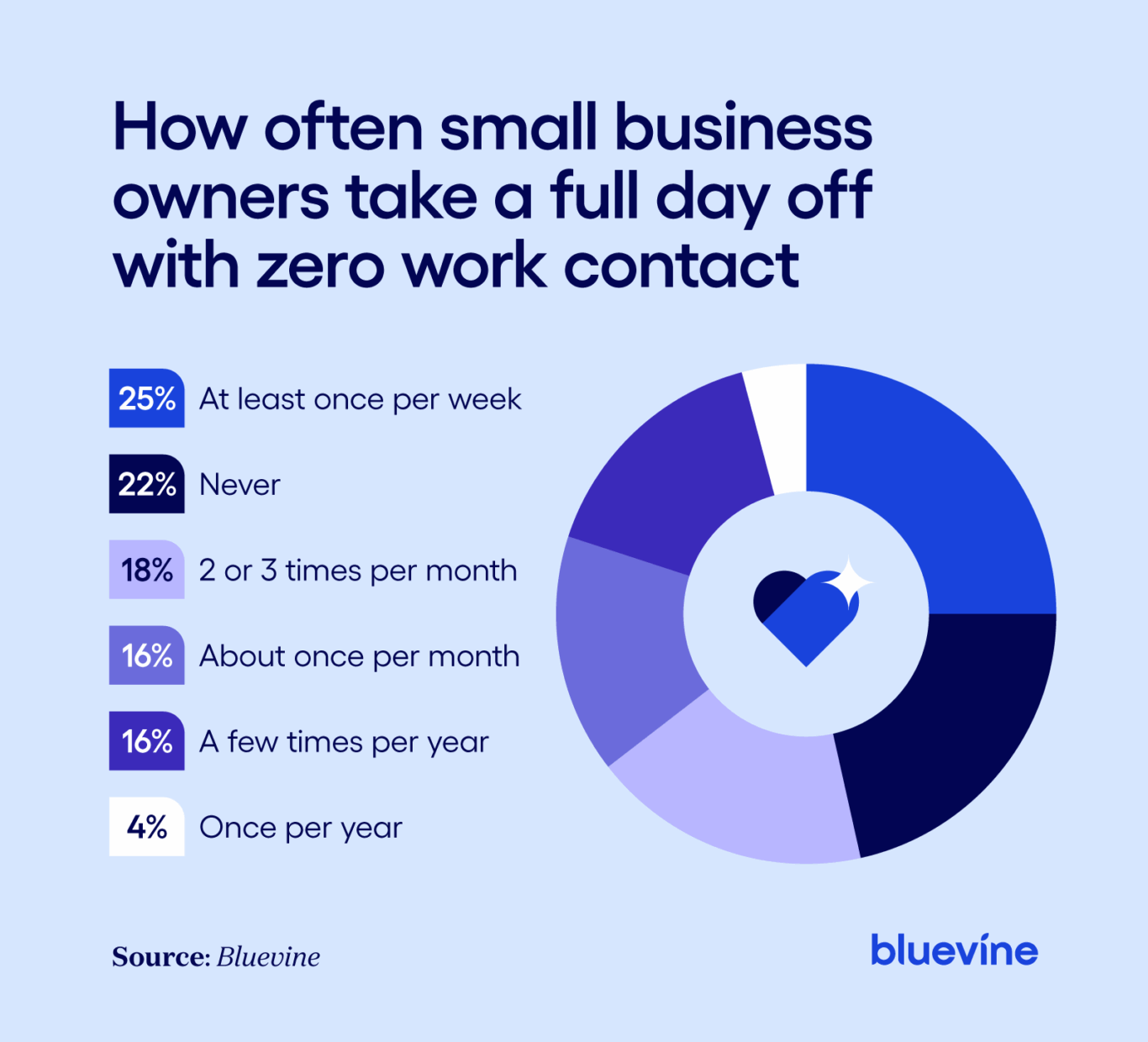
While small businesses turned over a successful year despite major economic headwinds, this success didn’t come without consistent, intense personal sacrifice.
Our survey data revealed that 75.1% of small business owners don’t take a full day off work with zero contact at least once per week. Among that 75.1%:
- 21.6% never take a full day off
- 17.5% take a full day off 2-3 times per month
- 16.1% take a full day off once per month
- 15.7% take a full day off a few times per year
- 4.2% take a full day off once per year
Further data shows that the amount of time the respondents spend on their business is taking a tangible toll on their personal lives. Seventy-eight percent of respondents indicated that they’ve sacrificed something to keep their business running. The top responses were:
- 21.6% — Time with family and friends (e.g., missing events, lack of quality time)
- 18.3% — Financial stability / personal savings (e.g., dipping into personal funds, personal debt accumulation)
- 17.7% — Hobbies and personal interests (e.g., losing time for things I enjoy outside of work)
- 13.4% — Personal health and wellness (e.g., sleep, exercise, diet, stress-related issues)
- 6.5% — Career growth / external opportunities (e.g., passing up a higher-paying job or promotion)
Only 22.5% said that they haven’t sacrificed anything significant and maintain a good balance.
3 in 5 sacrificed owner’s pay to keep their business running
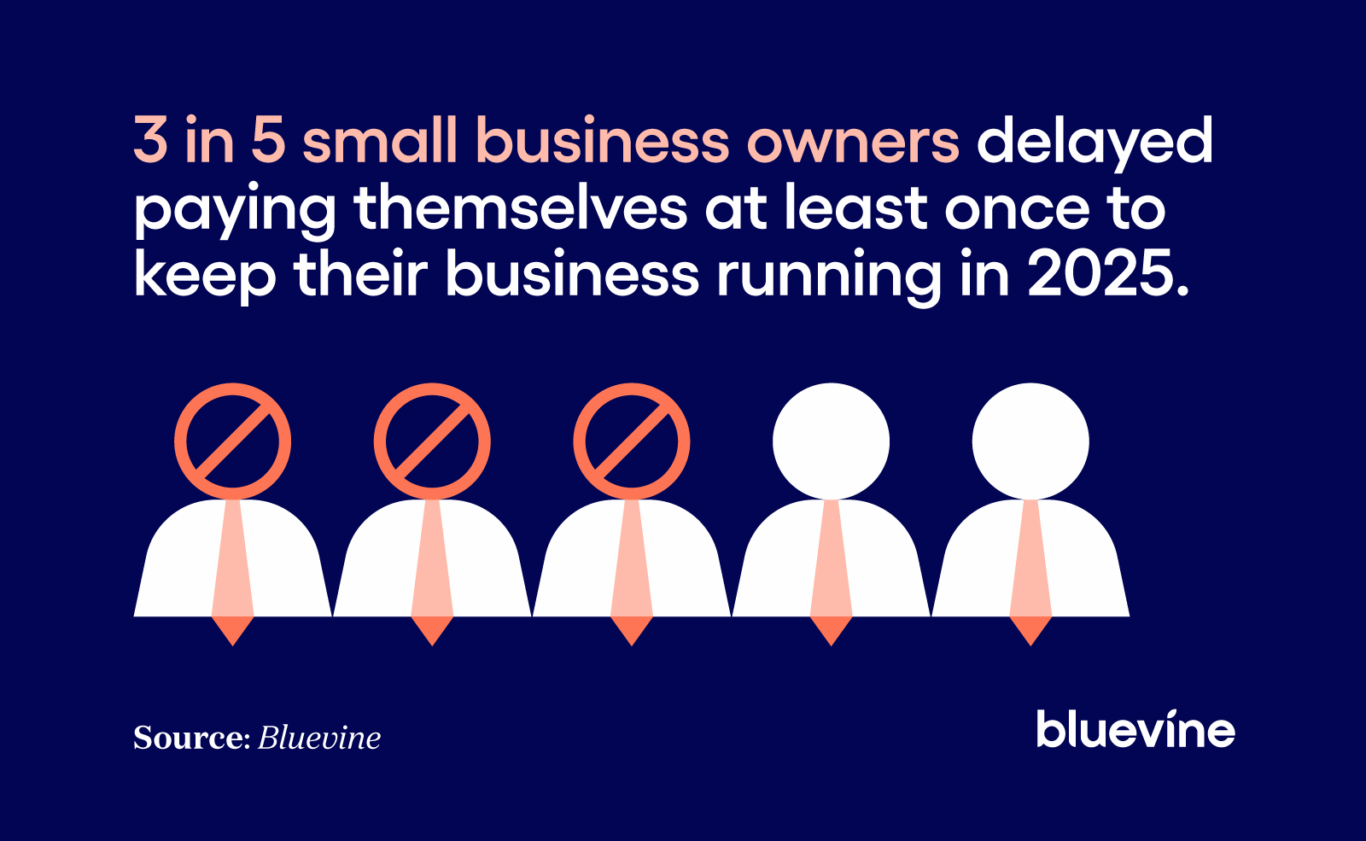
Unfortunately, the sacrifices of leading a small business don’t stop at just personal time or desires. Our survey also showed that 60.3% of small business owners delayed paying themselves in 2025 to keep their business running. Of those:
- 27.9% delayed paying themselves 1-3 times (< once per quarter)
- 18% delayed paying themselves 4-8 times (1-2 times per quarter)
- 7.2% delayed paying themselves 9-11 times (far too often)
- 7.2% delayed paying themselves 12+ times (every month)
You might be asking—why do small business owners endure these difficulties? When asked what best describes their motivation to keep going, 37.8% said financial freedom, while 25% said providing for their family.
Another 15.6% mentioned that they prefer the autonomy and control their path offers, and 10% want to leave an impact and legacy through their work.
Set your business up for success in 2026 and beyond with Bluevine
The data paints a clear picture: Despite major economic challenges, the small business economy thrived in 2025 and is set up with a lot of momentum heading into 2026. Bluevine can help small business owners turn that momentum into breakthroughs and continued success.
Join the thousands of businesses that have signed up for a Bluevine Business Checking account to serve as their financial home base, with no monthly fees for the Standard plan, high APY on checking,BVSUP-00147 and up to $3 million in FDIC insurance.BVSUP-00108 Plus, fuel your growth with a line of credit up to $250,000 or term loans up to $500,000 through our partners.BVSUP-00151
See why Bluevine is the largest small business banking platform in the U.S.BVSUP-00186
Methodology
Centiment Audience conducted this survey of 1,067 company owners, founders, partners, CEOs, presidents, or managing directors of U.S. businesses with annual revenue between $50,000 and $5,000,000 for Bluevine between November 4th and November 10th, 2025. It is paired with internal data measured from more than 200,000 active Bluevine accounts. Survey data is unweighted, and the margin of error is approximately +/-3% for the overall sample with a 95% confidence level.


