Exciting news: Bluevine has agreed to be acquired by Valley National Bancorp, the parent company of Valley Bank. Read the announcement or view Customer FAQs.
Report: AI handles the workload of at least one employee for 53% of small businesses
Traditionally, the thinking behind small-business growth has been fairly straightforward: Growing your business requires bringing on more employees. But according to Bluevine’s new Lean Team Economy Report, that is no longer necessarily the case, as advances in software are allowing small business owners to operate more efficiently than ever before.
Out of more than 700 U.S. small business owners surveyed, 53% say AI or automation tools enable their team to handle the equivalent of at least one extra employee’s workload, without increasing the number of employees on the payroll. Although many (60%) of small business owners continue to hire and develop their existing staff, 40% are actively choosing to keep their team size steady or delay hiring this year.
This report examines how small business owners are getting more done without adding to their headcount. It examines both the personal sacrifices they make and the benefits they believe their decision creates.
Key takeaways
60% of small business owners are actively trying to grow their business, yet 40% have paused hiring or intentionally kept their team small this year.
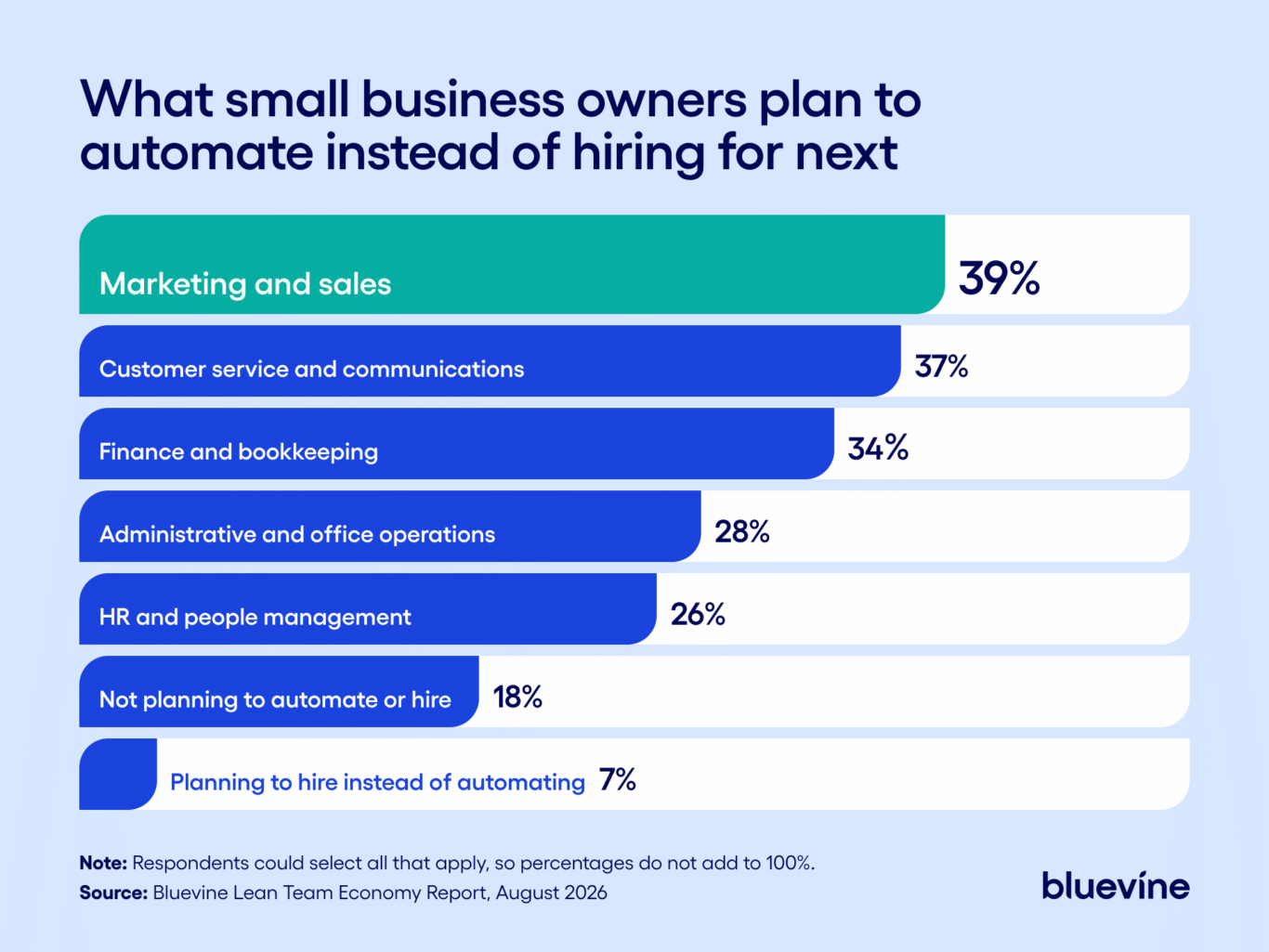
75% plan to hand off a business function to software or AI instead of hiring for it in the next 12 months.
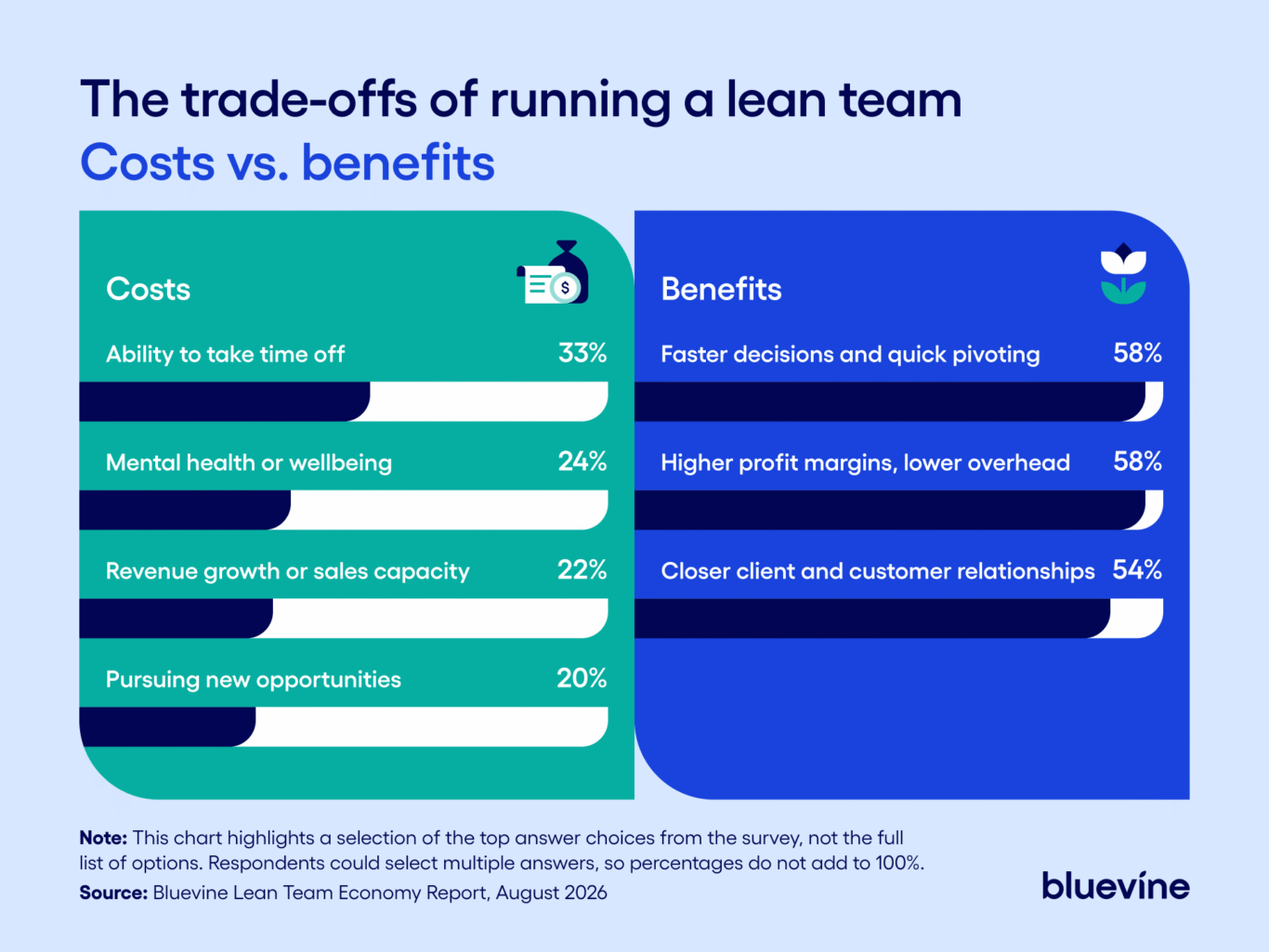
Faster decision-making and lower overhead are tied for the top perceived benefit of running lean, each cited by 58% of owners.
65% say operating with their current team size has cost them something, most often their own time off.
Despite Bluevine user balances increasing by 46% across the last 3 years, the average headcount per Bluevine account has remained flat across more than 160,000 active accounts
Small business owners are growing without adding headcount
Small business owners have traditionally treated growth and hiring as a package deal. When a small business needed more done, the proper answer was to bring on more people. That is still true for many owners, with 60% of those surveyed by Bluevine say they are actively trying to grow this year, while 40% have opted to pause hiring or intentionally keep their team small right now.
But what’s interesting in the findings is that those two options—growing or pausing hiring—no longer necessarily have the directly inverse relationship they used to: Many owners seem to be choosing to stay small on purpose, not just because they have no other options.
Among the owners who stated that they are actively trying to grow and scale their operations, 22% said they had paused hiring plans, and 16% said they purposefully chose to keep their team small. That’s almost two out of five small business owners choosing to slow or stop hiring while trying to grow their business.
This tells us that the tools and software running behind the scenes are handling more of the work in small businesses. Automation is part of a strategy many owners are using to succeed. A flat headcount used to be a sign that a business wasn’t growing, but that assumption no longer holds up as clearly as it used to. For instance, over the last three years–when measured across more than 160,000 active Bluevine customers—average headcount has remained completely flat despite the average balance of those Bluevine accounts growing by 46% in that time period.
AI is already carrying part of the workload
In recent years, automation software has become more of a team member than a simple tool. To illustrate this new reality: 53% of small business owners say that, over the past year, AI or automation tools have already taken on work equal to at least one employee’s workload.
When Bluevine looked closely at owners who have paused, delayed, or avoided hiring, 39% cited “keeping operations simple and lean” as their top reason. That is ahead of both high labor costs (30%) and uncertain revenue (33%).
Only 19% of those same owners pointed to the use of software, automation, or AI tools as their actual reason for holding off on hiring, even though most owners told us that AI is already handling at least one employee’s worth of work. That contrast could be the result of a few different factors.
Some owners may already be leaning on AI without directly linking it to their latest hiring decisions. Others may still be hiring for roles AI can’t touch, such as sales calls or in-person client work. Either way, AI’s part in a hiring decision doesn’t always get named, even when it’s doing plenty of work behind the scenes.
These findings align with the results of Bluevine’s 2026 Small Business AI Trends Report. Nearly half (48%) of small business owners who use AI are already saving at least 4 hours a week. That’s roughly half a workday back every single week, which is time an owner can put back into running the business.
Small business growth used to follow a pretty simple equation: more customers meant more work, and more work meant more people. Technology is changing that equation. AI and automation allow owners to absorb more work without automatically adding headcount, giving them more flexibility in how they grow. But being lean comes with trade-offs too. The real opportunity is giving owners the tools to decide where people add the most value and where technology can take work off their plate.”
– Siddharth Bellur, VP of Product, Bluevine
Owners are betting on software, not more hires, for what comes next
Owners might not always credit AI when explaining a past hiring decision, but they’re far clearer about where they plan to use it next.
Survey data revealed that 75% of small business owners plan to hand off at least one business function to software or AI rather than hiring for it in the next 12 months. Marketing and sales ranked first among the specific functions they want to transition to AI, with 39% planning to automate those responsibilities.
Customer spending tracked through Bluevine’s own banking data backs this up. Bluevine Business Checking customers with an active, verified AI subscription grew 50% between September 2025 and March 2026. And small businesses earning under $500,000 a year were the most active users of these tools, likely because they can shift their workflows quickly without the red tape of legacy systems slowing them down.
Comparing the data by company size reveals a similar result. Among the small business owners Bluevine surveyed, those with 50 to 99 employees are the heaviest users of AI. 82% say that AI already covers at least one employee’s workload, compared with the 53% of the overall respondent pool we noted earlier and just 34% of businesses with 2 to 4 employees.
There are two related reasons why larger operations likely lean on AI so much. They tend to have more repetitive, routine tasks that can be assigned to AI. And this same 50- to 99-employee group reported the highest negative impact due to their team size, so heavier AI use may also be a way they’re compensating for that strain.
This fits into a larger pattern Bluevine has been tracking across small businesses. Bluevine’s AI Trends Report revealed that nearly three-quarters (74%) of owners are currently using or testing AI tools. Owners who start incorporating automation into their day-to-day strategy now may gain a head start before their competitors catch on.
65% feel the cost of running lean, and it spikes for the biggest teams
Opting for a small team isn’t just a “cheap” choice for the people running these businesses. 65% of owners say operating with their current number of employees has caused a negative impact over the past year. Their ability to take time off (33%) was the most common sacrifice, followed by a negative effect on their mental health or wellbeing (24%).
Survey results revealed that the size of the team also changes how much those costs impact owners. The percentage of owners who report adverse impacts fluctuates without a clear pattern among businesses with fewer than 50 employees, ranging from 59% to 68%, then jumps to 80% for businesses with 50 to 99 employees.
Many might assume that owners with the smallest teams struggle the most. Instead, the data shows that larger small businesses feel the most strain with their current team size, particularly once a business grows past 50 employees.
But there are also perks to running a lean small business. 58% of owners said that faster decision-making and the ability to pivot quickly were top advantages of a small, tech-enabled team. And the same share (58%) credited it with lower overhead and higher margins.
These costs and benefits impact a small business on different levels. Owners seem to feel the costs personally, in their time and energy, while the business itself gets faster and leaner. So even a profitable, fast-moving company can still leave its owner feeling stretched thin.
The rise of fractional work is also keeping teams lean
Another element worth noting is the increasing popularity of fractional and consultant work, especially in leadership roles that would otherwise cost small businesses higher-end salaries and equity.
Eric Trettel, Bluevine customer and founder of Sota Bookkeeping, works as a fractional bookkeeper and controller/CFO for other businesses. According to Trettel, his clients also bring in fractional support for everything from marketing and operations to human resources.
“A few years ago, many small businesses [in the Minneapolis area] felt stuck choosing between doing everything themselves or taking on a full-time hire they weren’t ready for. Now, there’s a whole layer of experienced, senior-level talent available part-time or by project, and it’s letting small businesses grow up faster without overextending.”
This rise in fractional CMOs, CFOs, and the like has done more than just help existing small businesses operate—it’s creating new businesses.
“A lot of the people doing this fractional work used to be somebody’s in-house hire before they went out on their own and built a small business out of it—the same way I did with bookkeeping,” says Trettel. “So it feeds itself: small businesses are being built specifically to serve other small businesses. Every person who goes fractional is one more small business, and one more reason the next small business doesn’t have to hire full-time before it’s ready. I think that loop only gets bigger from here.”
A lean team deserves a financial partner that keeps up
Hiring more people is no longer required to grow your small business. But running a lean business can come with increased demands on everyone on the team, not just the owner. Adopting reliable tools and planning for those challenges can help cut the risk of burnout for small business owners and their employees.
Find out more about how Bluevine can help your small business thrive.
See why 1 million+ small businesses have chosen Bluevine.
The survey was conducted by Centiment for Bluevine. It was fielded between June 25, 2026, and June 30, 2026. The results are based on 729 completed surveys. To qualify, respondents had to be residents of the United States, over 18 years of age, and owners of a small business.
Data are unweighted, and the margin of error is approximately +/-4% for the overall sample at the 95% confidence level.
Disclaimer
This content is for educational purposes only and should not be construed as professional advice of any type, such as financial, legal, tax, or accounting advice. This content does not necessarily state or reflect the views of Bluevine or its partners. Please consult with an expert if you need specific advice for your business. For information about Bluevine products and services, please visit the Bluevine FAQ page.
Get answers in a snap, right from your dashboard during business hours.
Disclaimer
This content is for educational purposes only and should not be construed as professional advice of any type, such as financial, legal, tax, or accounting advice. This content does not necessarily state or reflect the views of Bluevine or its partners. Please consult with an expert if you need specific advice for your business. For information about Bluevine products and services, please visit the Bluevine FAQ page.
Subscribe to our monthly email newsletter.
Be the first to hear about Bluevine’s latest tips, insights, and product offerings.
Bluevine is a financial technology company, not a bank. Banking services provided by Coastal Community Bank, Member FDIC. Not all features available in all countries. Limitations apply. See international features for details.