
Small business owners often can feel like they’re running close to the edge. And Bluevine’s 2026 survey of 760 small business owners on cash flow management showed that feeling may be justified: the typical cash buffer dropped from a month in 2025 to two weeks this year.
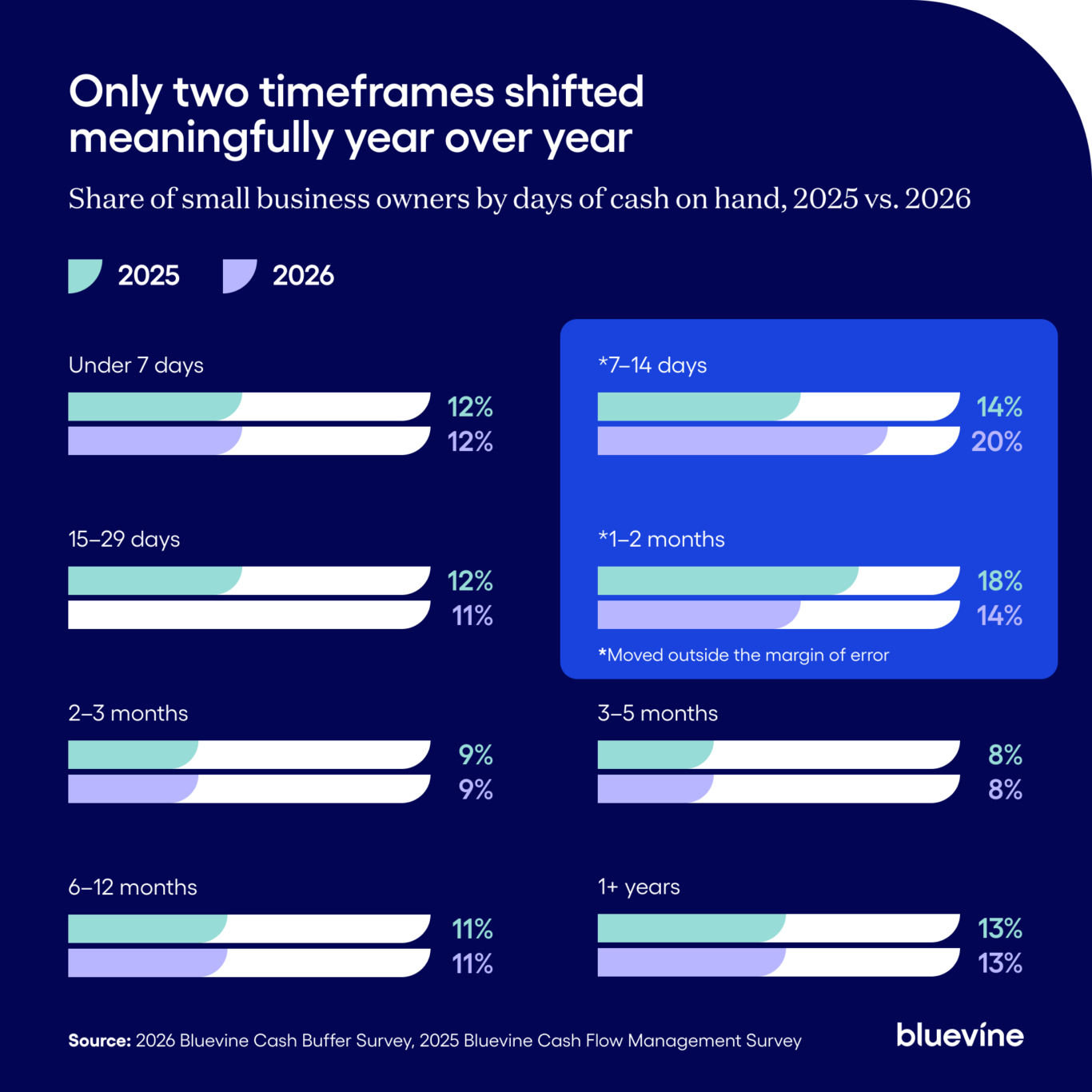
Compared to Bluevine’s 2025 Cash Flow Management Survey, the most common cash position last year was one to two months, reported by 18% of owners. This year, the most common position has dropped to only one to two weeks, reported by 20%.
Owners are covering the difference themselves: more than four in ten delayed their own pay this year, rising past half among the thinnest-cushion group. Rising fuel and materials costs are adding to that pressure, hardest on construction and trades.
And most owners still call themselves confident, even the most exposed ones, despite having few forecasting tools to back that confidence up. That mismatch between confidence and visibility is what this report actually measures.
Key takeaways
- The most notable year-over-year shift: the share of owners with a 1–2 month buffer fell from 18% to 14%, while the share with just 1–2 weeks grew from 14% to 20%.
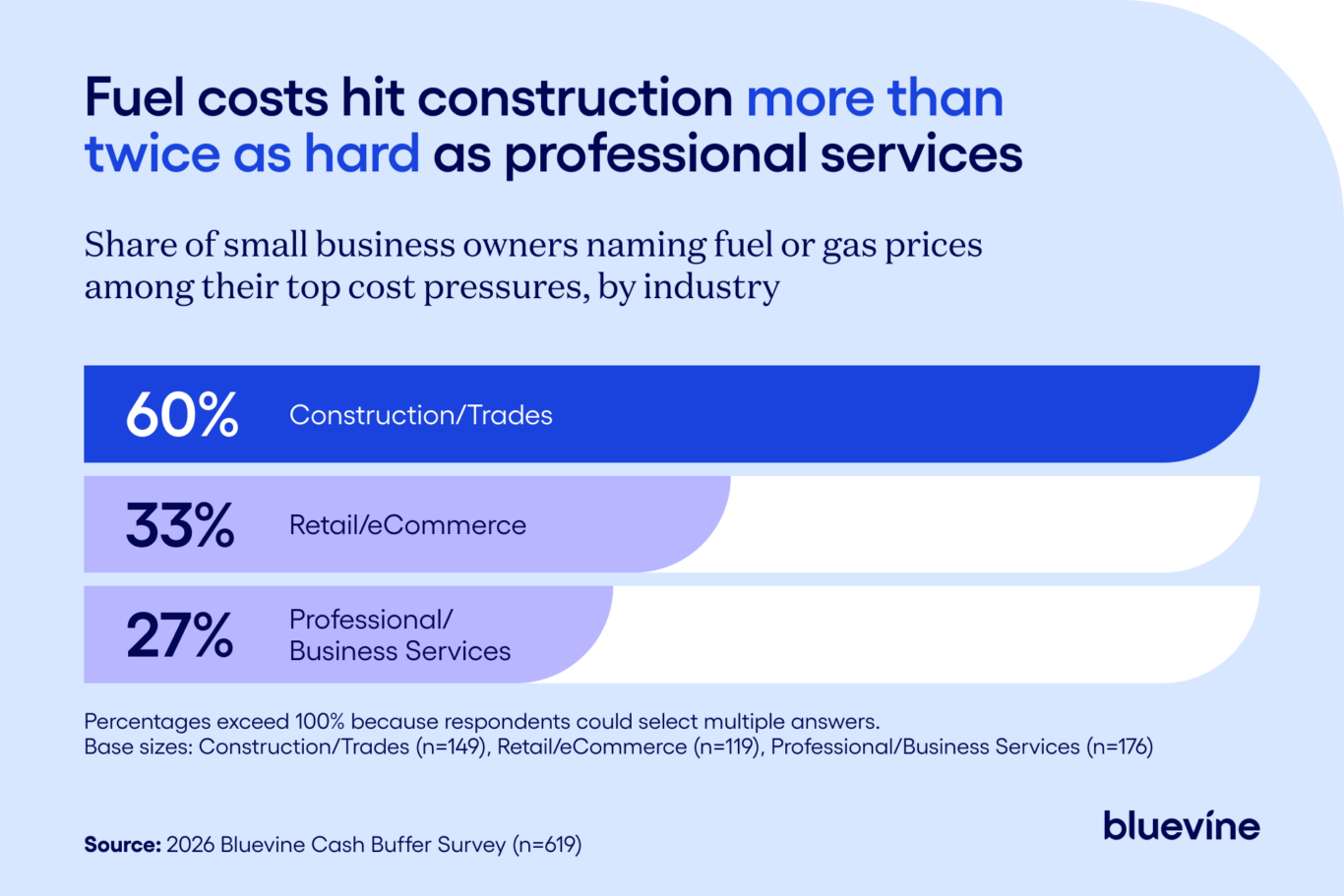
- Construction and trades businesses are the hardest hit, facing both the steepest fuel costs (60% vs. 27% for professional services) and the highest rate of any industry with a reportable sample size (36% vs. 28% overall).
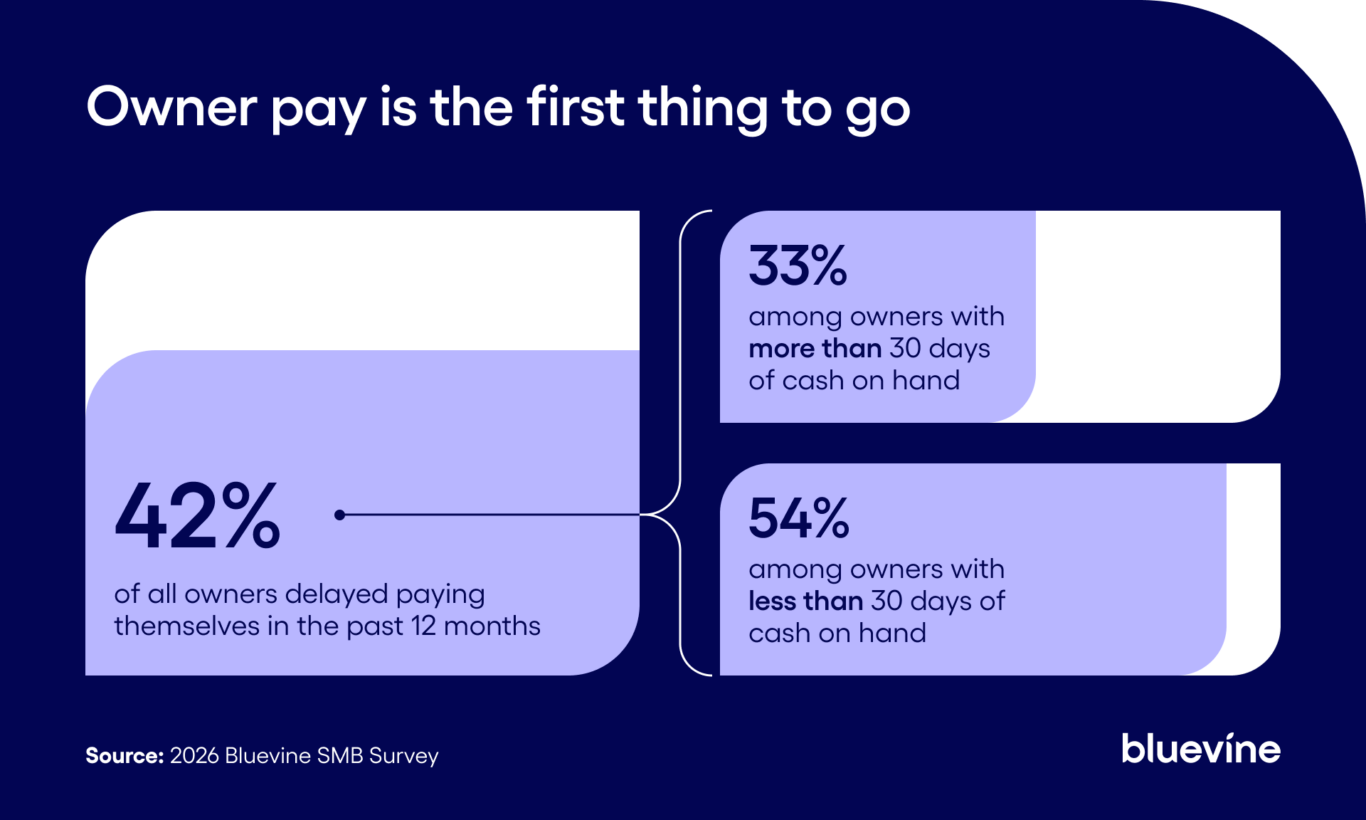
- 42% of small business owners delayed paying themselves in the past 12 months to keep the business running, and 17% did it more than three times.
- Confidence in predicting cash flow drops significantly among owners with buffers of less than 30 days (75% vs. 86%).

Buffers shrank from a month to two weeks
Cash on hand is the clearest sign of how much room an owner actually has, and this year, that shrank. Forty-three percent of small business owners now have less than a month of cash on hand for operating expenses, up from 39% last year.
The shift shows up when you look at which band owners actually fall into. The share of the group with 7–14 days of cash on hand for operating expenses rose nearly 50% from 14% of total respondents in 2025 to 20% in 2026, while the share with 1–2 months fell from 18% to 14%. Every other band held roughly steady. These two are the only real movements in the data this year.
The group facing the most severe cash flow issues didn’t grow. Owners with less than 7 days of cash held flat at 12% in both years, and 57% of all owners still have more than a month of buffer. The real movement is in the middle: The group that used to have a month of breathing room now reports having closer to two weeks.
A thinner buffer also means less room to absorb a surprise. Fifty-eight percent of SMBs said the largest shortfall they could cover without new financing is under $50,000, essentially unchanged from 2025.
Some of that pressure is hitting every business the same way. Some of it is landing hardest on one industry in particular: construction and trades.
Construction and trades are getting squeezed from two directions
Materials and fuel are both at the top of the list of rising costs with the biggest impact on cash flow, each named by 39% of owners. For most small businesses, there’s a variety of expenses driving costs up.
Fuel is the sector where construction is hit hardest of all industries surveyed. Construction and trades businesses cited rising fuel costs at 60%, more than double the rate among professional and business services firms (27%). This is the largest group we surveyed among industries with the lowest fuel costs, making it a solid comparison point.
That split tracks with how these businesses actually operate. A contractor running a truck fleet feels every price move at the pump. A consultant working from a laptop doesn’t.
Bluevine’s internal spend data backs this up. Construction businesses show unusually concentrated spending in categories like automated fuel dispensers, lumber, and plumbing supplies, which aligns with what owners report feeling.
But fuel costs are only half of it. Construction gets hit on the invoice side too, and timing is the issue there. Late payments from customers were named among the top cash flow strains by 36% of construction and trades respondents, the highest rate of any industry with a reportable sample size, against 28% overall.
Construction businesses also end up exposed on both ends of the transaction: they invoice and wait to get paid, carrying that timing risk directly, while also running the vehicles and equipment that make fuel costs unavoidable. This causes both pressures to land on the same balance sheet in the same week.

Did you know?
According to Bluevine’s Payment Gap Report, nearly 3 in 10 small business owners have delayed paying themselves because customers paid late, and 17% have missed or nearly missed payroll as a result.
That kind of exposure isn’t limited to one industry or cause. Across all owners, inventory or supply purchases topped the strain list (34%), followed by late customer payments (28%) and payroll (24%). Three more categories showed up as meaningful pressures: taxes (27%), utilities (24%), and interest rates or loan costs (14%), named on their own as real pressures.
Despite all this, most owners are still finding ways to absorb pressure themselves, and for many, that starts with what they’re willing to give up first: their own paycheck.
Note: Manufacturing, Transportation/Logistics, and Technology/SaaS were surveyed, but are excluded from industry-level cuts. Each has a sample size under 30 respondents, which produces margins of error too wide to report reliably.
Owner pay is still where the cuts land first
When cash flow tightens this many ways at once, something has to give, and for most owners, it’s their own paycheck. Forty-two percent of SMBs delayed paying themselves in the past 12 months because of cash flow. That’s not a one-off for most of them, either: 17% did it more than three times in a year, suggesting a recurring issue rather than a single bad month.
The pattern gets sharper when the owner has less buffer. Among those with less than a month of cash on hand, 54% delayed their own pay, compared to 33% of owners with more runway. If you include owners who seriously considered delaying their pay but held off, 71% were affected by this pressure in some form.
It’s not just what already happened, either. Asked what they’d cut first in a cash crunch, 44% still named owner pay, more than double the next most common answer of marketing and ad spend (19%), and consistent with last year’s findings (41%). Two years running, owner pay is the first instinct, not a one-time reaction.
SMBs have also turned to using their own money, with 45% saying they used personal funds to bridge business cash flow in the past year, close to 2025’s 47%. Separating business and personal finances makes it easier to see whether the business itself has a buffer.
That kind of sacrifice isn’t limited to cash flow. Bluevine’s 2026 Business Owner Success Survey found that more than three-quarters of owners gave something up last year to keep their business running, and this year’s data shows that pattern sharpening around a second source: credit.
47% of owners now rely on credit to operate, not to grow
Credit is now doing work it wasn’t designed for.
Among the 47% of owners who currently have a line of credit or loan for operating expenses, half used it to cover routine day-to-day operating expenses or a cash flow shortfall, against only 26% who used it for planned growth or expansion. Credit has become a way to smooth out timing rather than fund growth.
That’s a strong case for choosing a line of credit over a credit card, which owners often reach for first. A revolving line typically carries a lower interest rate and is built around business cash flow rather than personal credit limits.
A business line of credit is also a different tool from a term loan: a line sits unused until it’s needed, while a term loan puts the full amount on the books from day one.
Owners without credit aren’t all staying away by choice. 31% said they don’t need a line of credit or loan right now, and 24% don’t want more debt. The remaining 27% ran into an actual obstacle: they were turned down, unsure where to start, or they never got around to applying. For that group, access is the problem.
And access to credit isn’t the only thing running thin—the information owners are working from is, too.
What's the difference between a term loan and line of credit?
A term loan is a lump sum form of financing that you typically repay over a set term at a fixed rate.
A line of credit is a revolving line you can draw from as needed, usually with a variable rate for each individual draw. With a business line of credit, you only repay for what you draw.
Owners are confident, but what’s backing it up is thin
Given everything above, owners with the thinnest buffers would expect to feel exposed. But they mostly don’t, at least not by their own account.
Three in four owners with less than a month of cash still call themselves confident in predicting their cash flow 30 to 90 days out, compared with 86% of owners with more buffer. Confidence does drop as cash gets tighter, but many of the most exposed owners still feel in control.
The tools behind that confidence are thin
Forty-five percent of owners used manual tracking through spreadsheets or notebooks, running about even with accounting software (44%). For a meaningful share of owners, that likely means both at once.
Running both creates friction: context switching between two systems and manually copying numbers between them, which is exactly where small transcription errors creep into a business’s actual cash position.
A joint Bluevine and Xero survey on financial visibility found that half of small business owners spend four or more hours every month just categorizing expenses, and 43% spend that much time reconciling information across banking, accounting, and payment systems.
And forecasting is the exception rather than the norm: only 20% use cash flow forecasting software, and that figure barely moves among owners with less than a month of cash (22%). So the owners who’d benefit most from warning aren’t any more likely to have it.
The same Bluevine and Xero survey backs this up. Owners with real-time access to their cash position were far more likely to feel confident making financial decisions (94%) than owners who only see an accurate picture weekly (72%). Visibility, more than cash position itself, tracks with how confident owners feel.
Reserve accounts don’t close that shortfall on their own either. Twenty-eight percent of owners with less than a month of cash keep a dedicated savings or reserve account, essentially the same share as owners with more buffer. But having the account isn’t the same as having the visibility to use it well.
Owners are pulling back
Owners are also more protective of the reserves they do have. The share of respondents who move money out of emergency funds to cover payroll within the next two days fell from 51% to 35%. The share saying none of the listed triggers would prompt them to touch emergency funds rose from 12% to 18%.
That same caution shows up around AI. Interest in using AI tools for cash flow management fell from 68% to 53%, while opposition rose from 13% to 21%.
Bluevine’s customer data points the other way on AI overall, though. The AI-adopting customer base grew 50% between September 2025 and March 2026, and 1 in 10 active customers now use at least one AI tool. Yet Finance, Healthcare, Legal, and HR categories show only moderate adoption, with usage mostly under 10 transactions per month. Owners are adopting AI quickly everywhere except their own books. They keep saying they’re fine, but the tools underneath them tell a thinner story, and better information is what actually helps.
Closing visibility issues are what owners can control
Owners aren’t short on discipline: They’ve cut their own pay and guarded reserves harder than last year to keep things running. What they need is a warning, and unlike the buffer itself, that part is fixable.
Only 1 in 5 owners use a cash flow forecasting tool, and that barely changes even among owners with the least room for error. Most can’t see a shortfall coming. Knowing what’s owed against what’s coming in makes the difference.
A Bluevine Business Checking account with no hidden fees brings sub-accounts, accounts receivable, and bill pay together in one place, giving owners a way to keep reserves separate from operating cash and see what’s coming in versus what’s going out.
Business banking, easier done than said.
Methodology
The survey was conducted by Centiment for Bluevine. The survey was fielded between August 3, 2026, and August 5, 2026. The results are based on 760 completed surveys. To qualify, respondents were screened to be residents of the United States, 18 years of age or older, and small business owners. Year-over-year comparisons reference Bluevine’s 2025 Cash Flow Management survey, which was fielded to 774 respondents using the same core questions and screening criteria. Data is unweighted, and the margin of error is approximately +/-3% for the overall sample with a 95% confidence level.