

Responding to our Business Owner Success Survey, only 30% of small business owners reported finishing 2025 with profitability above expectations (down from 57% at the end of 2024), and 63% planned to seek more capital by early 2026—up from just 38% one year before.1 Despite these sentiments, around three-quarters (78%) of respondents felt optimistic about their profitability forecasts for 2026.1
Since we conducted that survey, optimistic consumer sentiment has continued to shrink amid rising prices and political and technological uncertainty. Those trends were present in 2025, but did not abate holiday spending—one forecast projects as much as 6.7% YoY growth for the 2026 holidays.2 How do we reconcile consumers’ economic bearishness with continued holiday spending growth? The answer is multifaceted and complex, and the data deliver mixed signals regarding the role of three forces that have shaped this decade’s economy: the rise of Generation Z as a customer base, the impact of price increases on spending, and the role of generative AI as a marketing channel.
These are the main subjects of our third annual holiday trend guide, Bluevine’s definitive marketing and sales guide to your 2026 holiday season. This year, we analyzed over a dozen reports and forecasts, and below present data-supported insights and strategic challenges to help you tackle the months ahead.
Key insights
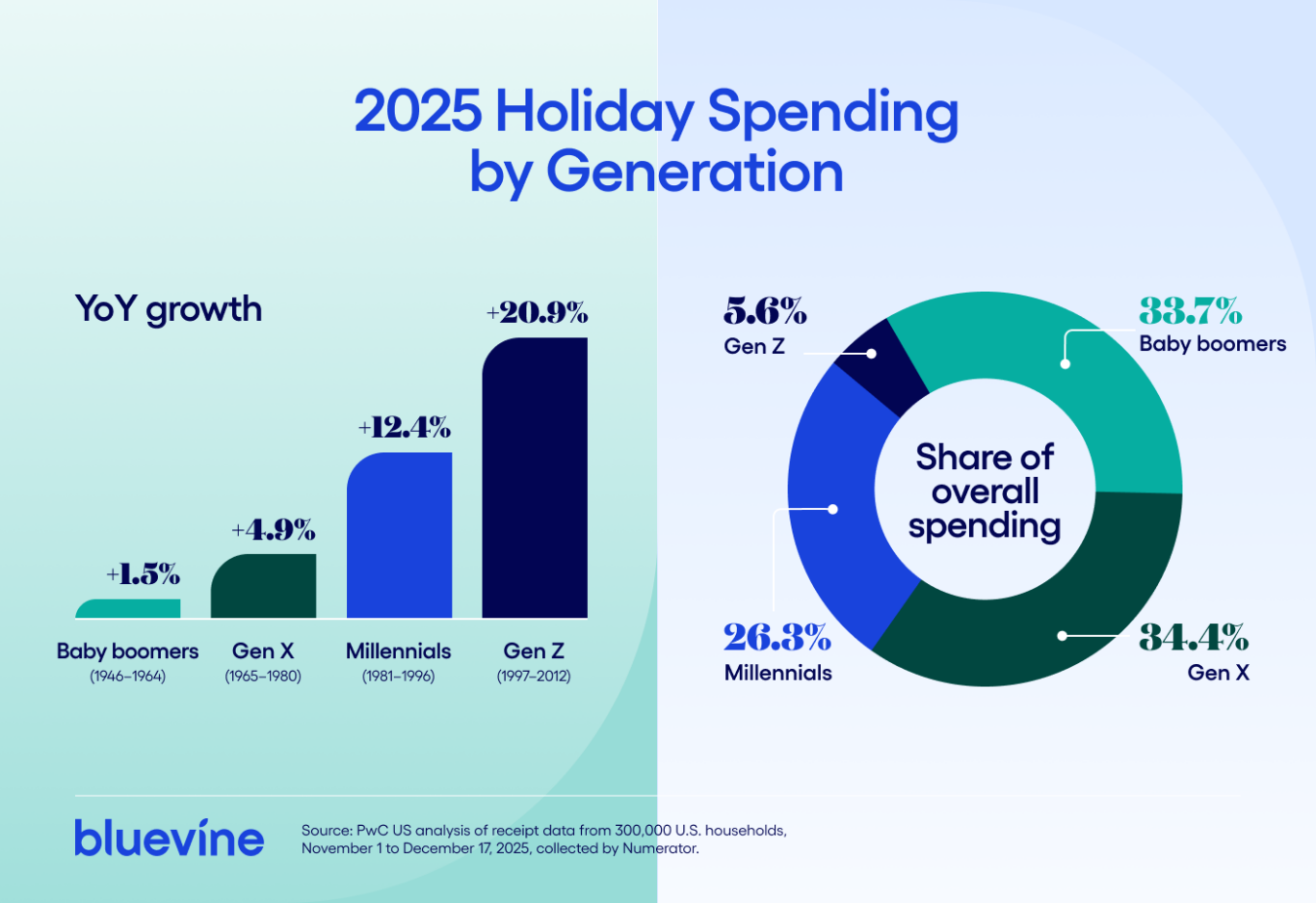
- Gen Z holiday spending grew 20.9% in 2025, making it the fastest-growing generation, but it accounted for just 5.6% of total holiday spending.
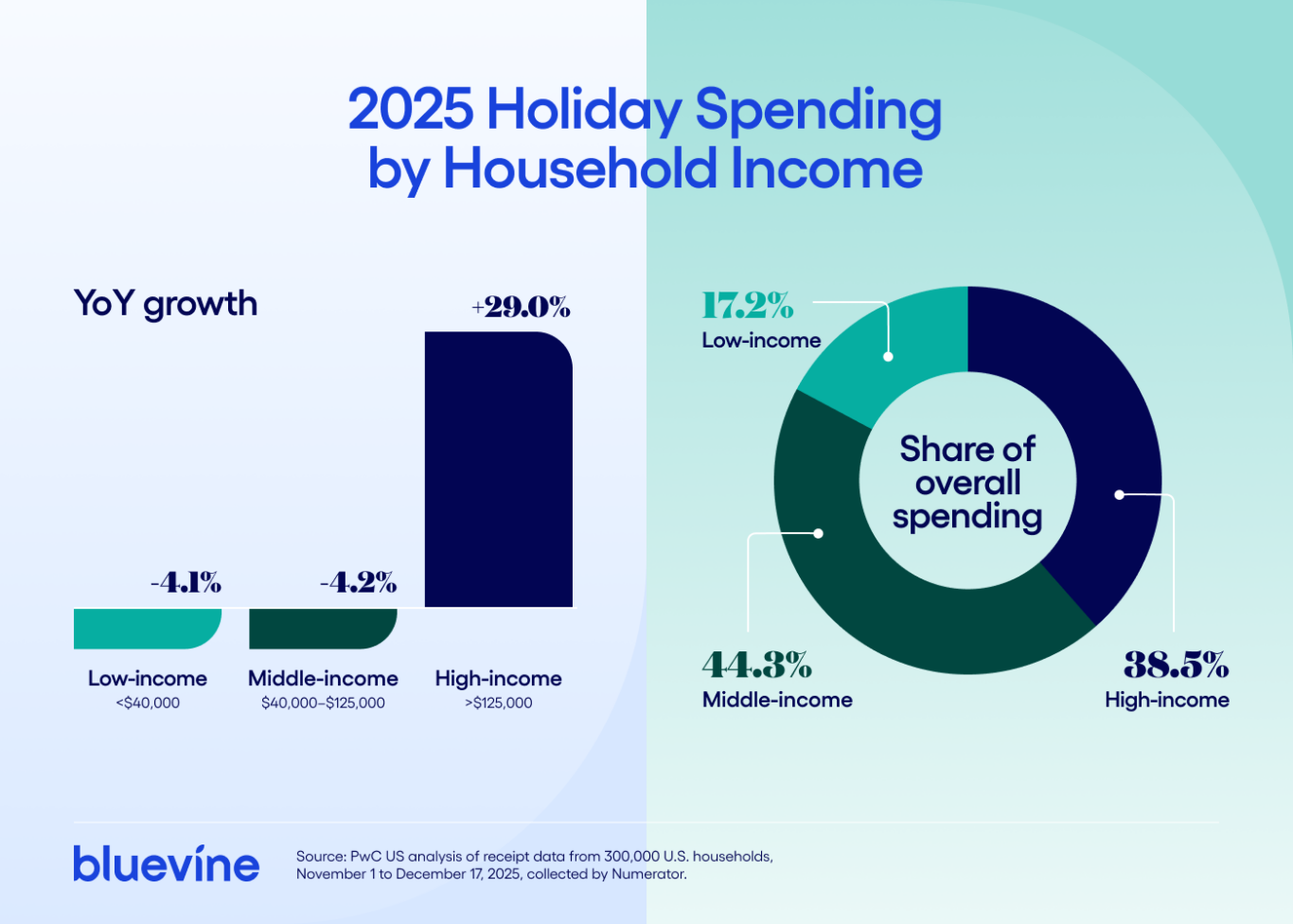
- High-income households are driving holiday spending growth, while middle- and lower-income consumers remain more constrained by rising costs.
- Generative AI is an emerging (but not dominant) holiday marketing channel. Optimize for GEO with consistent product information, clear pricing, structured content, and credible customer reviews.
- Plan holiday marketing across the full Q4 season. Early shopping takes off in October, Cyber Week drives peak sales, and post-Christmas demand brings returns and gift card redemptions.
- Balance competitive pricing with perceived product quality. Consumers prioritize price and quality, while aggressive increases and dynamic pricing can undermine trust.

3 trends that continue to define consumer spending in 2026
Generation Z is now mostly adults, whose YoY spending grew almost 21%
Generation Z refers to the cohort of people born from 1997–2012, now teenagers and young adults 13–29 years old. Despite a majority of Gen Zers having planned to spend the same or less,3 Gen Z as a whole spent 20.9% more during the 2025 holidays than 2024.4 This makes Gen Z by far the fastest growing generational segment, but they still represent a small share of overall holiday spending at just 5.6%.4 As expected, Gen Z planned to and did spend comparatively more on products related to their transition to adulthood, as well as on self-gifting.3,4 This includes comparatively high spending on apparel, jewelry, and self-care.3,5
High-income households drive growth, overall recovery remains elusive
The Consumer Price Index rose 2.7% from December 2024 to December 2025,6 while the median household pre-tax income increased 2.6% during the same interval.7 Holiday spending, meanwhile, grew at least 4.0%.8 We’ll break down the exact growth metrics in our calendar section, but first let’s consider why and how holiday spending outgrew both inflation and median income in 2025.
Average selling prices rose 7% YoY,9 meaning shoppers spent an average of 7% more per item purchased. Given that the CPI only rose 2.7%, this indicates that, in addition to prices increasing across the board, consumers opted for still more expensive gifts. This latter theory may be the effect of another finding: during the 2025 holidays, households earning more than $125,000 accounted for 38.5% of spending, a seven-point (29%) increase from 2024—the report on this finding goes so far as to claim that these high-income households drove “nearly all growth” for the season.4 Middle-income households—the largest group by population and defined as earning $40,000–$125,000—maintained the highest amount of holiday spending, but their overall share declined by 4.2%.4 Low-income households saw a similar decline.
One survey found that high-income shoppers were more likely than low-income shoppers to claim they’ve adopted cost-cutting behaviors such as DIYing gifts and using budgeting tools.5 That high-income shoppers are adopting such behaviors indicates that wariness about the economy is not limited by income. Surveys report that 38–55% of all U.S. shoppers anticipate a higher holiday shopping budget this year, while 30–38% expect to spend about the same as last year.10,11 These higher budgets probably reflect an expectation of higher costs: survey data from August 2026 show consumer optimistic confidence in the U.S. economy is down seven points compared to August 2025, while mixed and pessimistic sentiment have increased three and four points, respectively.3

HOLIDAY 2025: BUY NOW PAY LATER SURPASSES $20 BILLION
One factor that may skew our holiday spending analysis of middle- and low-income households is the high growth in Buy Now, Pay Later (BNPL) purchases, which rose 9.8% YoY to exceed $20 billion in November–December 2025.9,13 (Cyber Monday 2025 became the first single day to see over $1 billion in BNPL sales.9) For 2026, BNPL spending is forecast to grow another 6.6% YoY, to $21.3 billion.13
AI sees massive growth that can compliment your other digital channels
During the 2025 holiday season, traffic to retail sites from shoppers clicking links in responses from genAI language models increased a whopping 693.4% YoY.12 Based on their data, Salesforce estimates that AI agents drove 20% of all holiday retail sales.8 Since then, AI-driven traffic has continued to grow, with 127% YoY growth in August 2026, and 130% YoY growth forecast for November and December.13
While growth trends are stark, exact usage statistics remain unclear, at least at first glance. Surveys vary widely, reporting that roughly 17%9 to 23%14 of shoppers use AI to buy holiday gifts, while up to 72%10 used AI tools specifically for shopping ideas or gift recommendations. However, planned usage for the 2026 holidays ranges from just 17%14 up to 46%.3 Optimove found that, in the abstract, 44% of high-income shoppers trust AI-generated recommendations more than other product research sources, and 31% trust it the same.10 But when McKinsey & Company directly surveyed trust in different sources, genAI responses were rated the second least trustworthy by Gen Z, and third-least by Baby Boomers.5
A clue to this discrepancy lies in one consistent finding: The highest reported planned use cases for genAI are product comparisons, deal-hunting, and gift ideation.3,14 It may be that many users of language models don’t trust their results directly, instead using AI to consolidate information and relying on links to more trusted sources (such as online storefronts and brand websites)5 to legitimize results. Whether this counts as shopping via AI depends on how a survey question is posed, and how the respondent conceives of the transaction. This conception may be further confused as search engines and social media platforms implement AI-enabled summaries and chatbots, blurring the distinction between channels.
With this understanding, online retailers, search engines, and social media still far outpace genAI in surveys of gift inspiration and purchasing channels,14,15 but language models appear to deliver more high-intent shoppers5—shoppers linked to a retail site from an AI response converted nine times more often than those arriving from social media links.8 The introduction of purchases made by AI agents on behalf of shoppers may increase the share of purchases made directly via genAI platforms,5 but these tools are very new and the data do not yet exist.
We’ll cover how to manage your small business presence in genAI responses in the strategies section below.
IN 2026, SOCIAL COMMERCE IS A GROWING NICHE
While social media ranks more highly than AI as a holiday shopping tool,14 direct social commerce is still a niche, with only 19% of shoppers reporting they are somewhat likely to buy gifts directly through a social media app this year, a 72.7% increase from 2025.15
The holiday calendar: Consumer spending in 2025 and predictions for 2026
Total retail sales (excluding gas and auto) rose 4.53% YoY in November 2025, and 3.54% YoY in December 2025.16 Total online holiday spending grew at least 4.0% according to Salesforce data8 or as much as 6.8% according to Adobe Digital Insights—a slower growth rate than 2024, but faster than 2023 or 2022.9 The record-breaking sum total of 2025 e-commerce holiday spending was between $257.8 billion9 and $294 billion8 and Adobe predicts another 6.7% YoY growth for the 2026 holidays.2
In 2025, holiday mobile spending grew to $145.2 billion (+10.7% YoY), and accounted for 56.4% of all online transactions for the season.9
Here’s everything the data tell us about holiday spending in 2025, and what to expect in 2026.
October and early November: Early shoppers
McKinsey & Company reported that 45% (+1 pp) of shoppers planned to start holiday shopping before Halloween this year.3 Optimove reported that 66% (+2 pp) of high-income shoppers planned to do so.10 These data points signal one of this decade’s defining holiday shopping trends: Consumers are spreading holiday purchases across all of Q4 (or even H2) instead of waiting for Black Friday—in fact, 54% of shoppers agreed that it isn’t essential to shop during Cyber Week, as deals are available throughout the season.14 (While we recommend small business owners conceive of the holiday season as October–December, note that when we report on 2025 spending statistics, our sources all use the conventional November–December window.)
This may seem to place small and medium enterprises in a bind: Overdiscounting or overmarketing across all of Q4 poses a bigger financial risk than it does to large companies. But the same Optimove report found that 63% of high-income households planned to wait for Cyber Week to begin shopping.10 Since this was a survey of intent, the authors interpreted this discrepancy to mean their respondents’ shopping habits are flexible.10
The average discount levels internet-wide spike to more than 10% during Amazon Prime Big Deal Days9—which fell on October 6–7 this year—but normalize afterward until the week preceding Cyber Week. Amazon is a juggernaut among consumers: 81% of holiday shoppers reported Amazon as a preferred retail site—the number one choice by ten percentage points.10 When asked what would entice them to shop earlier than normal, 78% of U.S. shoppers reported discounts and 67% reported availability of desired items.10 If you’re an Amazon seller, you can capture early shoppers by discounting items for Prime Big Deal Days. If you’re not a seller, consider offering equivalent sales through your own website or storefront. After Prime Big Deal Days, shoppers won’t expect large discounts until just before Cyber Week, but strategically discounting beforehand could give you a competitive advantage.
As for your marketing, 59% of shoppers report already being tired of holiday messages by October,10 but this only tells us about sentiment toward “holiday messages” in the abstract. You can avoid inducing marketing fatigue by evolving your campaign with the season, which we cover in the strategies section below.
Cyber Week: Peak sales
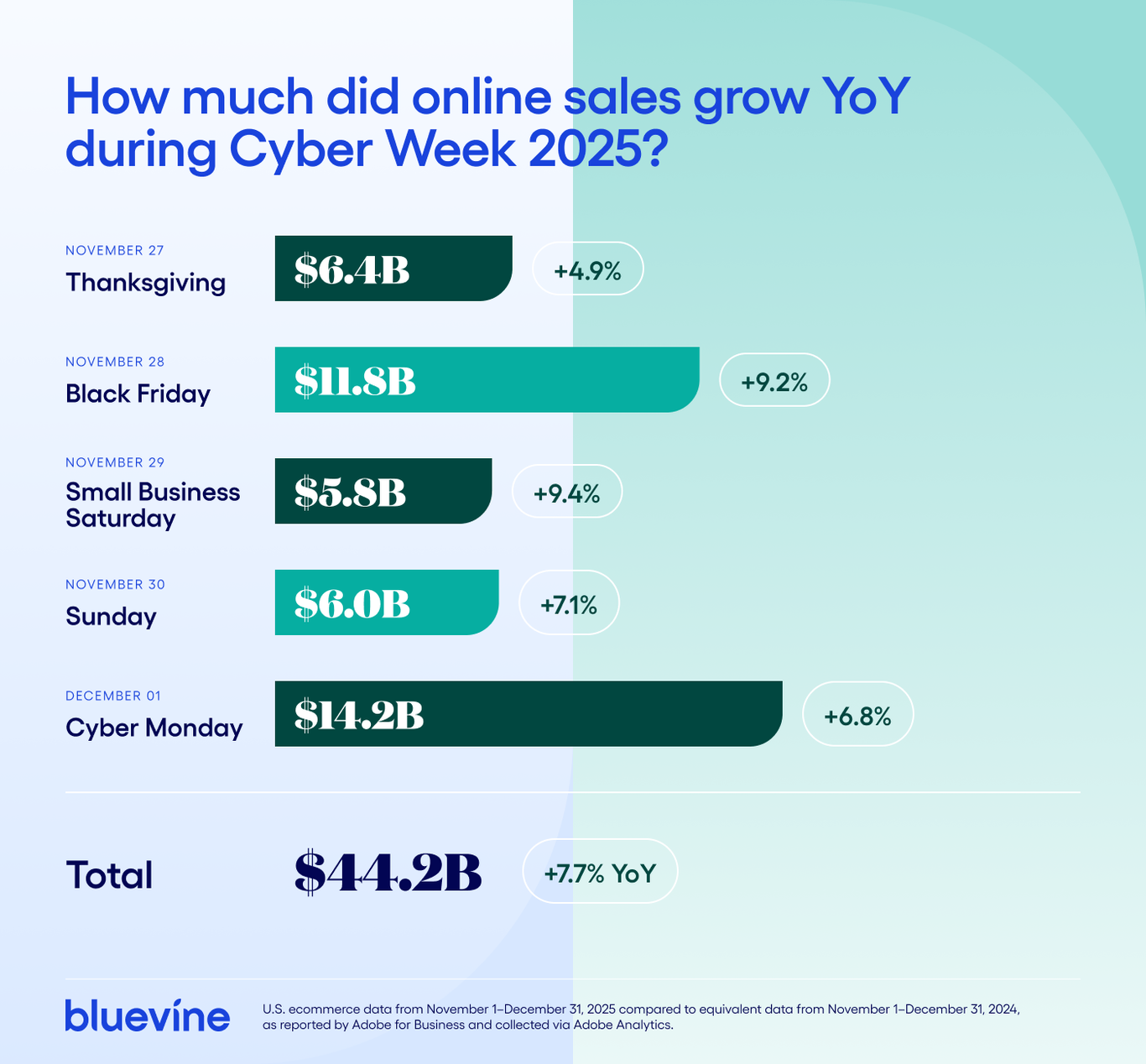
While consumers may be holiday shopping earlier and for longer, spending remains highly concentrated around Cyber Week, which once again broke records in 2025 by offering by far the highest average online discount levels, peaking at almost 25%.9
According to Adobe Digital Insights, during Cyber Week 2025, spending grew 7.7% YoY, and totaled $44.2B, or 17.1% of the season’s $257.8 billion.9 Cyber Monday remained the highest spending day, but Small Business Saturday saw the highest YoY growth at 9.4%.9
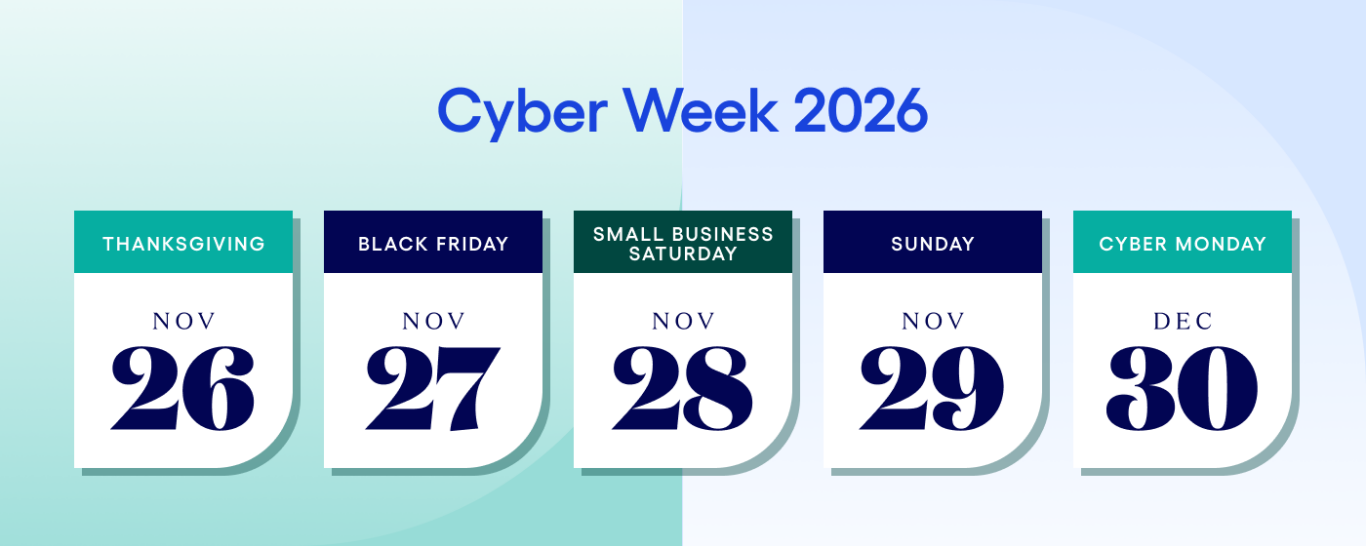
Thanksgiving is expected to be this year’s strongest day for mobile shopping in 2026, with 11% projected YoY growth.13
December and Christmas week: Last-minute shoppers
After Cyber Week, sales tend to stabilize in December before ramping up again starting the Friday before Christmas (December 18). Daily average discounts follow a slightly different trajectory: They slowly descend from Cyber Week highs, stabilizing in the 5–10% range before actually lowering more in the days before Christmas.9 After all, last-minute shoppers pursue deals with far less fervor than early shoppers.
Buy Online Pickup In-Store (BOPIS) has declined steadily since its high in 2020, but still 17.1% of all holiday orders were made using BOPIS in 2025.9 BOPIS ordering peaked on December 22, at 35% of all online orders.8 Curbside pickup peaked the following day, December 23, at 39.0% of orders.9
Christmas and the New Year: Returns and gift card redemptions
Adobe Digital Insights reported that online returns fell 1.2% YoY in November and December 2025, but increased 4.7% YoY for the span December 26–31.9 Salesforce, conversely, estimated that 14% of all online purchases made in November and December 2025 had been returned by January 8, 2026, a 10% increase YoY, and that the items most likely to be returned in January were in-store purchases from December 21–24.8 While these numbers tell different stories, both reports suggest that, although sales are spread out across the season and concentrated during Cyber Week, returns remain reliably back loaded to the after-Christmas period.
SHOPPERS PURCHASE ON MOBILE, RETURN ON DESKTOP
During the 2025 holiday season, 56.4% of online spending was made using a mobile device, compared to only 38.8% of returns.9 Overall, consumers prefer shopping on mobile, but make returns on the computer.
Just as last year, out of every product category, shoppers plan to spend the most on gift cards. Gift cards ranked first among baby boomers and Gen X, third among Millennials, and tied for first among Gen Z.3
3 strategic questions to consider this 2026 holiday season
1. Which marketing channel is more important in 2026: GEO, SEO, or social?
While consumers still broadly trust and prefer to use social media over AI to shop, but both channels will remain important in the years ahead. In fact, your GEO, SEO, and social strategies should work synergistically: As discussed above, AI language models are a strong conversion tool that deliver users near the end of the customer journey. Search engines will likely continue to lose eminence, but won’t become irrelevant—AI models are more likely to surface your brand if you have a strong web and social presence. Social media, meanwhile, natively meets customers at both ends of the journey (discovery and conversion), and may also drive more in-store conversions, which don’t appear in the e-commerce sales data.
Generative engine optimization (GEO)
When asked what percentage of their holiday gift purchases are planned versus discovered, 43% reported a rough 50-50 split, while 39% reported that at least 75% of their gifts were planned in advance.14 These customers may use genAI tools to pre-catalog options for them to browse. Therefore, the goal of your AI strategy is to relieve shoppers who’ve decided what type of item they want and wish to make a final decision.
You can increase your chances of being cited by AI algorithms by making product information easy for AI tools to replicate, and prices consistent across platforms.3 Your brand will fare better if you have a strong, consistent presence across both branded (website, social media) and third-party sources (forums, customer reviews).
McKinsey & Company identified several best practices for establishing a small business GEO strategy:5
- Structured, scannable content such as bulleted features, product FAQs, or comparison tables. Ensure that your brand voice and information are consistent across channels.
- Original insights and product information, such as technical documents, instructions, and original research.
- Third-party validation, such as customer comments, reviews, or endorsement in product/gift guides. Maintaining strong public relations with review sites and a brand presence in relevant forums can help you reinforce your business in a way language models can process.
Search engine optimization (SEO) and web
When we read that the revenue share of “natural search” (as opposed to paid search) is expected to shrink by 5% in 2026,13 it suggests that SEO is losing relevance. In addition, when considering just the top ten sources cited by ChatGPT, Gemini, and Perplexity from October 2025–May 2026, business websites accounted for just 3–10% of citations.5
However, while your business website may not be a discovery touchpoint, it will remain a powerful brand signal and a convenient place for providing and corroborating information to customers and AI language models. If you already have a business website, your existing SEO provides a useful foundation for your GEO.
Social media
Social shoppers use social media to both browse gift ideas and make purchases. Like AI shoppers, they emphasize brand reputation and product quality, and place a premium on unbiased customer reviews. The number one reason shoppers used social media was to verify product quality (46%). Related to that end, high-quality product photography and video (47%), ads for in-store promotions (46%) and user-generated content (39%) drove the highest percentages of social shoppers in-store,15 so make sure positive customer reviews are visible within your branded materials during the holidays.
In addition, publish product information that’s consistent with what’s on your website, and allow user comments, tags, and other interactions to bolster your brand for AI algorithms.
2. How to maintain a season-long holiday marketing campaign
To successfully cover all of Q4, your small business holiday campaign must evolve throughout the different phases above, which can be further divided as follows (dates for 2026):
- October 1–11: Early autumn. The early campaign should focus on gift discovery and availability,8 and smaller, more strategic discounts may entice early shoppers. Embrace the changing seasons in your marketing.
- October 12–31: Halloween. If appropriate, a campaign based on the aesthetics and traditions of the Halloween season will feel timely and stave off holiday messaging fatigue.
- November 1–19: Late autumn. You might implement targeted or limited sales during this period to convert customers who are otherwise waiting for Cyber Week deals. Make all necessary preparations for Cyber Week—such as hiring, inventory, and promotions—during this period.3
- November 20–30: Thanksgiving and Cyber Week. This week brings the highest sales of the season, and on average the highest discounts. In our 2024 holiday trend guide, we found that shoppers prefer store-wide sales, especially those of 30% or more. Depending on what you sell, you may choose to lean into messaging around Thanksgiving, Small Business Saturday, and/or Cyber Monday. Costs tend to spike during this period, but conversions spike even more.17
- December 1–17: Winter approaches. Shift seasonal messaging toward the colder, darker months. Embrace communal values in your marketing and encourage customers to prepare for Christmas. If appropriate, you might implement messaging around other December holidays (such as this year’s early Hanukkah) as well.
- December 18–25: Christmas. To improve last-minute conversions, update your messaging toward urgency around shipping deadlines, BOPIS options, and last-minute shoppers.17
- December 26–January 10: Post-Christmas and New Year. The price of digital ads falls in January, but conversions remain elevated.17 You’ll be processing the most returns and fulfilling orders made via gift cards, making this an important period for building brand loyalty via good service. New Year messaging might encourage resolutions or renewal in 2027.
When planning your seasonal campaign, remember that the season’s holidays mainly center around gift-giving and family ties. U.S. shoppers place high value on quality time (85%), remembrance (61%), and tradition (61%), and parents even more so.14 When asked how they planned to split their holiday shopping this year, 67% of shoppers responded they were spending “mostly for family,” and 24% “equally among family and friends.”10 If executed well, campaigns that leverage the purpose of gift-giving can help subvert holiday messaging fatigue, and gift guides, collections, and in-store recommendations can help customers solve gift ideation fatigue.10
3. Will higher prices hurt your holiday sales?
If you’ve had to raise selling prices to stay afloat this year, then you may be wondering how to approach discounting throughout the long holiday season. We already covered how average discounts fluctuate over the course of Q4 in the calendar section above, so you can remain competitive during peak discounts (Prime Big Deal Days and Cyber Week through mid-December), but how do we expect customers will respond to YoY price increases?
In one survey, when asked what drives purchasing decisions, shoppers reported price (54%) and quality (53%) as by far their top movers.15 Quality (81%) and price (70%) topped a similar survey of only high-income households.10 When those households were asked what influences them to try a new brand, the top answers again were quality (85%) and price (80%).10
What’s significant about price and quality is that they are relative. While it remains wise to align your price increases and discounts with quantitative priorities—such as volume, revenue, or margin18—don’t overprioritize metrics either. Your customers’ feelings about your product quality are what determine its acceptable price and discounting—raising prices on an item that is perceived to be of quality will not necessarily turn away shoppers, and raising the perceived quality of an item is a good way to temper the disappointment of price increases.
Not all price increases trigger the same response, either, and we have data to suggest what thresholds start driving customers away from discretionary buying. According to a report from the consulting firm, Simon-Kucher:18
- 5% increases see limited spending change.
- 10% increases begin turning customers away.
- 20% increases can drive away up to 30% of customers.
Keep in mind that these thresholds are not uniform across the generational and income cohorts we discussed in the trends section above. Because the majority of spending is driven by older and middle-to-high-income households, raising your prices may inadvertently drive away your Generation Z and low-income customers while still raising overall revenue. (You can account for this by tracking both customer and financial metrics.)
Credit delinquency has climbed steadily across the board since 2020, but is climbing fastest among Generation Z and low-income ZIP codes.4 Certain types of payment flexibility, like Buy Now Pay Later (BNPL) can help provide short-term relief to these customers.13 However, another type that consumers resoundingly dislike is dynamic pricing: 59% of shoppers think it is equivalent to price gouging, and 78% believe a product’s price ought to be the same no matter who buys it. Only one-third (33%) of respondents believed dynamic pricing could allow them to get deals.19

To read more about the research cited above, check out our sources below.
Sources
- “The 2026 Edition BOSS Report” – As part of Bluevine’s (that’s us!) ongoing Business Owner Success Survey™ (BOSS), market research firm Centiment Audience surveyed 1,067 owners and leaders of U.S. businesses with annual revenue between $50,000 and $5,000,000 from November 4 to November 10, 2025.
- “U.S. Holiday Shopping Season to Hit Record $275.1 Billion Online, Rising 6.7% YoY” – Adobe for Business, a division of software company Adobe, forecast spending for the 2026 holiday shopping season (November 1–December 31 2026), based on data collected from their Adobe Analytics platform from January 2019–August 2026. This is their first press release on the subject.
- “An update on US consumer sentiment: Holiday budgeting begins” – Management consulting firm McKinsey & Company conduct their ConsumerWise Global Sentiment Data research survey each quarter. The most recent survey was issued to 4,013 U.S. shoppers in August 2026.
- “What holiday 2025 spending reveals about the year ahead” – The U.S. branch of professional services network PwC analyzed receipt data from 300,000 U.S. households from November 1 to December 17, 2025 consumer insights company, Numerator.
- “State of the Consumer 2026: When tech acceleration and cost pressures collide” – The 2026 State of the Consumer Survey by McKinsey & Company surveyed 4,863 shoppers from five countries (Brazil, France, Germany, the U.K., and the U.S.) from March 31 to April 8, 2026.
- “Consumer Price Index: 2025 in review” – Official report from the U.S. Bureau of Labor Statistics, a federal agency that collects data about the U.S. economy.
- “Income in the United States: 2025” – Official report from the U.S. Census Bureau, a federal agency that (among other responsibilities) conducts demographic studies.
- “Holiday Season Rakes in Record $1.29T for Retailers, Salesforce Data Shows” – CRM platform provider Salesforce analyzed proprietary and third-party data collected from November 1–December 31 on the online shopping activity of over 1.5 billion global shoppers, with a focus on key markets including the United States.
- “Report: 2025 Holiday Shopping Recap” – Adobe for Business analyzed data from over 1 trillion visits to U.S. retail websites from November 1–December 31, 2025, as collected by their Adobe Analytics platform.
- “Holiday Shopping Report 2026” – Optimove Insights, the research arm of marketing technology provider Optimove, surveyed 648 U.S. adults with household incomes of $75,000 or more on their shopping habits and plans.
- “Inside the 2026 Holiday Shopper: Spending, Priorities & Purchase Drivers” – Market research firm, CivicScience released the latest results of two ongoing holiday shopping sentiment surveys. The first survey includes responses from 33,209 U.S. shoppers from July 6, 2021 through August 11, 2026, the second responses from 187,465 U.S. shoppers from August 6, 2021 through August 11, 2026.
- “Adobe: Holiday Shopping Season Drove a Record $257.8 Billion Online with Consumers Embracing Generative AI Tools” – A press release from Adobe for Business, announcing total 2025 holiday season spending as collected from their Adobe Analytics platform from November 1–December 31, 2025.
- “2026 Holiday Shopping Trends: Forecast” – Adobe for Business’s official holiday spending forecast report, based on data collected from their Adobe Analytics platform from January 2019–August 2026.
- “2026 Winter Holidays Shopping Trends” – Basis Technologies, a digital advertising software company, surveyed 2,006 nationally representative U.S. shoppers on how they shopped for and celebrated the 2025 holidays and their plans for the 2026 holidays.
- “What 14,473 holiday shoppers told us about how the world shops.” – Technology company Meta commissioned a survey by market research and consulting firm Ipsos of 14,473 global holiday shoppers (1,674 were based in North America) from November 5–19, 2025. Meta reported the results along with insights from their own platform data. Meta owns Facebook, Instagram, and WhatsApp,
- “CNBC/NRF Retail Monitor December 2025” – Business news network CNBC, retail trade association the National Retail Federation, and market research company Affinity Solutions collaborate on the monthly Retail Monitor, a measure of retail sales based on debit and credit cards sales data. This report is ongoing, and the December 2025 edition is no longer available via the NRF website. See the latest here.
- “2026 Meta Holiday Playbook: Small Business Edition” – Meta published several holiday “playbooks” based on insights gathered from their research collaboration with Ipsos, including this one aimed at small business owners. You can download each playbook here.
- “US consumer affordability in 2026: Insights from our tariffs and price increase pulse study” – Global management consulting firm Simon-Kucher released the results of their 2025 U.S. Consumer Tariff Survey, which they issued monthly from February–December 2025 to 5,054 respondents.
- “People are not fans of dynamic pricing” – Ipsos released these results from their Ipsos Consumer Tracker, a survey of 1,290 U.S. adults’ sentiments toward dynamic pricing.