
Top 9 Ramp Alternatives Worth Exploring in 2026


More than 50,000 finance teams use Ramp to manage corporate expenses, and for good reason. This SaaS expense management software combines corporate cards with expense tracking, invoice processing, bill pay, and vendor insights into a streamlined spend management system. For incorporated businesses with consistent cash flow, it offers a powerful way to streamline spending, automate accounting, and close the books faster.
That said, Ramp is not the right fit for every business. Sole proprietors and unincorporated businesses are excluded entirely, as Ramp requires applicants to be a corporation, LLC, or limited partnership with at least $25,000 in a U.S. bank account. The platform operates as a charge card, meaning balances must be paid in full each month, which can strain businesses with variable cash flow. And because Ramp is a spend management tool rather than a full banking platform, it does not offer business checking accounts, savings products, or lending options like lines of credit.
Whether you need a more inclusive banking platform, interest-earning accounts, or access to business financing, alternatives like Bluevine, Brex, Mercury, and BILL (Divvy) offer different strengths. Below, we break down nine cloud-based providers from full-service banking platforms to spend-focused tools, so you can find the best Ramp alternatives for your business. You can also explore our broader comparison of Bluevine competitors for additional context.
Highlights
- Ramp is a spend management platform, not a bank. It does not offer business checking accounts, savings products, or interest on deposits, so businesses looking for a complete banking solution will need to pair Ramp with a separate bank.
- Sole proprietors and freelancers cannot use Ramp. The platform requires incorporation (C-Corp, LLC, or LP) and at least $25,000 in a U.S. business bank account, which excludes many small business owners.
- Where Ramp stops at spend management, Bluevine picks up with a full banking platform: high-APY checking1, cash deposits at 90,000+ locations2, and access to a line of credit up to $250,000, so businesses don’t need to juggle a separate bank3.
- The best alternative depends on your priorities: full-service banking, high-yield deposits, spend controls, international payments, or access to financing. This guide breaks down nine options to help you decide.
Why Consider an Alternative to Ramp?
Ramp excels at what it was built to do: automate expense management, enforce spending policies, and give finance teams real-time spend visibility into corporate card transactions. Its AI-powered receipt capture with OCR, automatic categorization, and vendor price intelligence features are widely praised, and the free tier includes more functionality than many competitors charge for. For incorporated businesses with predictable cash flow and a dedicated finance function, Ramp can be highly effective.
However, that narrow focus on spend management comes with trade-offs that matter once you consider the full picture of what a business needs financially. While Ramp can reduce manual work around expense reports and optimize day-to-day spending, here are some common reasons companies explore alternatives:
- No banking or deposit products. Ramp does not offer business checking accounts, savings accounts, or interest on idle cash. While it integrates with popular accounting software and accounting systems, businesses that want to earn yield on deposits or consolidate banking and spend management on one platform will need to look elsewhere.
- Excluded business structures. Sole proprietors, freelancers, and unincorporated businesses are not eligible for Ramp. Companies must be organized as a corporation, LLC, or limited partnership with at least $25,000 in a U.S. bank account, which eliminates a significant portion of small businesses.
- No lending or credit products. Ramp does not offer lines of credit, term loans, or other financing options. Businesses that need access to working capital alongside their spend management tools will need a separate lending relationship.
- Charge card limitations. As a charge card, Ramp requires full monthly balance payments. While its spending limits and out-of-policy controls are effective, and Ramp Flex offers short-term bill financing, the platform lacks the revolving credit flexibility that some businesses need to manage uneven cash flow cycles.
Ramp vs. Competitors Overview
1. Bluevine
Best for: Small businesses that want high-yield checking, lending access, and cash deposit capabilities in one platform
Ramp vs. Bluevine: While Ramp focuses exclusively on spend management, Bluevine combines interest-earning business checking, a line of credit, and cash deposit access on a single platform, making it a more complete financial home for small businesses.
Bluevine is an all-in-one banking platform built for small and medium-sized businesses. Unlike Ramp, which requires a separate bank account, Bluevine provides business checking that earns up to 3.0% APY4 with FDIC insurance up to $3 million through Coastal Community Bank, Member FDIC and partner banks5. The platform is open to a wide range of business structures, including sole proprietorships, making it accessible to the many business owners that Ramp excludes. You can learn more about opening a bank account for your LLC on the Bluevine blog.
Bluevine goes beyond basic checking with integrated financial tools. Businesses can accept payments through payment links powered by Stripe6, deposit cash at over 90,000 locations through the Allpoint+ and Green Dot networks2, and organize funds across up to 50 sub-accounts with an upgraded plan. For businesses that need capital, line of credit customers can access approved draws instantly in their Bluevine Business Checking account7 with a line of credit up to $250,000. Bluevine also offers term loans up to $500,000 through lending partners.
Bluevine holds a 4.6 out of 5 rating (Excellent) on Trustpilot.8 Users frequently praise the application process, the ability to earn interest on everyday balances, and responsive customer support. Some users note that the mobile app could benefit from additional features, but overall sentiment is positive.
Key features:
- Up to 3.0% APY on business checking balances4
- FDIC insurance up to $3 million through Coastal Community Bank, Member FDIC and partner banks5
- Integrated invoicing and bill pay with payment links powered by Stripe6
- Up to 50 sub-accounts with an upgraded plan for organizing business funds
- Access to apply for a Bluevine Line of Credit up to $250,0003
Pricing:
- Standard: Free, with 1.3% APY on balances up to $250,000 (activity requirements apply)
- Plus: $30/month, or $0/month if you meet fee waiver requirements9 (1.75% APY)
- Premier: $95/month, or $0/month if you meet fee waiver requirements10 (3.0% APY)4
See all plans and pricing on the Bluevine website.
2. Brex
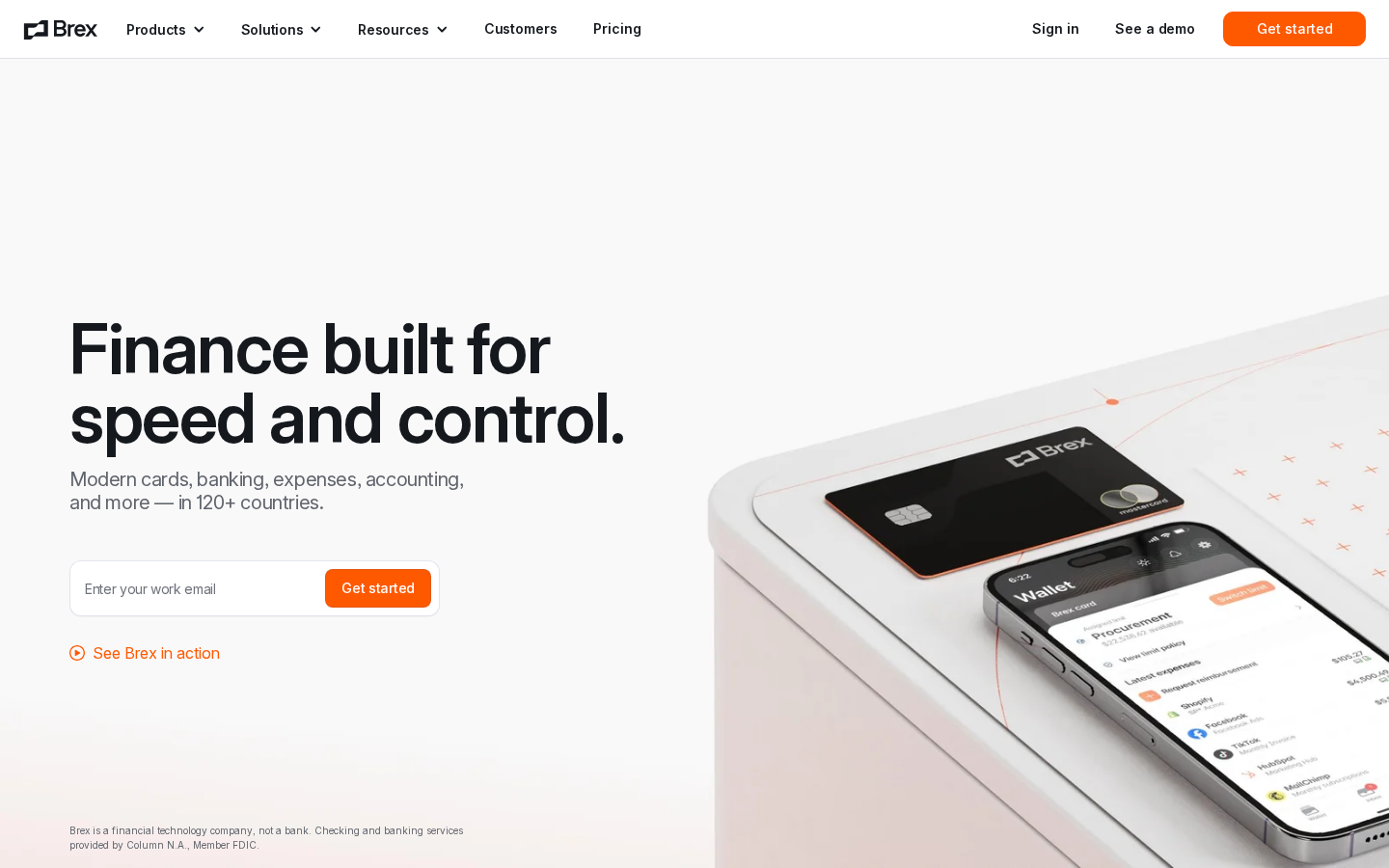
Best for: Venture-backed startups needing high credit limits and global payments
Ramp vs. Brex: Brex offers both corporate cards and business banking with treasury yield, giving startups a single platform for spend management and cash storage that Ramp cannot match on its own.
Brex combines corporate cards, expense management, and business banking in one platform. Originally built for VC-backed startups, it underwrites based on company cash balance rather than personal credit, offering credit limits up to 20 times higher than traditional cards. The Brex treasury account lets businesses earn yield on idle cash with same-hour liquidity, and FDIC coverage extends up to $6 million through partner banks.
Brex supports global payments in over 60 currencies and offers 24/7 customer support. It is worth noting that Capital One announced a $5.15 billion acquisition of Brex in January 2026, which may affect future product direction. Like Ramp, Brex does not support sole proprietors, and there is no cash deposit option. On G2, users consistently praise the platform’s user-friendly interface and ease of use alongside its high credit limits, though some note that the rewards program was recently devalued.
Key features:
- Up to 20x higher credit limits with no personal guarantee
- Business banking with treasury yield and FDIC coverage up to $6M
- Global payments in 60+ currencies with no wire fees
Pricing: Free (Essentials); $12/user/month (Premium); Custom (Enterprise)
3. Mercury
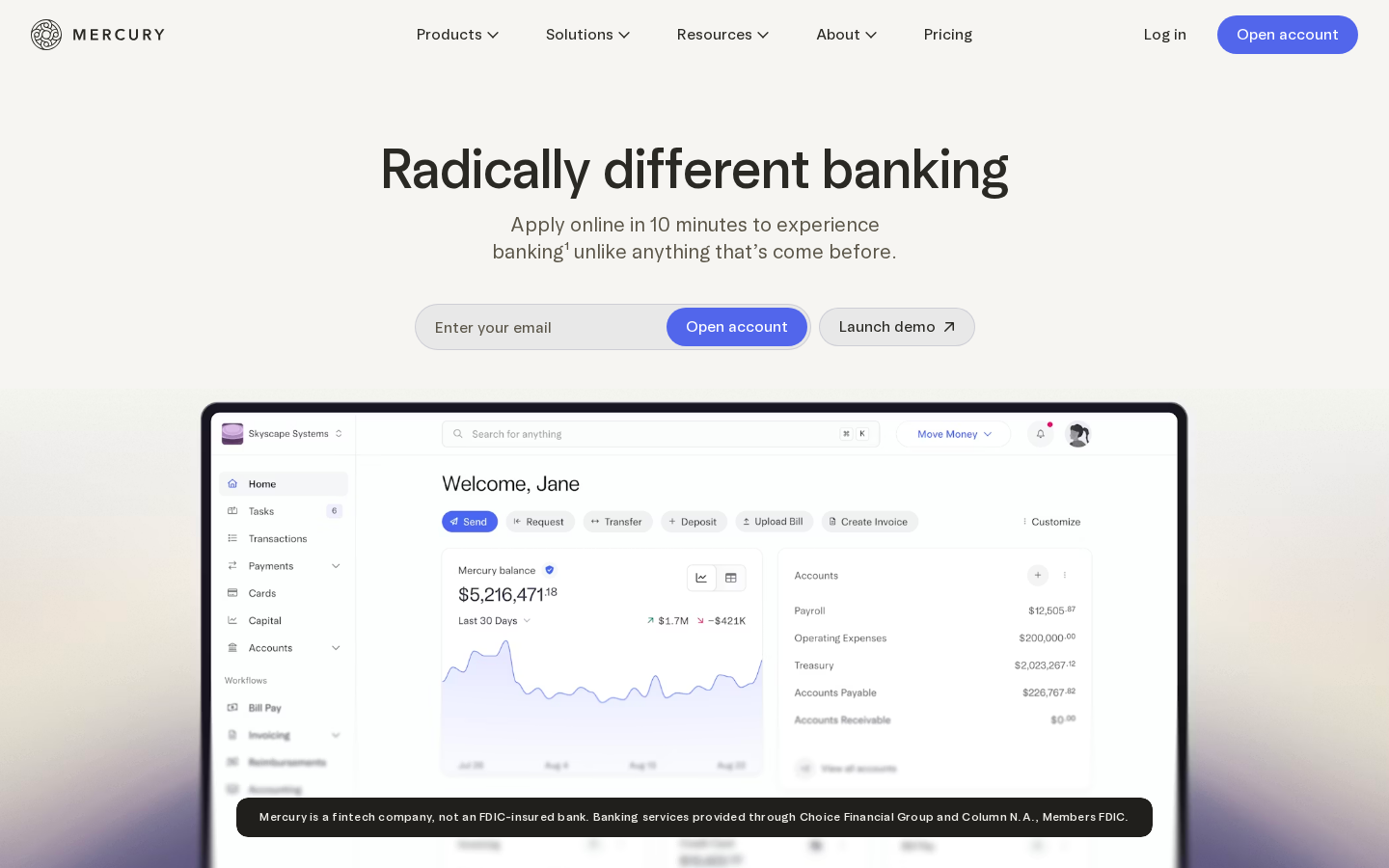
Best for: Tech startups that want a developer-friendly, fee-free banking experience
Ramp vs. Mercury: Mercury provides full business banking with free domestic wires and API access for custom workflows, filling the banking gap that Ramp leaves open.
Mercury has positioned itself as the go-to bank for Y Combinator alumni and early-stage tech teams. It offers free business checking and savings accounts with no monthly fees, no minimum balance, and free domestic wire transfers. FDIC insurance extends up to $5 million through partner banks Choice Financial Group and Column N.A. Mercury also provides venture debt for qualifying startups and a treasury product for balances over $250,000.
The platform stands out for its read-write API access, which allows developers to build custom dashboards, automate payments, and create internal financial tools. Mercury does not support cash deposits or offer a physical branch network. On Trustpilot, users praise the clean interface and free wires, though some note delays with check deposits.
Key features:
- FDIC insurance up to $5 million through partner banks
- Free domestic and international USD wire transfers
- Full read-write API access for custom automation
Pricing: Free (basic); Plus $35/month; Pro $350/month
4. BILL (Divvy)
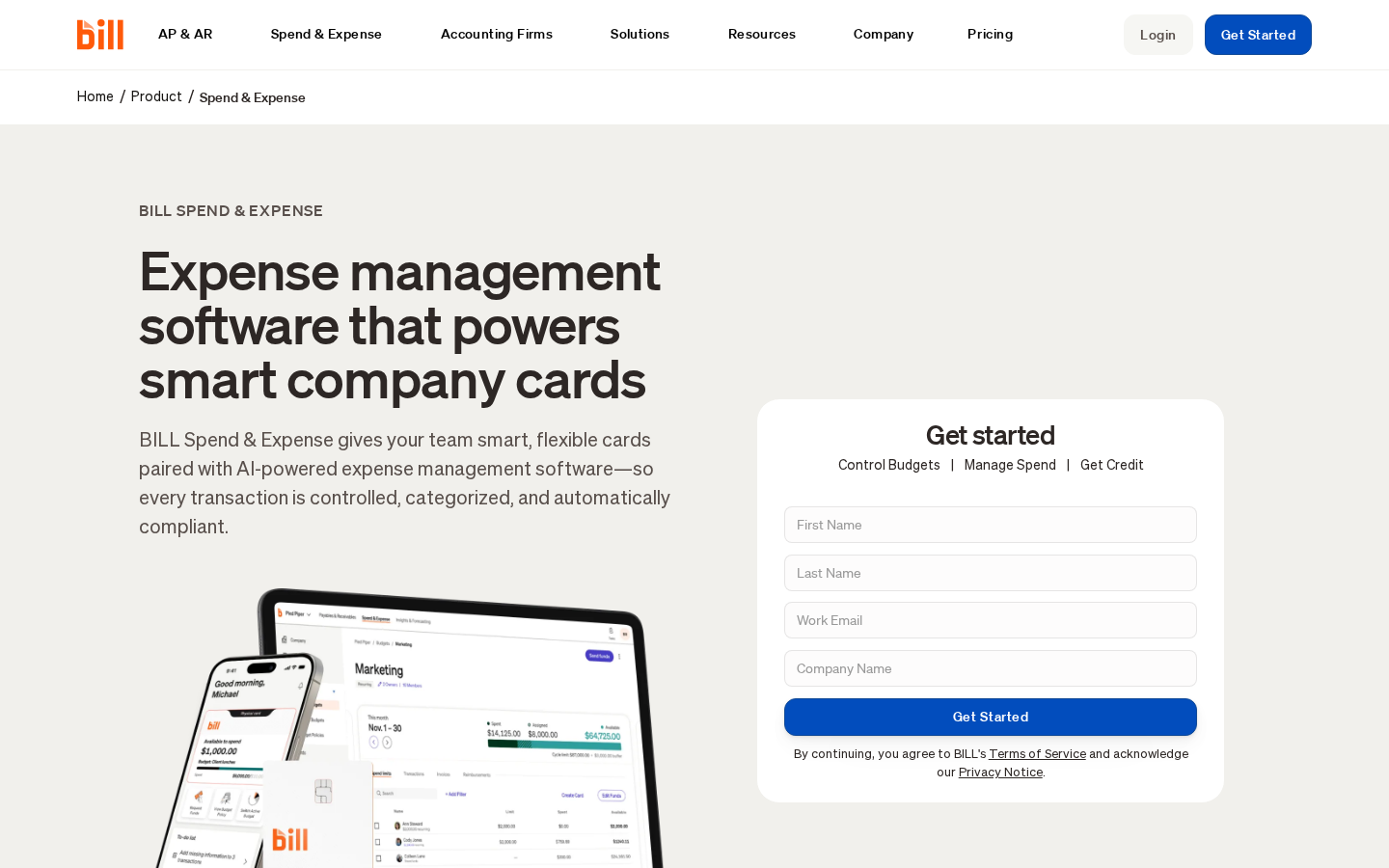
Best for: Established businesses that want rewards-driven spend controls and budget enforcement
Ramp vs. BILL (Divvy): BILL offers higher potential rewards (up to 7x points on restaurants with weekly billing) and does not require a minimum bank balance, making it more accessible to earlier-stage businesses than Ramp.
BILL Spend & Expense (formerly Divvy) pairs a corporate charge card with a powerful budgeting and expense management platform. The card offers up to 7x rewards points on restaurant spending and 5x on hotels when businesses pay their balance weekly, making it especially rewarding for teams with frequent travel booking needs. Unlike Ramp, which requires $25,000 in a bank account, BILL underwrites based on revenue and cash flow with credit lines ranging from $1,000 to $5 million.
One trade-off is the complexity of the rewards structure. Points cannot be redeemed until after 12 months of card membership, and rewards rates drop significantly if balances are paid monthly rather than weekly. BILL also reports to the Small Business Financial Exchange, helping businesses build a credit history. On G2, users praise the budgeting tools and receipt management, though some mention that accounting integrations require extra manual steps.
Key features:
- Up to 7x rewards points with weekly billing cycles
- Enforceable budgets by department, project, or vendor
- Business credit building through SBFE reporting
Pricing: Free (no annual fee or per-user charges)
5. Rho
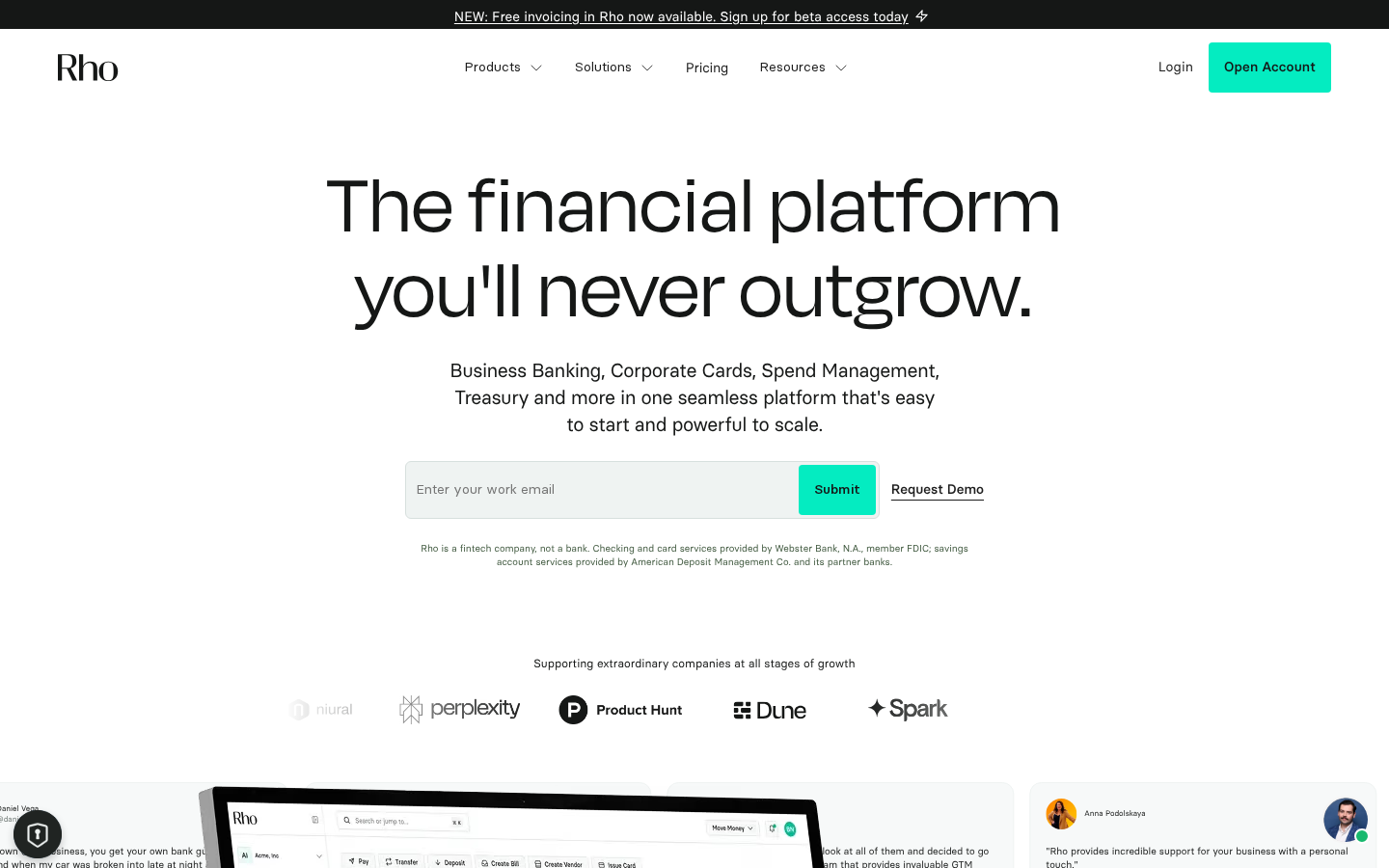
Best for: Startups and mid-market companies that want banking, cards, and AP automation on one platform
Ramp vs. Rho: Rho bundles business checking, corporate cards, treasury management, and bill pay into a single free platform, while Ramp handles only the spend management layer and requires a separate bank.
Rho bundles banking, cards, and AP automation into a single free platform, a rare combination at this price point. The platform includes FDIC-insured checking through Webster Bank, N.A., a corporate card with up to 1.25% cashback (or 2% with the Platinum card for combined banking customers), and automated accounts payable with no platform fees. All core features, including spend management controls, accounting integrations, and premium customer support, are included at no additional cost.
Rho's savings accounts offer up to $75 million in FDIC coverage through Insured Cash Sweep networks, making it especially attractive for businesses with large cash positions. The platform does not support cash deposits or serve sole proprietors. On G2, Rho earns consistently high marks for customer service, with users frequently citing the dedicated support team as a key differentiator.
Key features:
- Free same-day ACH and domestic wire transfers
- Up to 2% cashback with the Rho Platinum card
- FDIC savings coverage up to $75 million
Pricing: Free for all core banking, cards, and AP features; treasury management fees start at 0.60% annually
6. Airbase (Paylocity)
Best for: Mid-market companies that need a comprehensive procure-to-pay platform
Ramp vs. Airbase: Airbase offers deeper procurement workflows and guided purchasing processes, making it a stronger fit for companies that need to manage the full vendor lifecycle from intake request through payment.
Airbase, now a Paylocity company, is a spend management platform that unifies accounts payable, expense reimbursements, and corporate cards with a guided procurement layer. Its vendor management capabilities handle everything from vendor payments to intake requests. It is designed for mid-market finance teams, typically with 50 to 500 employees, that need granular approval workflows and deep ERP integration, particularly with NetSuite and Sage Intacct.
Airbase’s pricing is custom and typically starts around $8,500 per year, which puts it out of reach for smaller businesses. The platform also does not provide banking services such as checking accounts, savings, or lending. On G2, users highlight the intuitive interface and virtual card controls, while some note limitations in custom reporting and occasional technical issues during onboarding and implementation.
Key features:
- Guided procurement with automated purchase order creation
- Deep native integration with NetSuite and Sage Intacct
- Virtual and physical card programs with granular spend controls
Pricing: Custom pricing; Standard, Premium, and Enterprise tiers
7. Relay
Best for: Small businesses that want to organize cash by purpose using multiple accounts
Ramp vs. Relay: Relay replaces Ramp's spend-control approach with a multi-account banking model, letting business owners separate funds for taxes, payroll, and profit into dedicated checking accounts with their own debit cards.
Relay is a digital banking platform built around the idea of organizing money by purpose. Businesses can open up to 20 checking accounts, each with its own account number and debit card, to separate operating expenses, payroll, taxes, and profit. This makes Relay a natural fit for businesses using the Profit First cash management method.
Relay does not offer interest on deposits, corporate credit cards, or lending products, so it functions best as a pure cash management tool rather than a full financial platform. On Trustpilot, users praise the simplicity of the account setup and the ability to share account access with bookkeepers. Some users wish the platform offered more advanced reporting.
Key features:
- Up to 20 checking accounts with separate account numbers and debit cards
- Automated transfers for cash allocation
- Collaborative access for bookkeepers and accountants
Pricing: Free (Starter); Grow $30/month; Scale $90/month
8. Novo
Best for: Freelancers and solopreneurs seeking free, no-frills business checking
Ramp vs. Novo: Novo welcomes sole proprietors and freelancers that Ramp excludes, offering a free checking account with built-in invoicing and integrations with e-commerce platforms like Shopify and Stripe.
Novo is a digital banking platform designed for small business owners, freelancers, and solopreneurs. It offers a free business checking account with no monthly fees, no minimum balance, and no transaction fees. The built-in invoicing tool lets users create and send invoices directly from the banking platform, which is useful for independent contractors and service-based businesses.
Novo integrates directly with e-commerce platforms like Shopify, Etsy, and Amazon, as well as accounting tools like QuickBooks and Xero. The platform reimburses ATM fees up to $7 per month. Novo does not offer interest on deposits, cash deposit capabilities, or a line of credit. Customer support is available primarily through email and the app, with no phone support. On Trustpilot, users appreciate the simplicity and low cost, though some mention slower response times from support.
Key features:
- Free checking with no minimum balance or monthly fees
- Built-in invoicing with Novo Reserves for budgeting
- Direct integrations with Shopify, Etsy, Amazon, and Stripe
Pricing: Free
9. NorthOne
Best for: Local and Main Street businesses that handle cash
Ramp vs. NorthOne: NorthOne supports cash deposits through the Green Dot network and offers a straightforward banking experience for brick-and-mortar businesses that Ramp's digital-only model does not serve.
Where Ramp serves finance teams at scaling companies, NorthOne is built for local businesses: contractors, restaurants, and retail shops. The platform offers a simple business checking account with sub-accounts called Envelopes for organizing funds by category, along with built-in invoicing and basic bookkeeping tools. Cash deposits are available through the Green Dot retail network, giving NorthOne an advantage over most digital-first competitors.
At $10 per month, NorthOne is not free, but it includes features that other platforms charge extra for, such as unlimited transactions and sub-account management. The platform does not offer interest on deposits or lending products. On Trustpilot, users praise the customer service and Envelopes feature, while some note that the mobile app could be more polished.
Key features:
- Sub-accounts (Envelopes) for organizing business funds
- Cash deposits at Green Dot retail locations
- Integrated invoicing and bookkeeping tools
Pricing: $10/month
How to Find the Best Banking Platform for Your Business
Ramp may cover your spend management needs, but the right financial platform should do more than track expenses. Here are five factors to weigh as you evaluate alternatives:
- Accessibility and convenience. Consider whether you need cash deposit access, a mobile app for on-the-go management, or responsive customer support. For example, Bluevine offers cash deposits at over 90,000 locations through the Allpoint+ and Green Dot networks2, while digital-only platforms like Mercury and Ramp do not support cash at all.
- Financial tools and workflows. Match the platform to your day-to-day needs. If your priority is spend management and corporate card controls, a tool like Ramp or Brex may be sufficient. If you need checking, payments, invoicing, and lending in one place, a platform like Bluevine or Rho offers broader coverage.
- Interest rates and lending options. If your business keeps significant cash reserves, earning interest on those balances matters. Bluevine offers up to 3.0% APY on business checking4, while other platforms offer little or no yield. If you anticipate needing financing, check whether the platform offers a line of credit or term loan, as understanding how much to keep in your business checking account can help you plan.
- Pricing and hidden fees. Look beyond the monthly fee to understand per-transaction costs, FX fees, wire transfer charges, and per-user pricing on paid tiers. Some platforms like Rho include all features for free, while others like Ramp and Brex lock advanced features behind paid plans.
- Security and deposit protection. Verify the FDIC insurance coverage for any platform you consider. Bluevine provides FDIC insurance up to $3 million through Coastal Community Bank, Member FDIC and partner banks5, while Mercury covers up to $5 million and Rho offers up to $75 million on savings. For more details, read the Bluevine guide to FDIC insurance for business checking accounts.
Your business deserves a financial partner that keeps up
Spend management is only one piece of your financial stack. Earning yield on deposits, accessing credit, and depositing cash all require a banking platform that can keep up. If the Ramp spend-management-only approach leaves gaps, consider a platform that brings banking, payments, and lending together.
Bluevine Business Checking offers up to 3.0% APY on checking balances4, cash deposits at over 90,000 locations2, and access to a line of credit up to $250,0003. Whether you are a sole proprietor just getting started or an established business looking to consolidate your finances, Bluevine is designed to grow with you. Open your account today.


FAQs
answer



Disclaimers
This content is for educational purposes only and should not be construed as professional advice of any type, such as financial, legal, tax, or accounting advice. This content does not necessarily state or reflect the views of Bluevine or its partners. Please consult with an expert if you need specific advice for your business. For information about Bluevine products and services, please visit the Bluevine FAQ page.
‡ The national average and comparison are based on interest rates paid by U.S. depository institutions as calculated by the FDIC.
◊ Applications are subject to credit approval. Rates and terms may vary based on your creditworthiness and are subject to change. Eligibility for the maximum funding amount is available only to applicants with the strongest credit profiles. Offerings and eligibility requirements vary by partner.
1. Premier and Plus plan customers automatically earn annual percentage yield ("APY") on their available balances. Standard plan customers will earn interest on their available balances if they meet an eligibility requirement as detailed in the Terms of Interest Accrual which is incorporated as a part of the Bluevine Business Checking Account Agreement. Bluevine Premier is subject to a $95 monthly fee. Bluevine Plus is subject to a $30 monthly fee.
2. A $4.95 per transaction fee is applicable when depositing funds at Green Dot® locations. A fee of $1.00 plus 0.5% of your total deposit amount applies when depositing funds at Allpoint+ ATMs.
3. Applications are subject to credit approval. Rates, credit lines, and terms may vary based on your creditworthiness and are subject to change. Eligibility for the lowest rates is available only to applicants with the strongest credit profiles. Factors include FICO score, time in business, monthly revenue, and payment history. Additional fees apply. Bluevine Flex Line of Credit is issued by Celtic Bank, a Utah-chartered Industrial Bank, Member FDIC.
4. Bluevine Premier customers will earn 3.0% annual percentage yield ("APY") on total Bluevine Business Checking balances. Any interest accrued and payable for an account or sub-account will be paid to your main account. Enrollment in Bluevine Premier is not required to receive increased FDIC insurance coverage. Customers automatically receive increased FDIC coverage unless they have opted out of the Bluevine Business Checking Account Agreement Sweep Program.
5. Bluevine accounts are FDIC insured up to $3,000,000 per depositor through Coastal Community Bank, Member FDIC and our program banks. $3,000,000 in FDIC insurance is offered by multiplying the standard $250,000 FDIC coverage across multiple banks.
6. Payment processing services are provided by Stripe, Inc., N.A. Bluevine Inc. Payment processing services are available to most businesses, subject to eligibility determined by Bluevine.
7. Draw requests are subject to review and approval. Bluevine Line of Credit customers can access approved draws instantly only with their Bluevine Business Checking account. Approved draws being deposited to an external bank account will be available in as quickly as a few hours if you choose our bank wire option ($15). Or, choose our fee-free ACH transfer option which typically gets funds deposited the next business day, although it may take up to three. Bluevine Flex Line of Credit is issued by Celtic Bank, a Utah-chartered Industrial Bank, Member FDIC.
8. Ratings as of March 2026.
9. Bluevine Plus is subject to a $30 monthly fee. Avoid the fee by doing the following each billing period: 1) maintain an average daily balance of at least $20,000 in your Bluevine Business Checking account and/or sub-account(s) and 2) spend at least $2,000 with your Bluevine Business Debit Mastercard® or Bluevine Business Cashback Mastercard®.
10. Bluevine Premier is subject to a $95 monthly fee. Avoid the fee by doing the following each billing period: 1) maintain an average daily balance of at least $100,000 in your Bluevine Business Checking account and/or sub-account(s) and 2) spend at least $5,000 with your Bluevine Business Debit Mastercard® or Bluevine Business Cashback Mastercard®.
Bluevine is a financial technology company, not a bank. Banking Services provided by Coastal Community Bank, Member FDIC. FDIC insurance only covers the failure of an FDIC-insured bank. FDIC insurance is available through pass-through insurance at Coastal Community Bank, Member FDIC, if certain conditions have been met. Bluevine accounts are FDIC insured up to $3,000,000 per depositor through Coastal Community Bank, Member FDIC and our program banks. The Bluevine Business Debit Mastercard® and Bluevine Business Cashback Mastercard® are issued by Coastal Community Bank, Member FDIC pursuant to a license from Mastercard International Incorporated and may be used everywhere Mastercard is accepted. Mastercard is a registered trademark and the circles design is a trademark of Mastercard International Incorporated.
Mastercard, Mastercard Easy Savings, Mastercard Airport Concierge, Priceless Surprises and the circles design are registered trademarks and Mastercard ID Theft Protection is a trademark of Mastercard International Incorporated.
Application is subject to approval. No monthly or maintenance fees. Card Replacement Fees and Wire Transfer Fees may apply.
Banking Services for payments made via ACH or wire from the Bluevine Business Checking Account are provided by Coastal Community Bank, Member FDIC. Money transmission services for International Payments are provided by a third party and are also subject to their applicable terms and conditions.
The Bluevine Line of Credit is issued by Celtic Bank and is serviced by Bluevine. Applications are subject to credit approval. Rates, credit lines, and terms may vary based on your creditworthiness and are subject to change. Additional fees apply. Other commercial credit products are offered by a variety of Bluevine’s third party partners. Bluevine is not involved in the issuance or servicing of these products. Offerings and eligibility requirements vary by partner.
Certain financing may be made or arranged pursuant to California Financing Law-License No. 6054789.
Payment processing services are provided by Stripe, Inc., N.A. Bluevine Inc. Payment processing services are available to most businesses, subject to eligibility determined by Bluevine.
Tap to Pay is only available on supported devices and may require upgrading to the latest version of the Bluevine app and your phone’s operating system. Some Android devices may not be compatible. Android is a trademark of Google LLC. Tap to Pay on iPhone requires a supported payment app. Some contactless cards may not be accepted by your payment app. Transaction limits may apply. The Contactless Symbol is a trademark owned by and used with permission of EMVCo, LLC. Tap to Pay on iPhone is not available in all markets. For Tap to Pay on iPhone countries and regions, see here.
All other product names, logos, brands, trademarks, and registered trademarks are property of their respective owners. All company, product, and service names used in this website are for identification purposes only. Use of these names, trademarks, and brands does not imply endorsement.
® 2026 Bluevine Inc. All Rights Reserved. “Bluevine” and the Bluevine logo are registered trademarks of Bluevine Inc.